Back Issues of Nutshell News

On a Google search I found this site (see below) advertising backs issues of Nutshell News, including the those containing my three articles on The Greene & Greene house–Jan, Feb. and March 1990. They include a lot of detailed how-to on the various phases of the project. I don’t know if they’re still available, but they’re being offered at the original low price. If you’re interested, it’s worth checking out.
http://www.c-we.com/wild.orchid/order.htm

Posted in Miniatures | 15 Comments

A Love Affair and a Ghost Story–the Greene & Greene, Part I

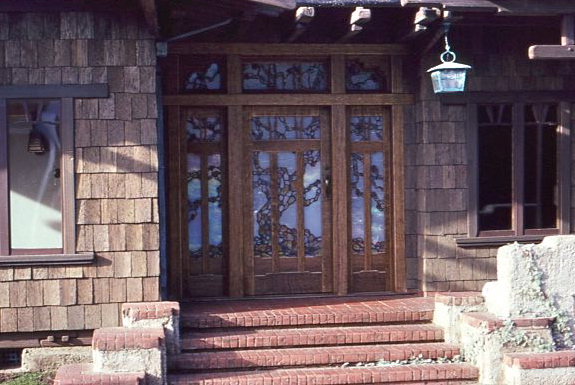
Doorway to the Greene & Greene Miniature House by Noel and Pat Thomas, 1986-89

That October day in 1983, the warmth of the “ultimate bungalow” coaxed us through the doorway like an old friend. Muted light radiated through the stained glass entry doors, reflecting off the oak floors, lustrous teak and mahogany walls, tiled fireplaces, the Tiffany-style light fixtures and windows. The fireplace inglenook, large, airy rooms, deep chairs, and hand-loomed carpets promised comfort in the winter months, as well as shelter from summer’s heat. The house was a work of art designed for people. There was a tranquility about it that was palpable.

The house is the Gamble House, now a museum in Pasadena, CA. Designed by Charles & Henry Greene as a home for the Gambles (of Ivory Soap fame), right down to the carpets, it was completed in January, 1908, a mere 11 months after the start of construction. Grover Cleveland was President, and the first Hershey’s Kiss had just rolled off the production line. The Gamble House is dubbed the ultimate bungalow because it is considered their finest and most unified architectural statement. Our surrender to its charms marked the beginning of the love affair, and the ghost story, culminating in our completion of the Greene & Greene miniature house 6 years later. The ghosts would be Charles & Henry Greene, glowering or chortling over our shoulders as we worked, not telling us we were making mistakes until they were complete and staring us in the face. And it would be years before we understood the scope of their genius.

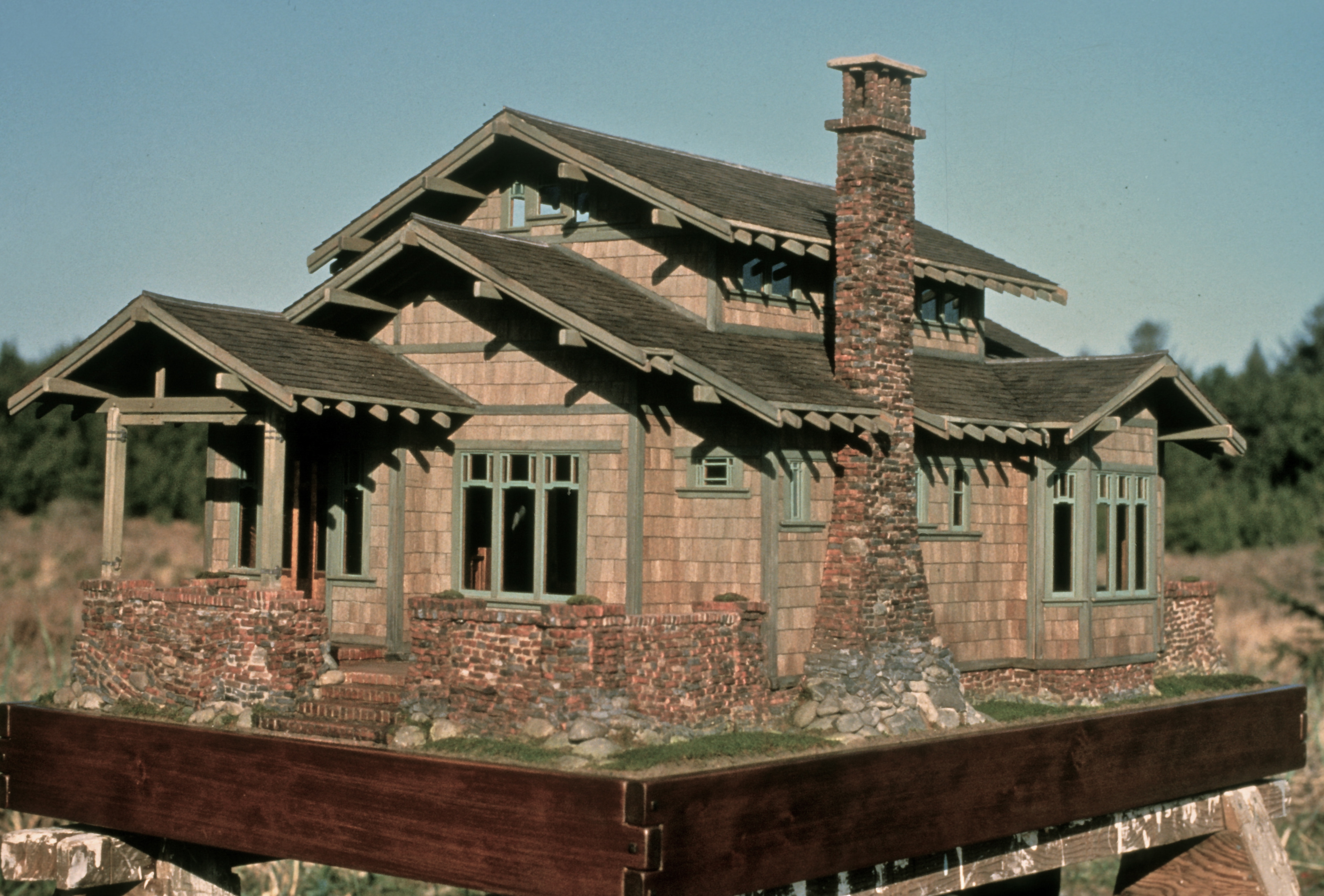
Like our full-scale predecessors 80 years before, history was propelling us away from Victorians, toward simpler and more horizontal lines, generous interior spaces, and details more functional than ornamental. In 1983-4, we dipped our toes in the Greene’s pond with the smaller house we called The Bungalow,

The Bungalow

and knew we wanted to wade in deeper. As fate would have it, a customer was waiting. At the 1985 NAME  National miniature show, Pat & Walter Arnell asked if we’d like to build another Greene & Greene, maybe even the Gamble House. We were elated, but also a little anxious about rekindling our affair with the Greenes. There had been so much trial and error on the first, so much hair-pulling, and we knew there would be more. Somehow we lulled ourselves into believing a second house would be easier.

In February 1986 we returned to the Gamble House, and discovered we were even more knocked out by it than before. It was the 20th anniversary of the museum, and most of the visitors were architects and students–Greene devotees. We all padded around in our socks, speaking in hushed tones, as if in church or at a golf match, pointing out this scarf joint, or that cloud lift. Noel and I got so fired-up our brains went into overload–we vetoed continuing to the second and third floors and drove the 1000 miles home with more than enough food for thought and conversation.

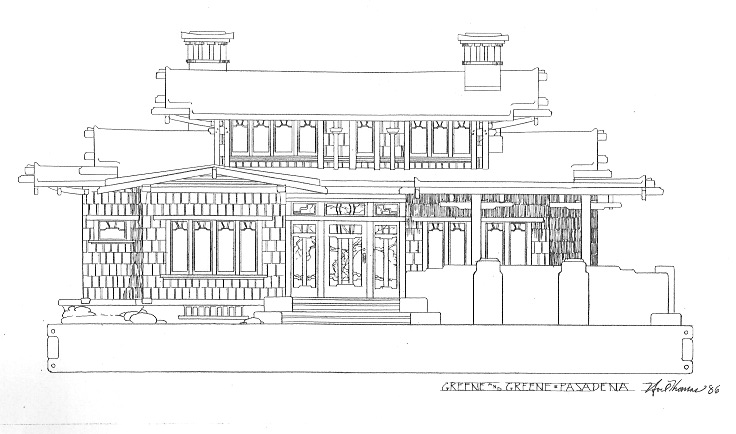
   In October 1986, while Reagan was President, Noel began putting the Greene & Greene on paper. The house wouldn’t be complete for another 3 ½ years, just before George H. W. Bush was sworn in. We had come home from Pasadena armed with books, slides, and postcards, each providing us with more details, another look at the house 1000 miles away. We spent the ensuing months poring over them, deliberating, planning, juggling all the information. The original structure covered 8000 sq. ft. Noel’s most crucial job was to determine what the Greenes would have done if they’d made the house smaller—what would they have left out while still maintaining the integrity of the design? It was like trying to figure out what Shakespeare or Beethoven would have left out of their finest works. He let it all filter through, and what emerged was a design for a modified, condensed version of the Gamble House that most people never suspected was not a copy of the original. It didn’t fool Charles & Henry (as we had come to refer to them), who had returned to haunt our waking and sleeping hours.

Noel’s final drawing of the project

Posted in Bio, Houses, Miniatures | Tagged , , , , | 14 Comments

A Tale of Twin Kitchens—Souwester and Shelburne

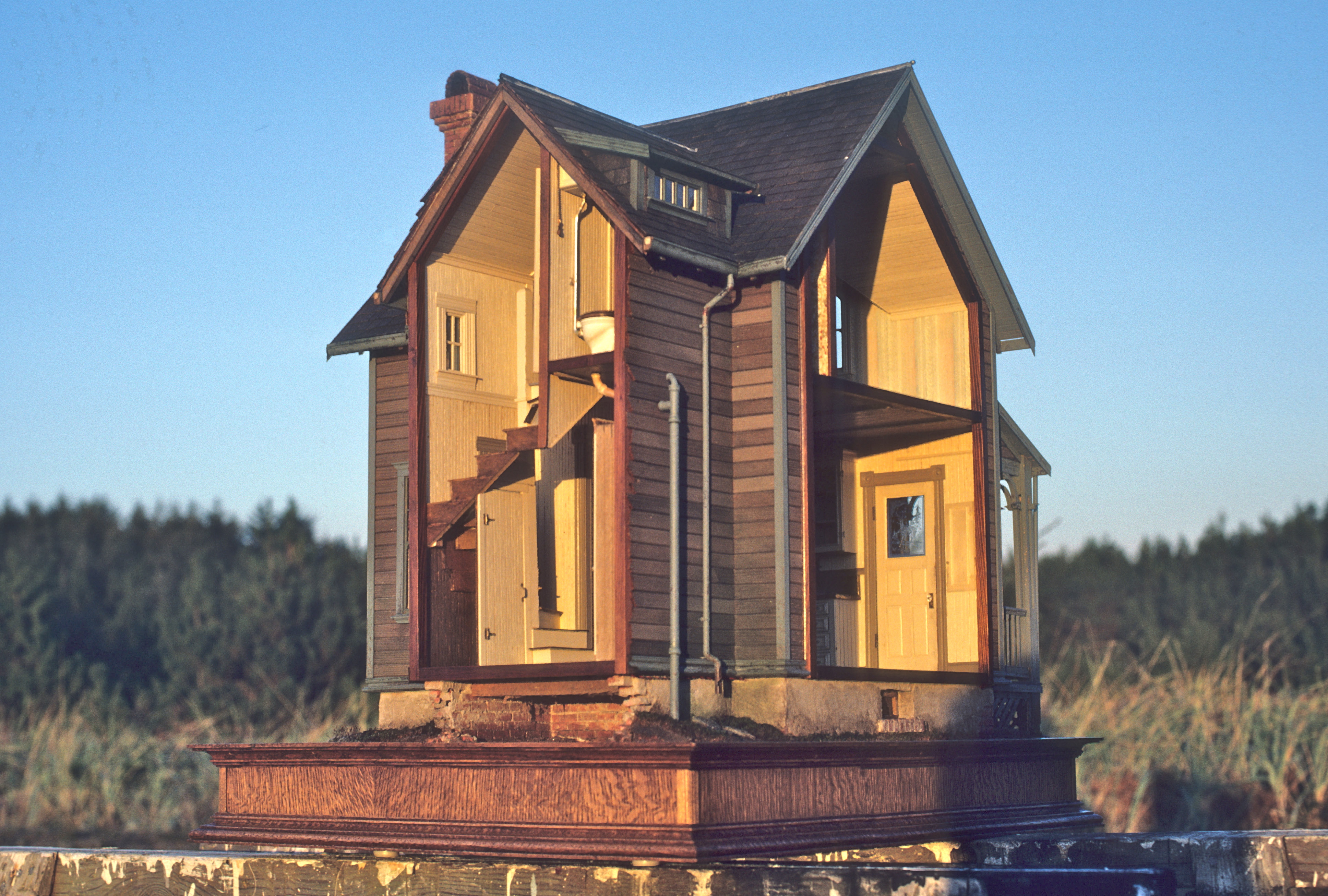
The Shelburne Kitchen Fragment

To round out 1986, we completed two house fragments–the Shelburne and Shoalwater Kitchens, named after two Seaview, WA inns.  These were smaller pieces than usual, but labor intensive—the women commissioning these projects were our two best and most supportive customers. While we toiled away in miniatures, the world at large was even busier—in 1986 the US bombed Libya, Reagan sold arms to our arch enemy Iran. We lulled ourselves with Magnum P.I. and the Cosby Show, and ached for the victims of the Space Challenger and Chernobyl disasters. We gassed up at .89 a gallon, sent our first emails, and took our first airline flights free of cigarette smoke.

Open end view

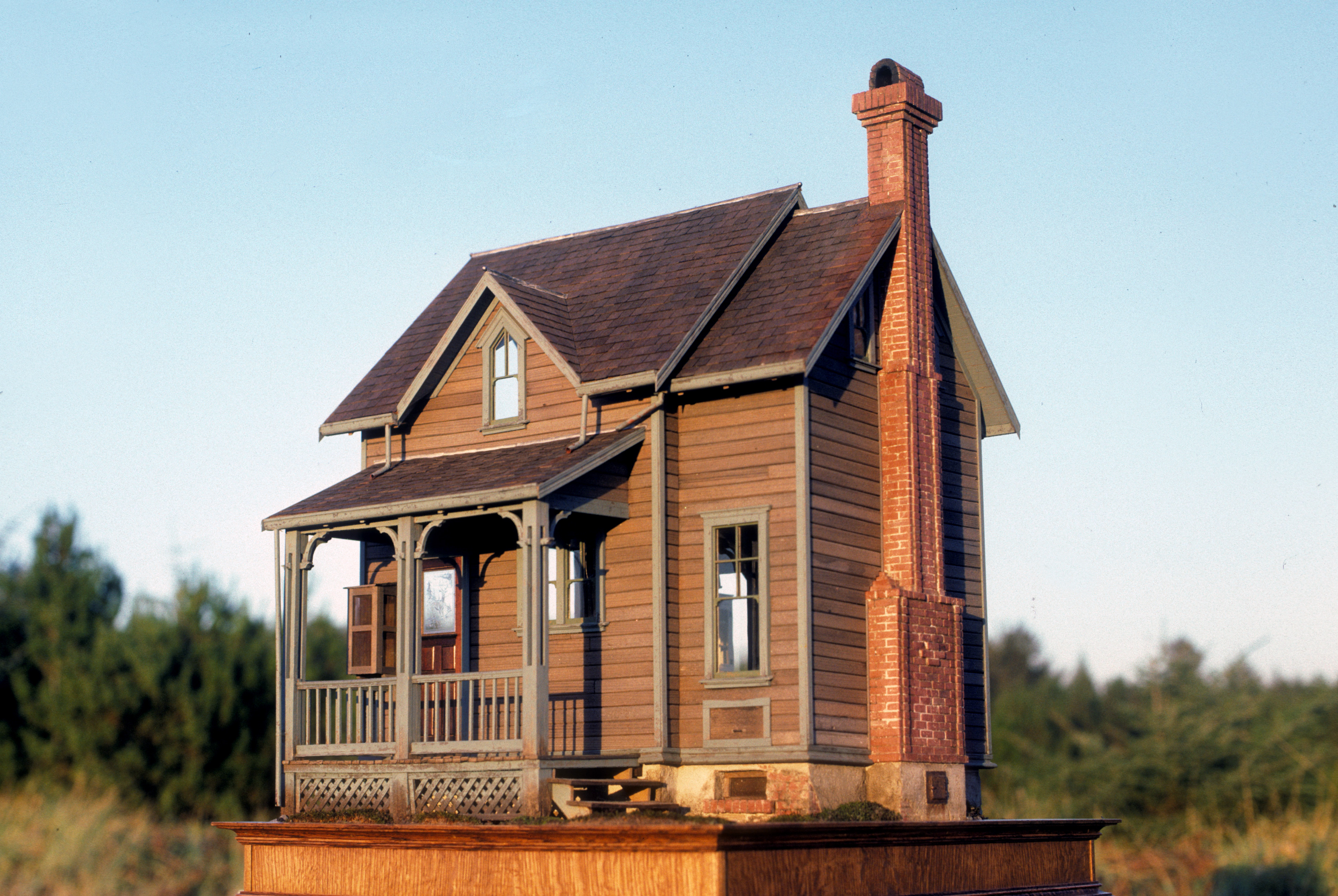
The Shelburne photos remind me how we were winding up our stint with Victorian architecture. Over the previous 12 years we had developed a vocabulary of elements that we moved around for each new project—the designs in the chimney brick, the inside/outside drawer for stove wood, bracketed, generous overhangs on the porch, drop siding, and aged cement foundations.  Each element became a word or phrase that formed the whole story of a structure and our signature style. I am pleased to see these kitchen are a prime example of our work, and don’t reflect our not-too-underlying desire to move on, to try out new dialects, and maybe a new language entirely.

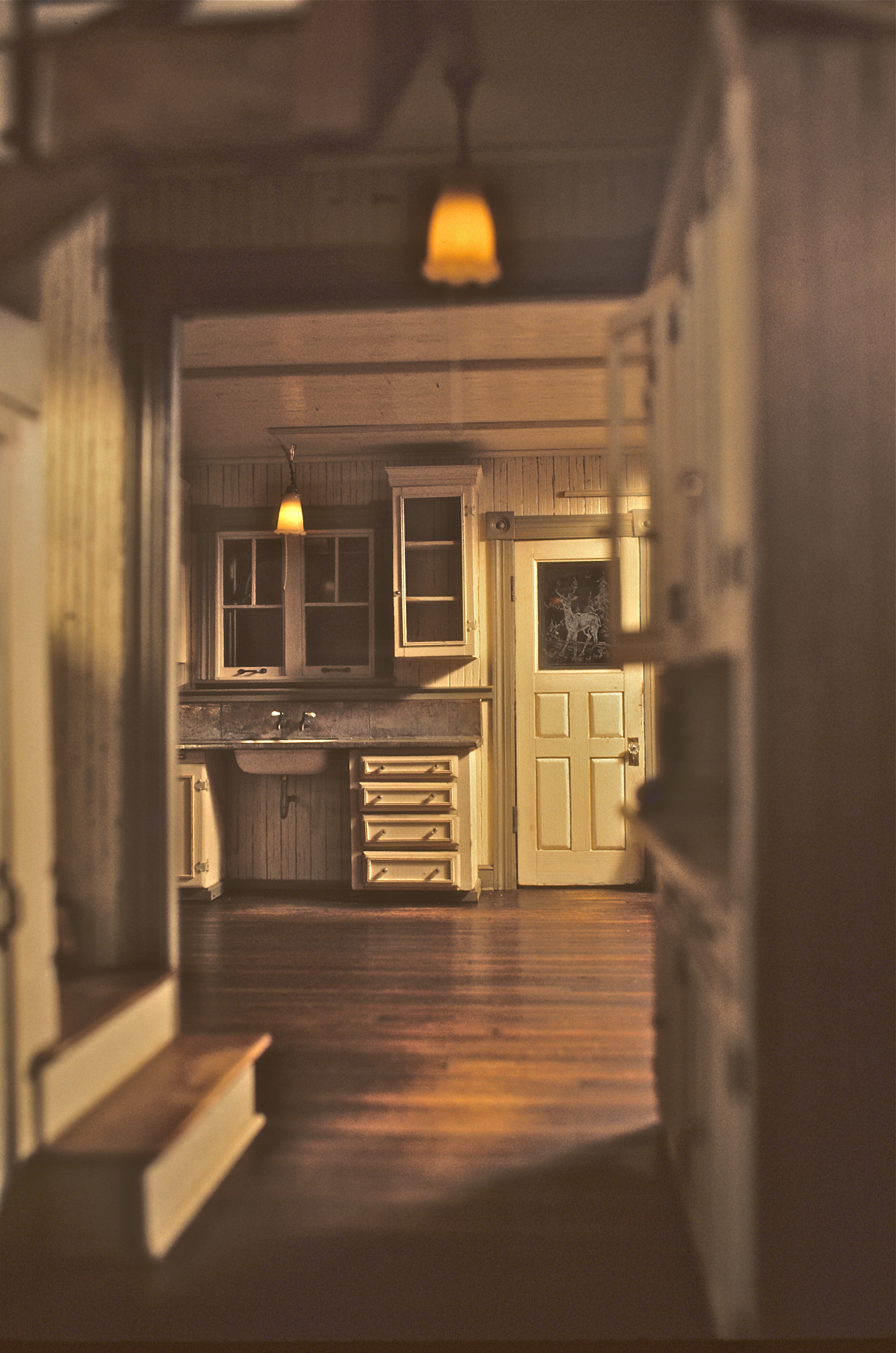
Kitchen view through butler’s pantry

The customers, two collectors, who often carried on a friendly but ferocious competition at miniatures auctions, each wanted a kitchen fragment, an expanded version of our small kitchen fragment, the 1983 North Cove kitchen. They agreed to have similar smaller pieces built. So as not to have to design two different structures, Noel designed one, then flipped the design for the second, so as not to make exact duplicates.  We changed paint colors, in and out, and a few other details, but memory fails me as to the particulars.

There was a drawback in building two at once. The idea of ganging up our work to save time (twin houses presumably would go faster than two different designs) had never appealed to us. Our friend Jim Marcus believed in building what he called editions of houses—setting up jigs to use on 2, 3 or more of the same piece, and enjoying the process, but we weren’t cut out to be jig people. We did it with our chairs and garbage cans, and found the assembly line aspect bored us to tears. It just wasn’t worth the time saved. Plus, on a structure, we enjoyed the discovery of each piece of the puzzle, or at least how it fit in a new setting. Repeating ta puzzle once you know the answers is no fun. This time expediency won out over fun—we brushed off our Victorian vocabulary and started in.

Upstairs bedroom

But there is the good part–the payoff for building a fragment is that you get to put a few evocative rooms into a small structure. For me, this Reader’s Digest version of a dollhouse is much more intimate than a larger structure. In this case the fragment was a large kitchen, butler’s pantry, with a winding staircase, leading to  an attic room/maid’s quarters and tiny bath above. Functional, but reminiscent of kitchens past, cooking, and family gatherings. Your mind can get lost in it. Much of the design stemmed from a similar setup in my grandmother’s house—something I must have nudged forward unconsciously, or not. I remember being thrilled to reach an age where I got to spend the night in that tiny room over the kitchen.

Once we got into the work, the story developed, and we became totally involved. Thomas quirks like lots of plumbing pipes are evident, along with the break-away walls that would have been attached to the rest of the house. Noel loved making drains and vent pipes (dowels), with elbows (wrapped with narrow strips of masking tape and painted to look like connectors).  Our vocabulary for any style included the cobby dust (thank you dear resident flock of baby spiders) that gathers between interior and exterior walls. Such utilitarian but important details, or phrases, add to what we called the reality of illusion, and were always a hit with the men viewing our houses. Handymen or not, guys seem to like plumbing. Maybe a way to enjoy miniatures without feeling silly.

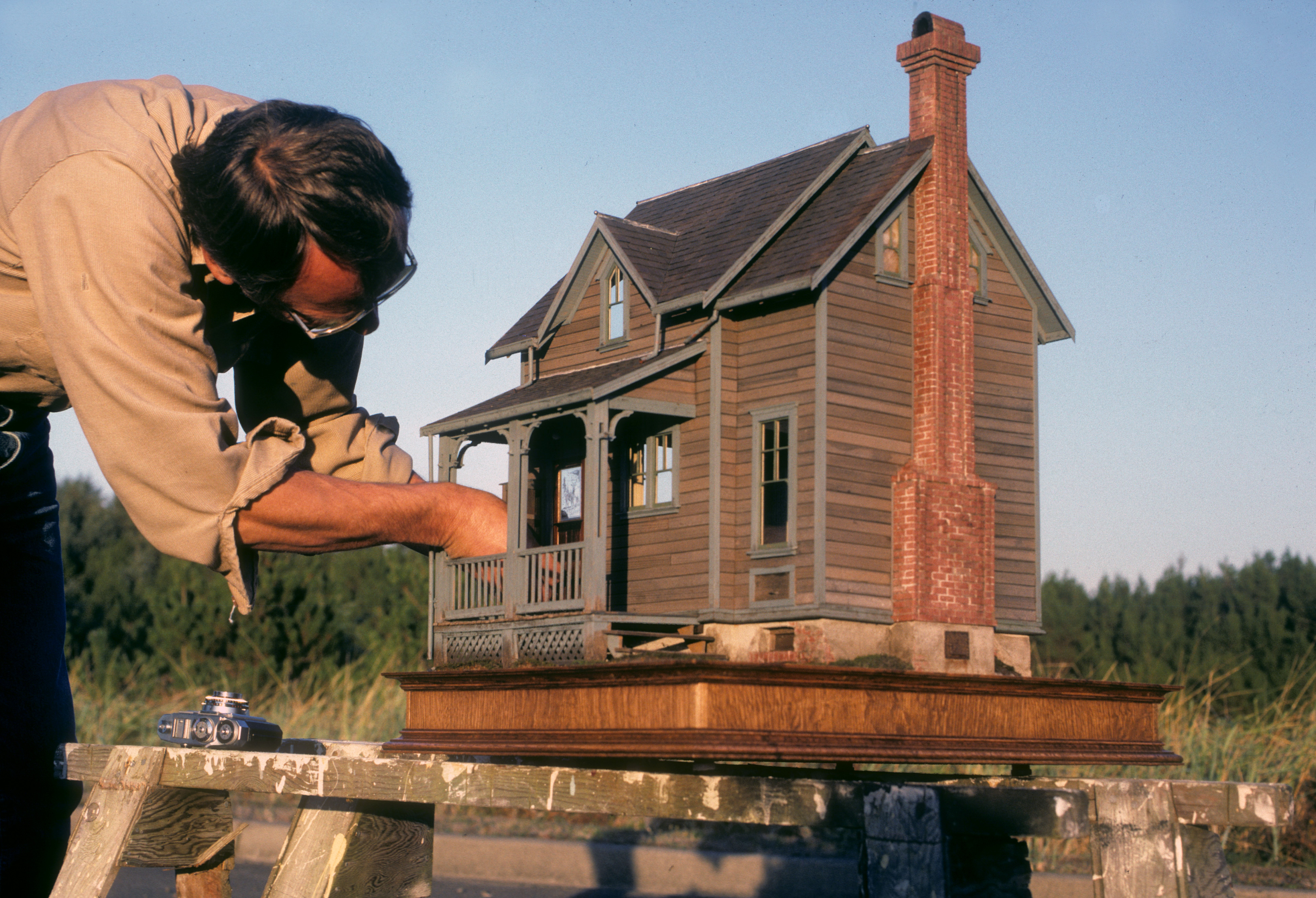
Looking for a location: Up on sawhorses in a beach parking at sunset

I‘ve combed our picture albums and boxes of slides, but can only find photos of the Shelburne. It’s mysterious–maybe we thought that with twins we could save film and only document the one? They weren’t exact twins, maybe fraternal, but you’ll just have to take my word for it. Today one resides in the Kansas City Miniature and Toy Museum, the other in a private collection.

Posted in Houses, Memoir, Miniatures | Tagged , , , | 13 Comments

The Beach Cottage–“Cuter than a bug!”

The Beach Cottage, 1986

As I pack up the Beach Cottage and the Garden Shed prototypes to send to their new owners, I’m feeling the tug of those days when we first built them. They are teaching samples for our first classes at the Guild School, and elsewhere. It was exciting to decide on a project, then to see Noel’s more or less final design, then watch it take shape over the next few months. But the real thrill was unveiling it to our students and fellow teachers at the school—the payoff for the months of design, finishing, and class planning and production. Their excitement energized us, propelling us out of whatever tiredness lingered from preparation and travel and into the job of showing the students how to do what we did. There was one early response that gave us pause—a student’s husband popped into the classroom as we were setting up and spent a few minutes looking at the prototype while we worked. On the way out the door he called over his shoulder, “Once again, cute as a bug!” What?! Cute as a bug?! Shoot us now, we didn’t want to be known for making “cute.” Once over the untintended bump, we used it as a kind of mantra, checking with each other to see if the finished project had that certain, bug-like quality. Over the years others have used the C word on our work, and we laugh—there’s no accounting for how people respond, or how one’s ego will be affected.

Anything for a good shot.

The Beach Cottage was project #37, built for the 1986 Guild School. Noel took the basic design of the Garden Shed, turned it sideways, added a porch, a chimney, and turned out outer shed area into an enclosed second room, played with proportions, et voila!–a two-room beach guest cottage. Amenities would have been located in the outhouse, or one could sprint to the main house for something more civilized. One friend did alter her project, knocking through the back wall, shortening the bedroom depth, and adding a little bathroom.

Chimney support & board & batten walls

Like the Garden Shed, the exterior walls were board & batten (1/4”vertical battens over ¼” plywood walls), but this time without the time-consuming chevron detailing—there was plenty else to keep us busy. We considered shingling the walls, but decided that too was a time-eater, and we knew our supply of shingles was limited.

As with many beach houses in the area, including our own, the bottom of the chimney didn’t reach the ground. It was built on a little wooden stand, attached to the outer walls. Maybe it saved on brick, but I don’t know the real reason. Nonetheless, it made for an eye-catching detail on a miniature. The rusted flashing was cut from our found rust collection, and the resulting rust stains on the roof were made with tube acrylics.  The bricks are our usual vinyl floor tiles, individually cut, glued in place, and grouted with quick-patch cement. There’s a little curved cement cap on the top, to prevent downdrafts from the prevailing winds, just like the one on our full-size house. When we had a chimney fire the fire department chiseled off the whole cap, then replaced it when they were done—it weighed enough to stay put, and was removable for the chimney sweep (or future fire-fighters). The cap on the prototype was also removable for shipping, as it extended above the roofline, and bumped the top of the shipping box. I can’t think how many times I must have packed and unpacked that project, probably more than 20, and managed never to lose the cap.

Aged roof detail

Regrettably, the roof always came at the end of the week, giving students minimal time to learn shingling and aging. After applying the shingles we wire-brushed them, and then went back with Exactos and needle-nose pliers to make them look weathered and in need of repair. The final step was painting in the moss (sap green transparent watercolor, dirt and rot (thin dirty water washes of raw umber, black acrylics) and some sienna for rust. That big dark spot we imagined had been shaded for years by a big evergreen. The flashing at the top was made from strips of rolled-out wine bottle lead, from the days before they decided it was unhealthy.  No, there wasn’t time to drink all that wine–we had an “in” with the local fine dining establishment.

Interior

Our classes only covered exterior finishing (no time!), but students had diagrams and a materials list if they wanted to finish theirs like ours at home. Like our own house,our miniature had beaded, fir walls, narrow fir plank floors, and a faux beaded wood ceiling–we scribed the lines into the plywood ceiling, and painted it before it was attached to the walls. The woodwork was finished with McClosky’s Tungseal light and dark oak transparent stain–another wonderful product that didn’t make it into the 21st century. The window shades we made from old roller blinds we dug up somewhere, just a single turn around a dowel to suggest a whole roll. The rocker is one of George & Sally Hoffman’s early pieces, maybe the first miniature we ever bought. It became a photo prop for nearly every structure we made.

Faux beaded wood ceiling
Electrical detail
Daybreak on the beach near our house

Our classes were hectic, sometimes dubbed marathons. There was a lot to  accomplish by week’s end, and students had a lot of new techniques to master in that short period of time. Plus, many had other classes and events to produce for, and everyone stayed up too late. It was impossible to finish during the class week, but we tried to make sure everyone had the skills to get to the end once they got home.  I remember one student in that first class, Bea Ricks, a retired school teacher, sweet woman, one of those quintessential “granny” types with white hair wound around her head in a braid. About day three, Bea was having trouble with a technique—mullions, or bricks maybe, and we kept piling on new things to do. At some point I noticed she wasn’t in the room, and went looking. There she was, down the hall, silently crying into the wall—whoops! Bad teaching when the student cries! I felt awful. We talked for a while and she recovered, returning with a smile, and I learned to take it easier, not just on her, but everyone. That may have been the most valuable teaching lesson I learned—pace, how to keep it going without leaving bodies behind. The payoff was that she finished her project at home and won first prize at the Boston Miniatures Show that year. And she returned to take more of our classes.

Posted in Houses, Miniatures, People | Tagged , , , , | 2 Comments

Why Miniatures?–Uncle Cecil’s Wheelbarrow

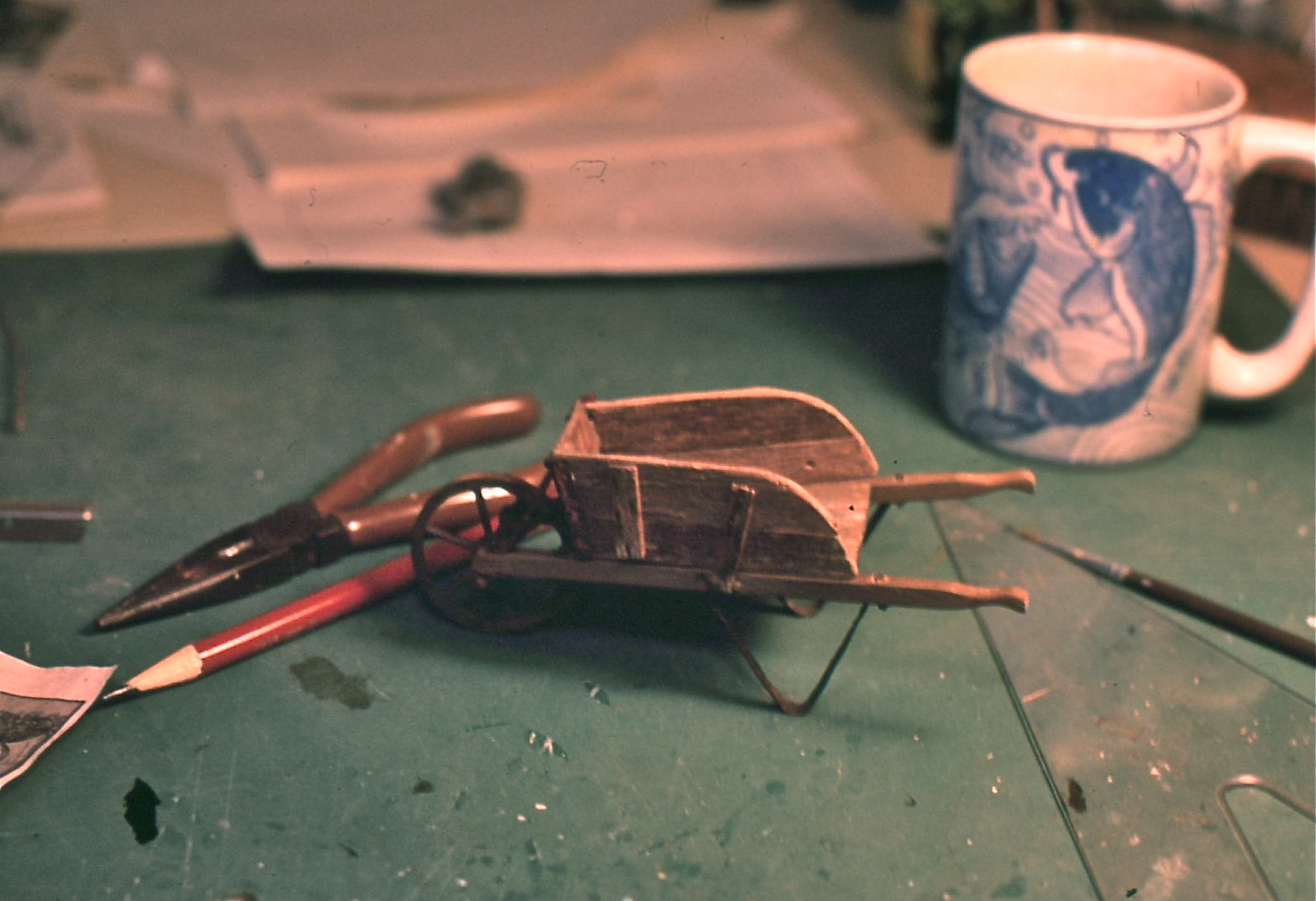
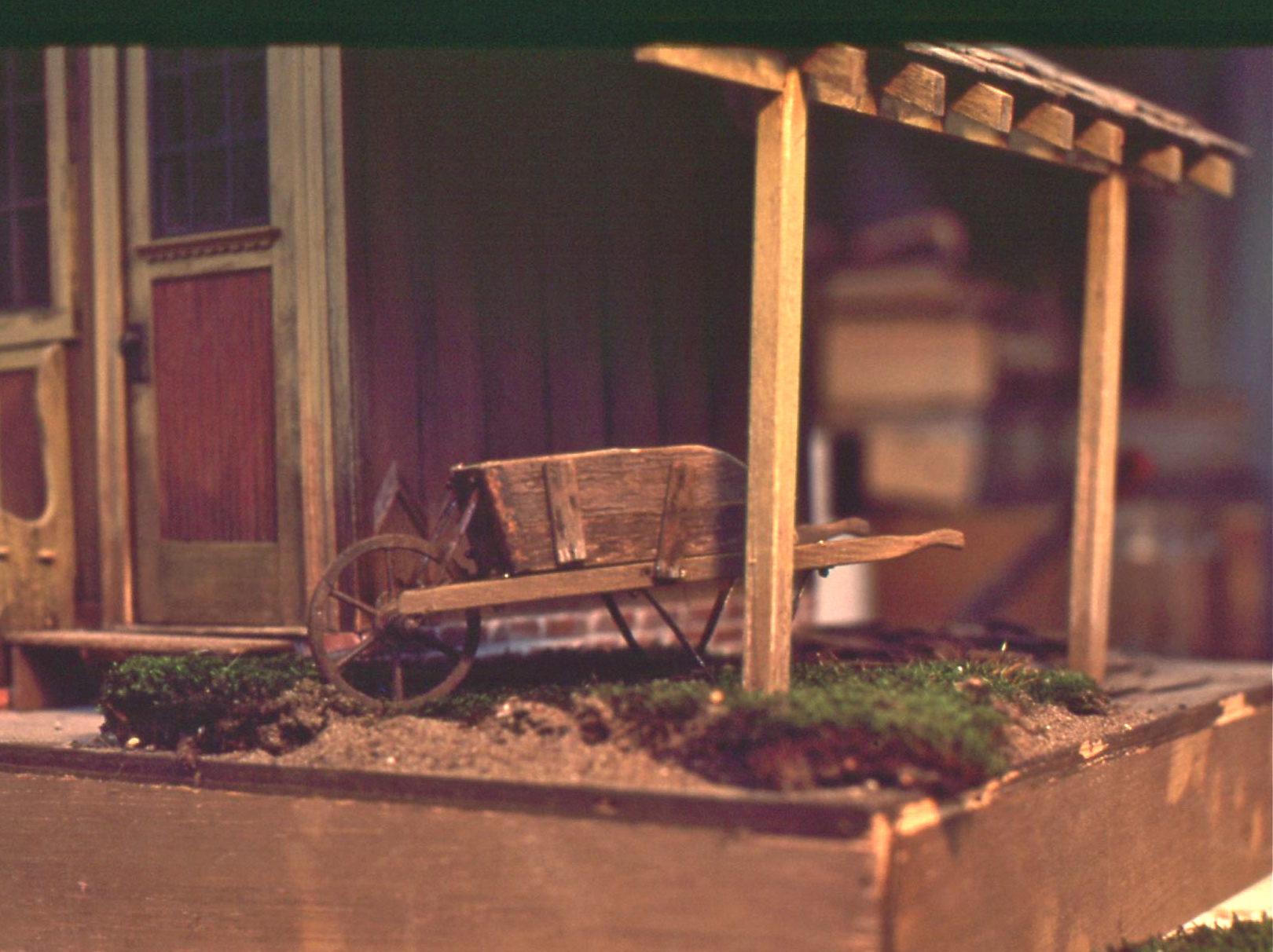
Uncle Cecil’s Wheelbarrow

The other night I was eating out with friends in Portland, people I have known for years through my life as a poet. They had another friend along who was visiting town, one of those people who thrives on asking questions. The wine arrived and he began to drill into the whats and how-comes of my life. Inevitably the topic of miniatures came up. As he pried open the miniatures box with more enthusiasm, I brought out my Ipod to show him photos. Of course it got passed around the table, and soon even my long-time friends were passing the pictures back and forth. By their response it seemed that for the first time they really “got,” and were impressed by, miniatures and the kind of work Noel and I did. The visitor’s big, squashy question of “Why?” went unanswered as we left the restaurant and headed out for ice cream. But why people connect with and/or make miniatures is the question that’s always interested me.

It was early 1986 when we got home from delivering the Whittier bungalow. We were slated to teach at the Guild School in June, which meant the class prototype needed building so the kit builder could get to work and we could figure out how to teach it, plus we had two commissioned pieces to get going. Then a letter came asking for a donation piece for the Guild School Auction. The fact that all would be done by the end of the year gives me a headache to even think about, but at the time it felt doable, and we set into our work. If I go by our scrapbook as the time-keeper, I started building a wooden wheelbarrow for the auction—the least important item in the triage line. Motto: postpone disaster for as long as possible

The real McCoy–Uncle Cecil’s very own wheelbarrow

This was not just any wheelbarrow, it was Uncle Cecil’s wheelbarrow, probably close to 100 years old–simple and totally functional. It had belonged to my friend Sydney’s Uncle Cecil in Oysterville, WA. I came upon it one day in his yard as we were walking around the town. It struck me as being a near duplicate of the one my father had when I was little. It had a big spoked iron wheel for negotiating rough terrain, and, the best apart, sides that came off for accommodating wide loads. Dad used it mainly to transport firewood out of the woods behind our house, wood that he and friends would cut in the spring from trees felled by the previous winter’s storms. They cut and stacked it in the woods to age, then Dad loaded it out of the woods to the house, where it was stacked again and eventually carried into the house to warm us. That was where I came in, following Dad into the house with a small load of kindling in my arms. Eventually the wheelbarrow went the way of all things, but on that day seemed to be reincarnated here in Oysterville. So, the wheelbarrow came with a story, one I wanted to continue in miniature.

Construction materials–note diagram upper center

I measured and photographed the original, but was mostly aiming for the finished piece to look convincing, like it had served its purpose for many years. The hardest part was finding the wheel—I wasn’t a metalsmith, and didn’t have the time to start that particular process. I finally found some manufactured wagon wheels–maybe in one of those handy NAME Houseparty favor bags. The rims were too thick, but I thought I could make it work. After filing out as much excess metal as I could, I used a rasp and Exacto to make rust shavings from our collection of rusted metal, things like old cheese graters, tin cans, discarded tools, and pieces of car bodies (rotted-out by the salt air) that fall off along the road (another motto: never pass up a good piece of rust). I painted the wheel rust-color (burnt sienna tube acrylic with a little raw umber), then painted it with Elmer’s, and rolled it in the shavings, a technique we would use in many projects to come. The framework, brackets to anchor the sides, and metal brace legs, were rusted strip metal, touched up with more rust.

My version

The wood was from our stash of aged and rotted wood, embellished with studio-made rot, and tiny iron nails. I’m sure Noel carved the handles, handles that were too far apart for my arms as a child to grasp simultaneously.  The best part was still that the sides came off.

Wheelbarrow with Garden Shed project

It was crude, functioning, and fun, and took way too much time out of our need to generate income, but it was one of my all time favorite projects. It reminded me of my dad, and those years trotting around after him in the woods. Maybe that’s why. Or one of the whys.

Posted in Memoir, Miniatures | Tagged , , , , , | 12 Comments

The Whittier: Travels & Tales in the Black Ambulance

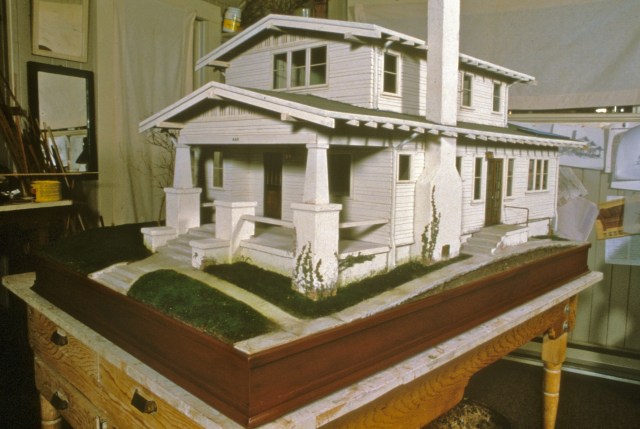
Whittier Miniature House, 1984-85

Starting with our 2ndmajor miniature show, Sarah Salisbury was an eager and repeat customer—she was open to suggestion, and introduced ideas of her own. Her enthusiasm for our houses had a lot to do with our ability to keep making them. Plus, on delivery, she always opened her house to us for a mini-vacation, which helped mitigate the long drives between So. California and Washington State. A lot of luck rode those miles with us and the un-tethered houses in the back of the van (aka the Black Ambulance, because one stormy night we delivered a friend in labor to the hospital in it). When we set out to deliver a house, it went in the back, surrounded by a few pillows, quilts and our clothes. And once our yellow Lab, Sunshine–invited to swim in Sarah’s pool. At the front end of the cargo area we set a cooler of home-fried chicken, peanuts, and dried banana chips—sustenance for the next 2 1/2 days. (One time it was cold poached salmon and gazpacho—left-overs from our traditional bon voyage potluck for friends who wanted to see our work). Great food, but not a barricade from a 50 lb. house should we have suddenly hit the brakes. These days I’d install a gate installed between us and the cargo area, and lash the house to the floor, but we were young, irresponsible, and fortunate.
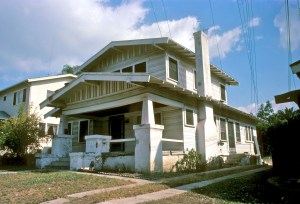
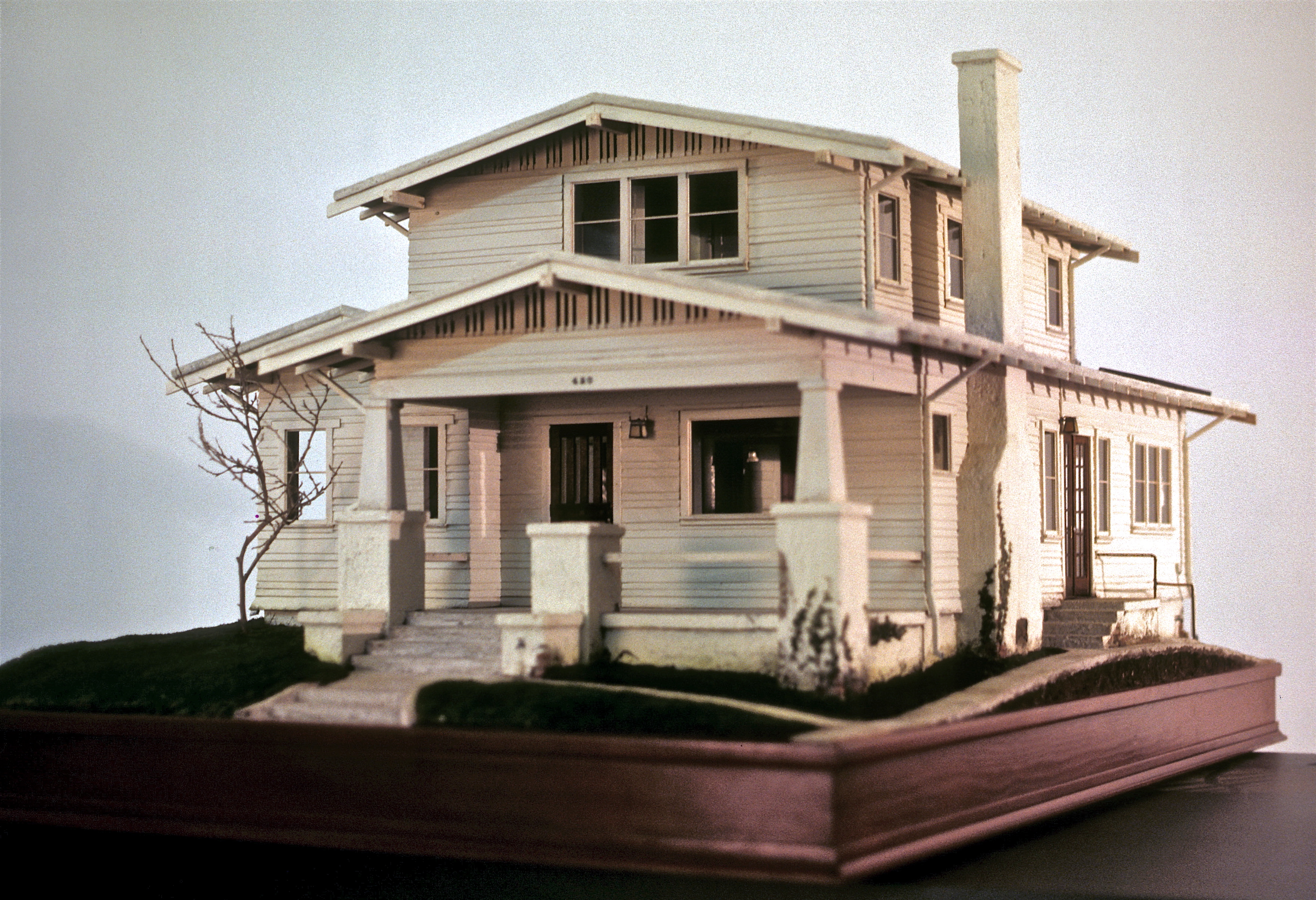
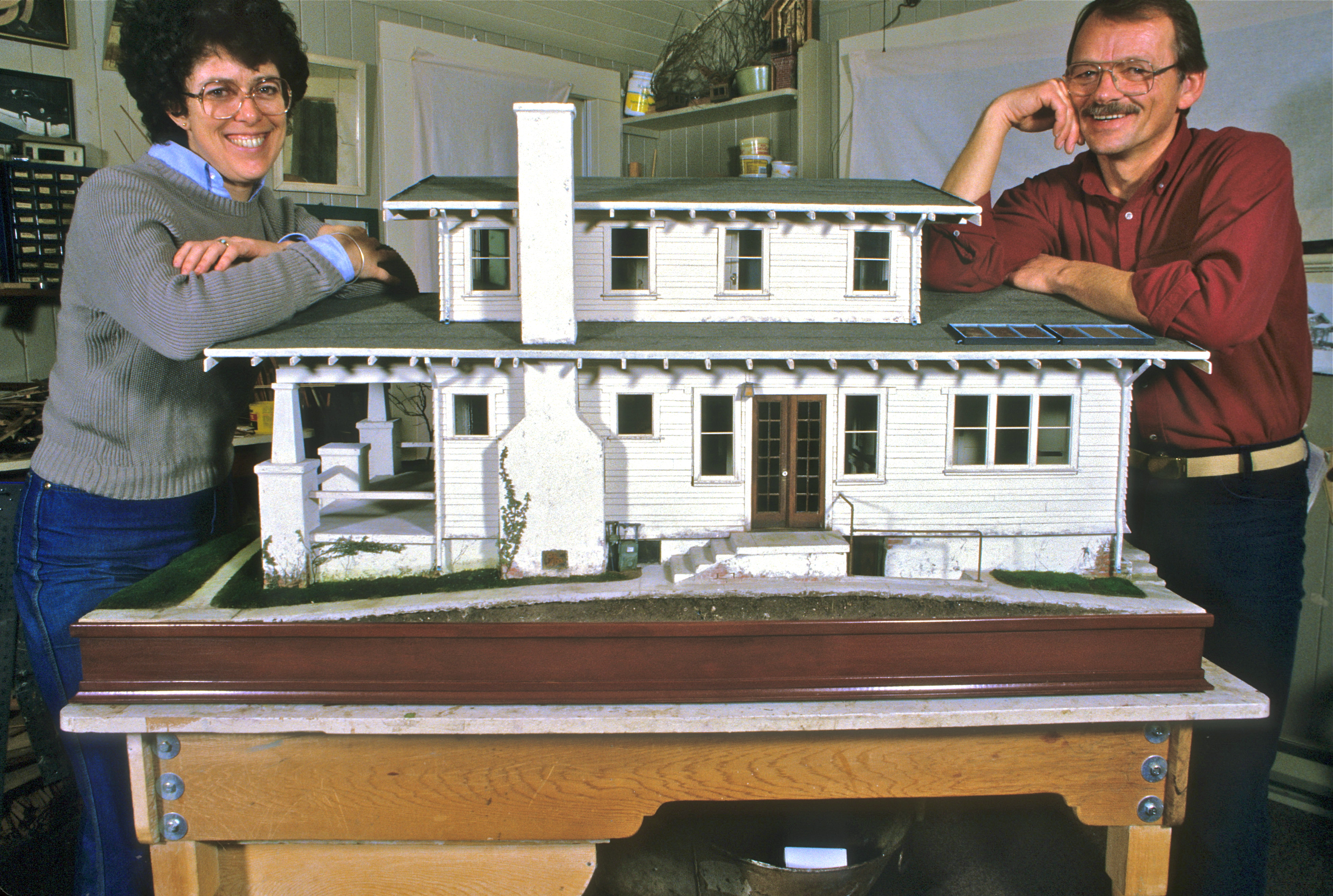
420 No. Painter, Whittier, CA

When Sarah proposed we make a model of her childhood home, an early 1900’s bungalow in Whittier, CA, we gulped. In dread. Years earlier Noel built a kit of a customer’s home, or tried to, from plans she sent. So many things were wrong with the plans he asked to see the house, but she refused, insisting her drawing was exactly what she wanted. He struggled, called her many times about details, and built a pretty awful plywood house, according to the plans. Of course after one look at the finished piece she said, “That’s not my house–that’s terrible!” Later we turned away a commission for a childhood home because the customer was so lost in the romance of the house, we knew we could never have satisfied her. She wrote pages about the swing in the yard, the lilacs, and the five purple bathrooms, not to mention the elephantine structure which wouldn’t have fit on our studio table, much less have been deliverable. We could only build houses, not dreamy memories.

So, there was Sarah, asking for the home she grew up in. We were intrigued because it was an “affordable” bungalow, built in the California Craftsman style, but with factory-built elements—a bungalow without the demanding Charles & Henry Greene peering over our shoulders. And it was Sarah, whom we knew to be a reasonable woman. If we were to take it on there would be caveats—it would not be a replica—better than a Cliff Notes, more a distilled version, filtered down to the essence of the style and spirit of her house.

Fine craftsmanship, and room layout

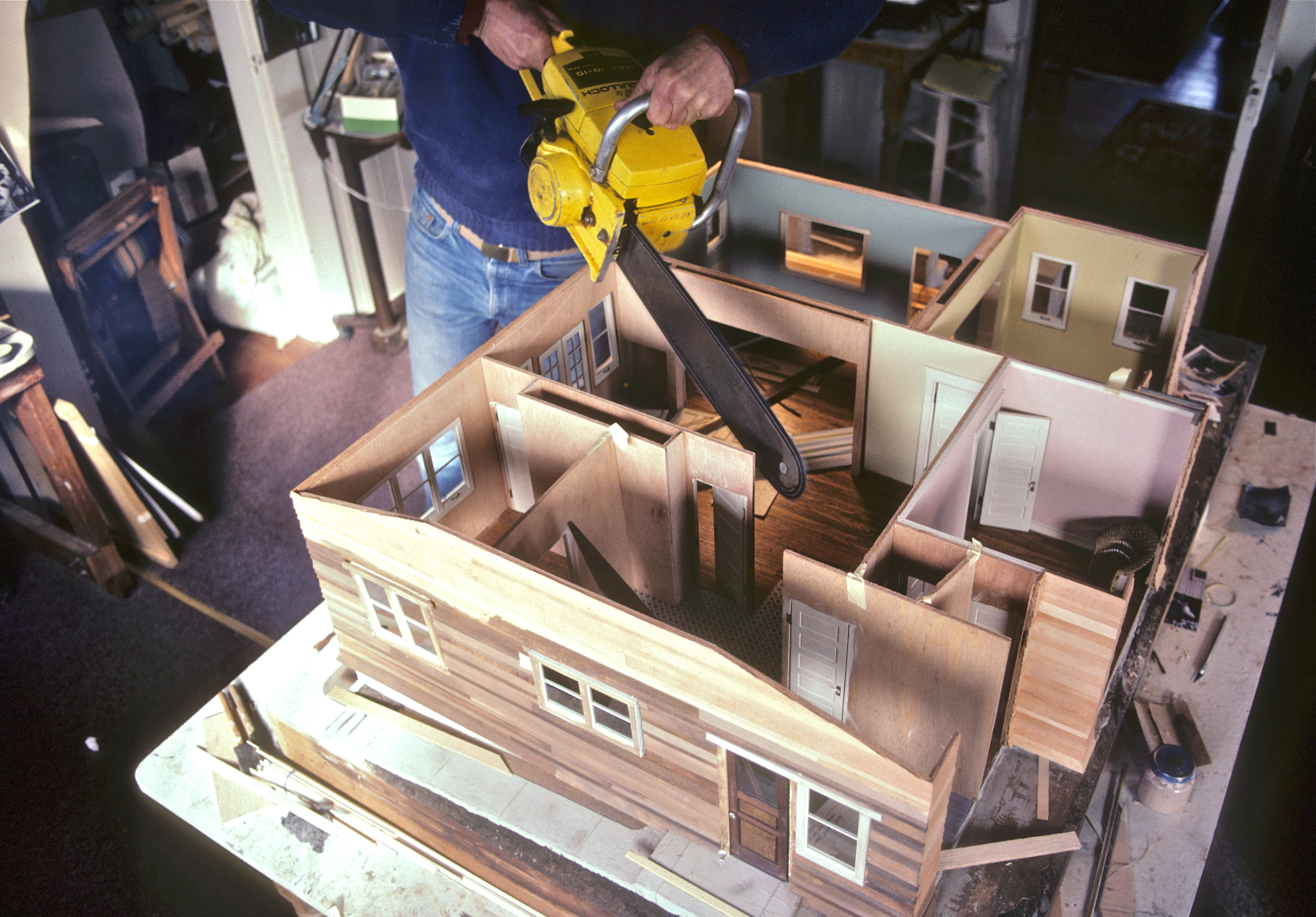
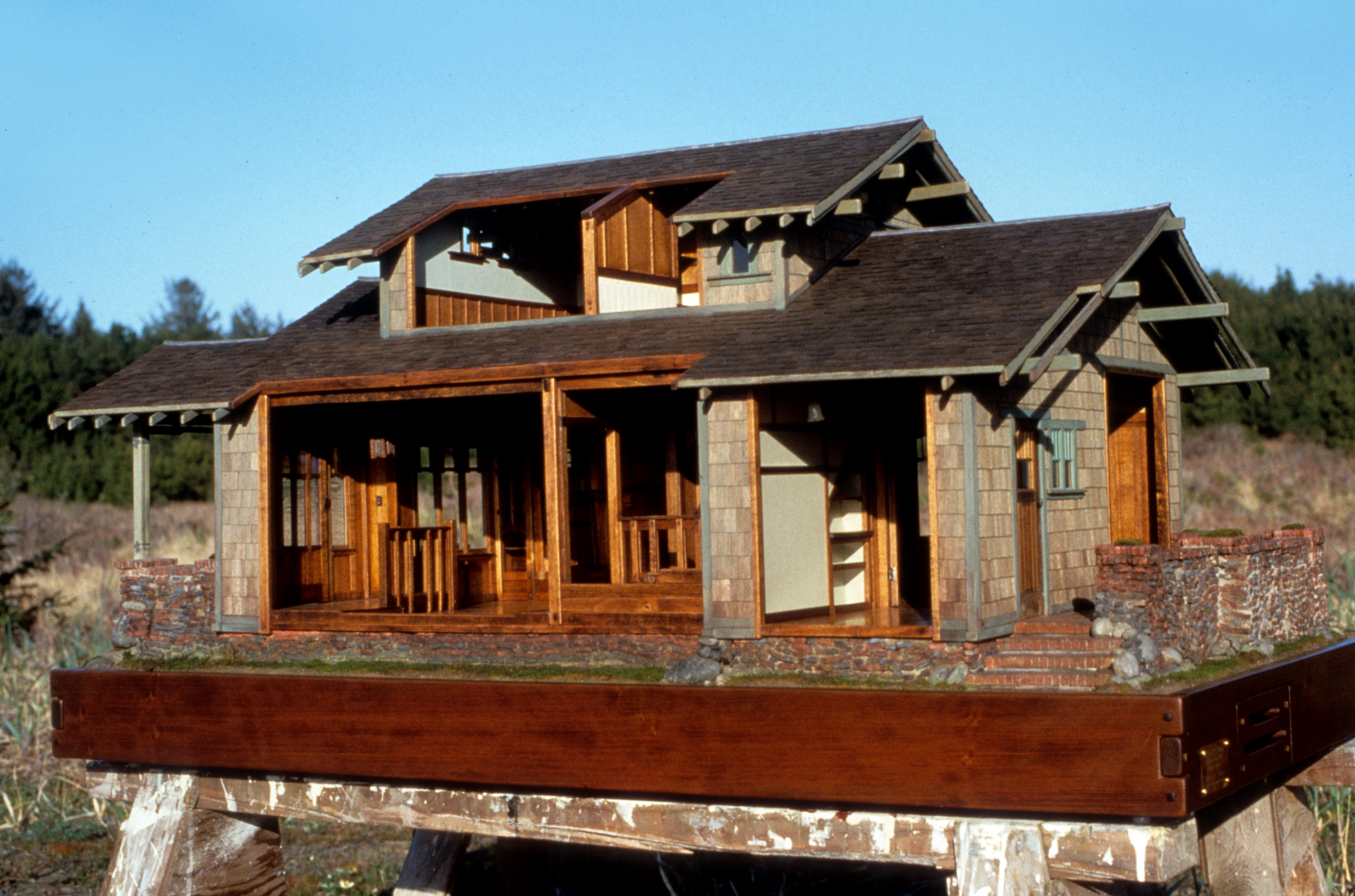
As with all our structures, it needed to fit on the work table, out the door, and into the van, so extraneous rooms had to go (miniature people only get one bathroom, or two, at the most), and placement of others had to be rearranged to fit the measurement constraints. In this case, Sarah had exterior photos of the house, plus she had drawn up fairly accurate plans for the interior layout. We had lots of scrap material on houses of the era, and could be guided by what Sarah remembered of interior details.

Whittier kitchen–counter tile made from Thomas-embossed Joe Hermes paper.
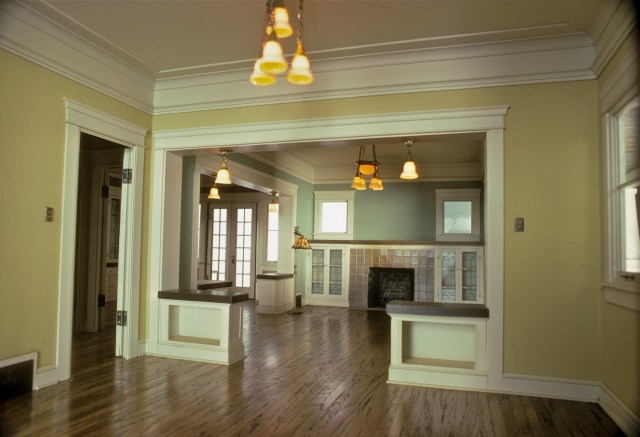
Whittier front and back parlors with built-ins, tile fireplace, and oak floors. Noel designed the lights that were custom built by Isabel Thompson.

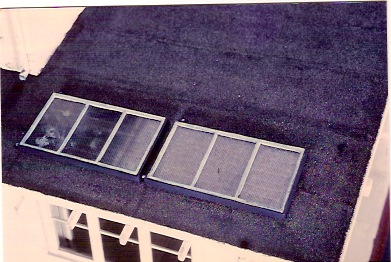
She remembered window seats in the dining room, lots of built-ins with glass doors, oak floors, and a kitchen with a basement door (with a lock, because little Sarah had been afraid of what might come up those steps). She also remembered it had back-up solar heating, with panels on the roof (yes, way back then, before the gas industry diverted our attention and $$$).
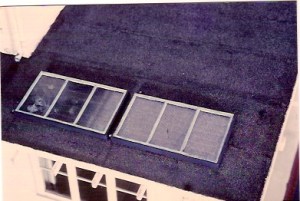
Whittier solar panels.

She remembered enough details to make it fun for us all. We could build a house that looked like hers on the outside, and included the important rooms for making a convincing interior. We agreed to give it a try.

Whittier studio shot–what remains of a lost batch of record shots by our friend Harry Liles.
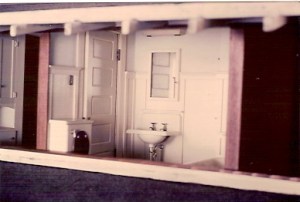
Whittier bathroom

We spent nearly two years on the Whittier (named for its location), in and around preparing for classes and teaching, giving us plenty of time to check in with Sarah to make sure we were on the right track.
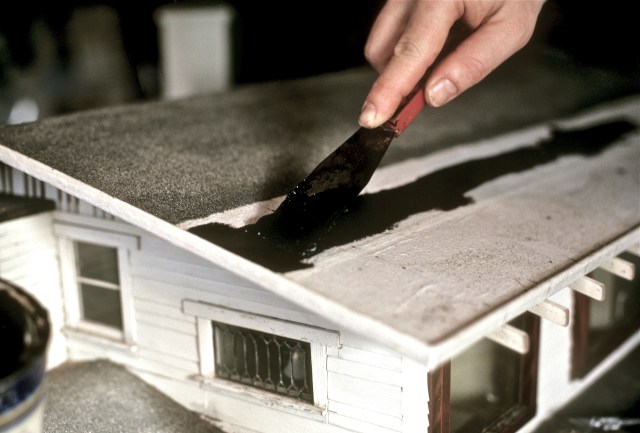
Applying roofing tar over strips of muslin before sprinkling on white bird gravel to simulate the reflective period roofing.
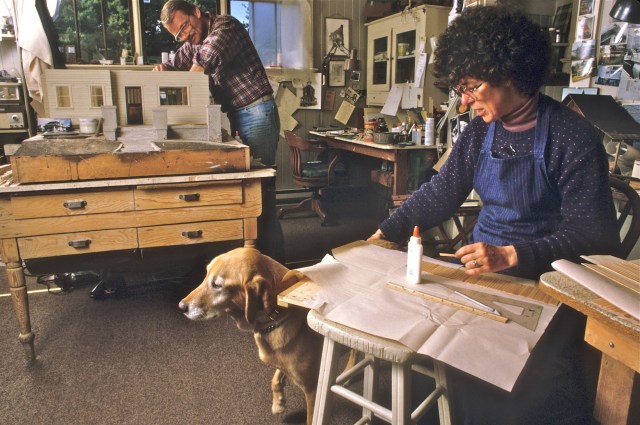
Sunshine trying to pry us away from work and out onto the beach.
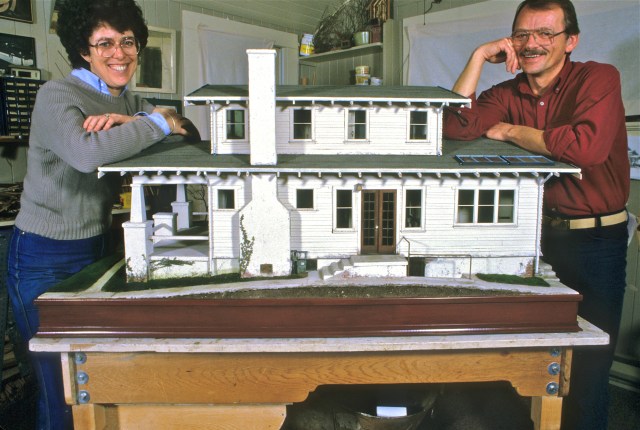
Done!

When we delivered it, a little nervously, she gasped a little gasp when she saw the dining room. Lifting the lid on the window seat she looked in–“ Oh! That’s where I stored my toys at dinner time, or when visitors came.”   The padlock on the basement door made her laugh–we knew we had done it right, and that the rest of the house would fall in place for her. With the final payment tucked under our belts, and a lightened load in the back, we headed the trusty van home, splurging on restaurant meals and better motels.

Posted in Houses, Memoir, Miniatures | Tagged , , , , | 15 Comments

The Garden Shed: Bird Poo 101

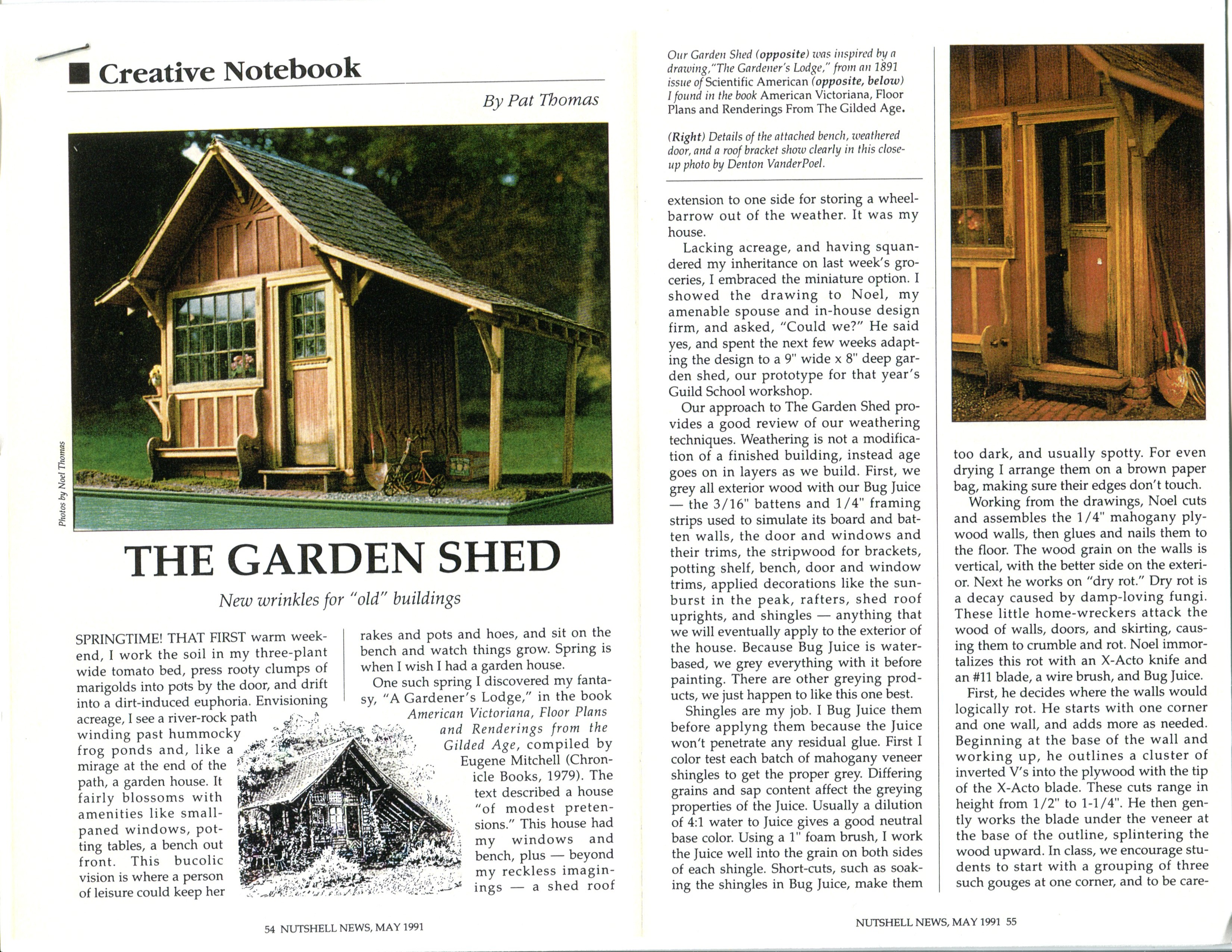
For Sale: The Gardener’s Shed

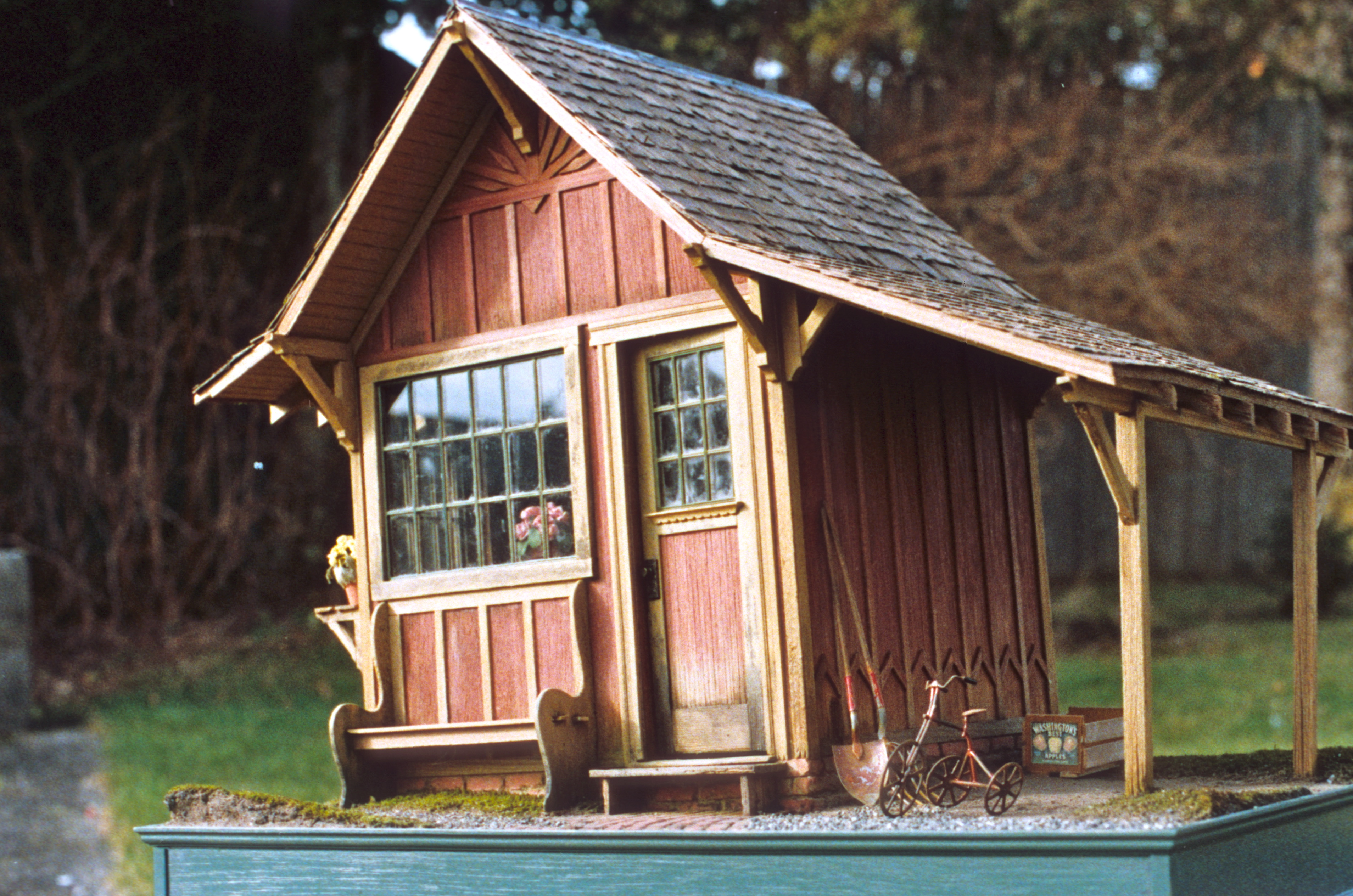
The Gardener’s Shed, project #33, marked the start of our official teaching career. Prior to that our “teaching” was more like the blind leading the blind, as those of you who took our early garage classes in Seattle can attest to. We taught without a detailed plan or instruction booklets, just trying to guide the students through the process of transforming a plywood shell into a recognizable, aged building.

Then came our first year at the Guild School—1983. We were invited to speak and teach a 10 hour class. That class consisted of our providing each student with a sandwich baggie full of birdhouse parts, along with some paints and glue. On the way into setting up our classroom, baggies in hand, I paused when I saw the other teachers lugging in trunks and boxes of supplies, tools and teaching manuals, thinking, “Oh my, they’re awfully prepared. Teaching manuals?” Our students finished on day three of five, and we spent the last two days taking them on walking tours to point out aging details on the historic homes of Castine, ME, where the school was held. For some reason (possibly our “bird poo” demo ?) we were forgiven our haphazard approach, and invited back for the next year. We went home to build a better birdhouse.

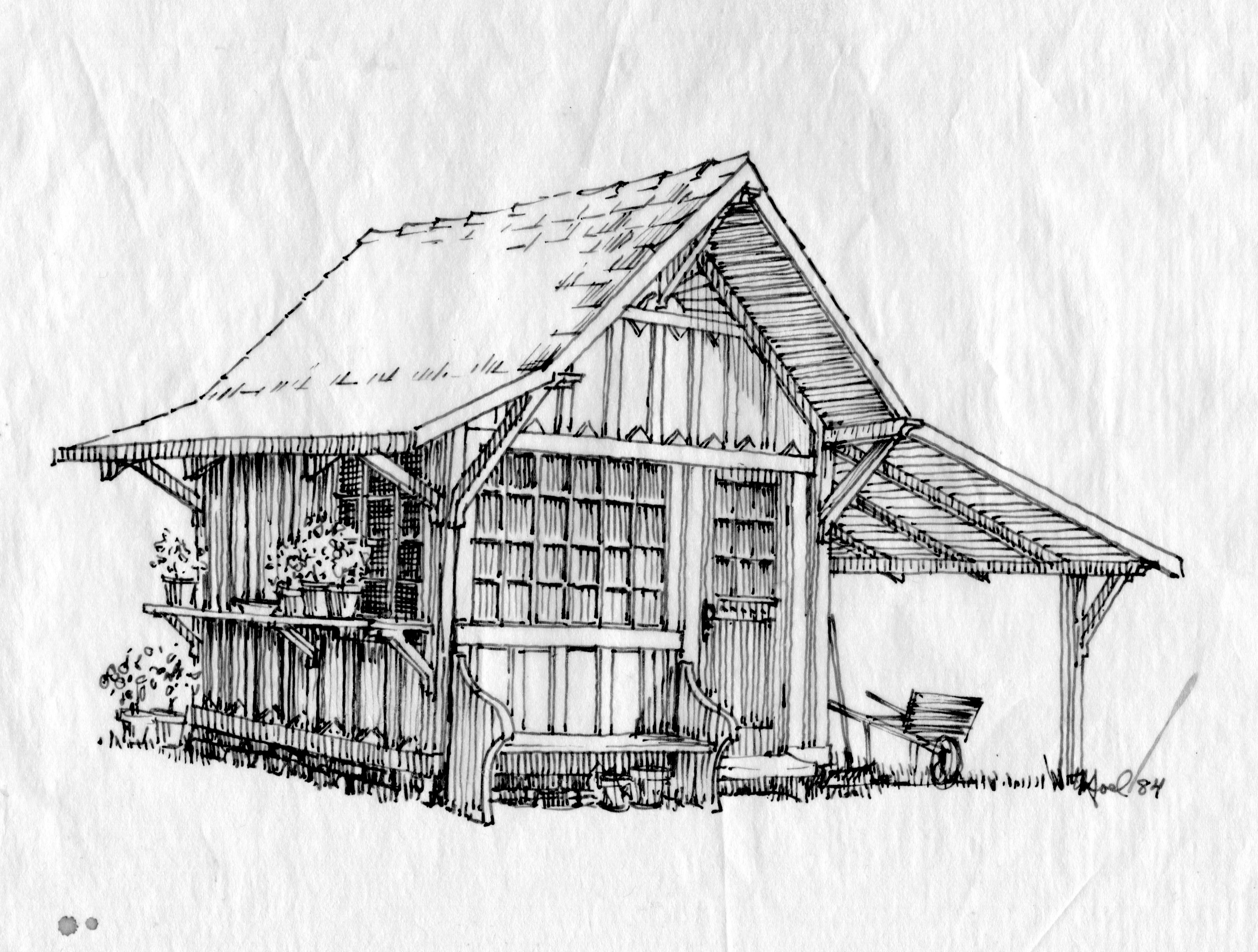
Early drawing

The better birdhouse turned out to be the Garden (or Gardener’s) Shed. It’s inspiration came from a reprint of the July 1891 Scientific American. It’s a gardener’s dream—a potting shed deluxe in which to store one’s pots, rakes and hoes. It blossoms with amenities like lots of reflective glass, and a bench from which a tired gardener might listen to the birds and watch things grow. If it was out of reach for my life-size, postage-stamp yard and bank account, it was possible in miniature. It also presented the perfect vehicle for teaching the illusion of age–slant, sag and rot–board-and-batten siding (simple enough for a classroom setting), bricking and shingling. It also seemed doable for a 5 day, 6-hour class schedule, though the only basis for that assumption was gut feeling—we’d make them do it in that time!

Final Drawing

Preparing kits from the prototype

Working hard on the second prototype–the first one sold to Noel’s brother.

Real diagram from the real instruction booklet

We arrived at the 1984 Guild School, somewhat confidently equipped with boxes, diagrams and booklets. However, as with any teaching situation, it’s the knots you never thought of that cause the most trouble.

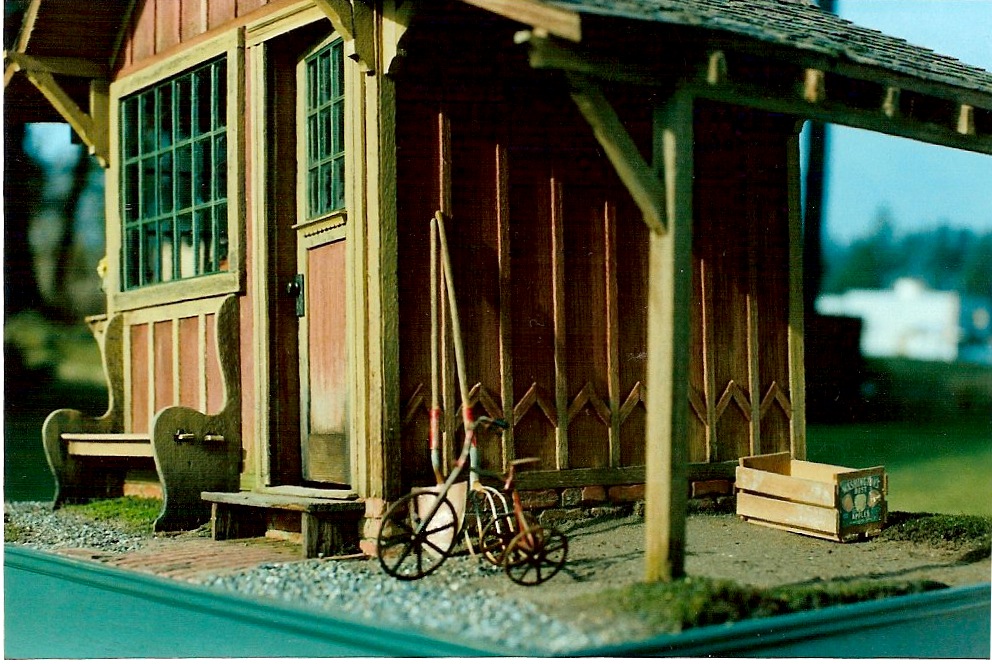
Shed roof detail, with tricky uprights.

While we had pretty much ironed-out a method for the tricky chevron detail on our garage projects, we didn’t count on how long it would take a non-whittler to carve the multiple brackets with an Exacto knife (a whole class unto itself), or attach the uneven posts that hold up the shed roof. As with many future teaching projects, Noel took over such headaches in the last day or two, while I helped the class through the rest of the project. We always gave the student the option of completing all the work themselves, no matter how far beyond their skills, but in all our years of teaching, only two people accepted the challenge. Nobody needed to finish in class (and few ever did) but they did need the skills and materials to go home and finish on their own. What always cheered people up at the end was that everyone could shingle, and that was one of the final jobs. We still get photos from students who, years after their class, finally finished (the kids are gone!) the project. With wonderful results!

Hinged back wall with birdhouse and chevron detail.

Yes, bird poo was one of the lessons, for the birdhouse, and the Garden Shed. What roof doesn’t have a little, or a lot, of bird poo? Our Artistic License dictates we use only a little—as with anything in miniature, and maybe art as a whole, a tiny suggestion drills a long way into the mind of the observer. You want to pique their interest, not bludgeon them with your new-found technique. Bird Poo 101 consists of dampening down the already aged  (Bug Juiced) roof surface with a big drop of water on a small paint brush (a #4 watercolor round is good). A second brush (dry) is then dipped into titanium white acrylic paint. Dot a little blob on the dampened area. A tinier dot of raw umber or Mars black should be added for graininess, and/or some blue if it’s berry season. Finish it off with another drop of water from the first brush, dropped from just above the pile so it wets the whole slightly–enough to mix the colors a little and stain the area around the blob, but still keep some dimension to the blob. It takes a little playing with, but the end product, so to speak, is worth it. Unfortunately I cannot find a single photo that includes a close-up of bird poo.

Door detail with some of those brackets above

Another year at the Guild School we taught the popular Bird Poo Demo as a seminar. A student from South Africa, a fairly buttoned-down man, spent the whole demo at the back of the room with his brow furrowed. All I could think was that he was offended, but not so much as to leave the room. Finally, as we put the finishing touches on the “poo” his face lit up. “Oh,” he blurted in his rich English accent, “Fulmar!!” Fulmar presumably being their word for bird droppings. He applauded. Everyone applauded. Now bird poo had a class, and some class.

End Notes: For more detailed how-to’s on the Garden Shed, see my Creative Notebook entry in the May 1991 Nutshell News. Purportedly that series is still available by order from Dollhouse Miniatures. I am not allowed to reprint them myself, but any of you may copy and distribute them as you like. People subscribing to The Camp or other mini-chat groups might be willing to send you a copy.


Posted in Houses, Memoir, Miniatures | Tagged , , , , , | 8 Comments

It’s a Matter of Perspective: Pippen Hill, Part II

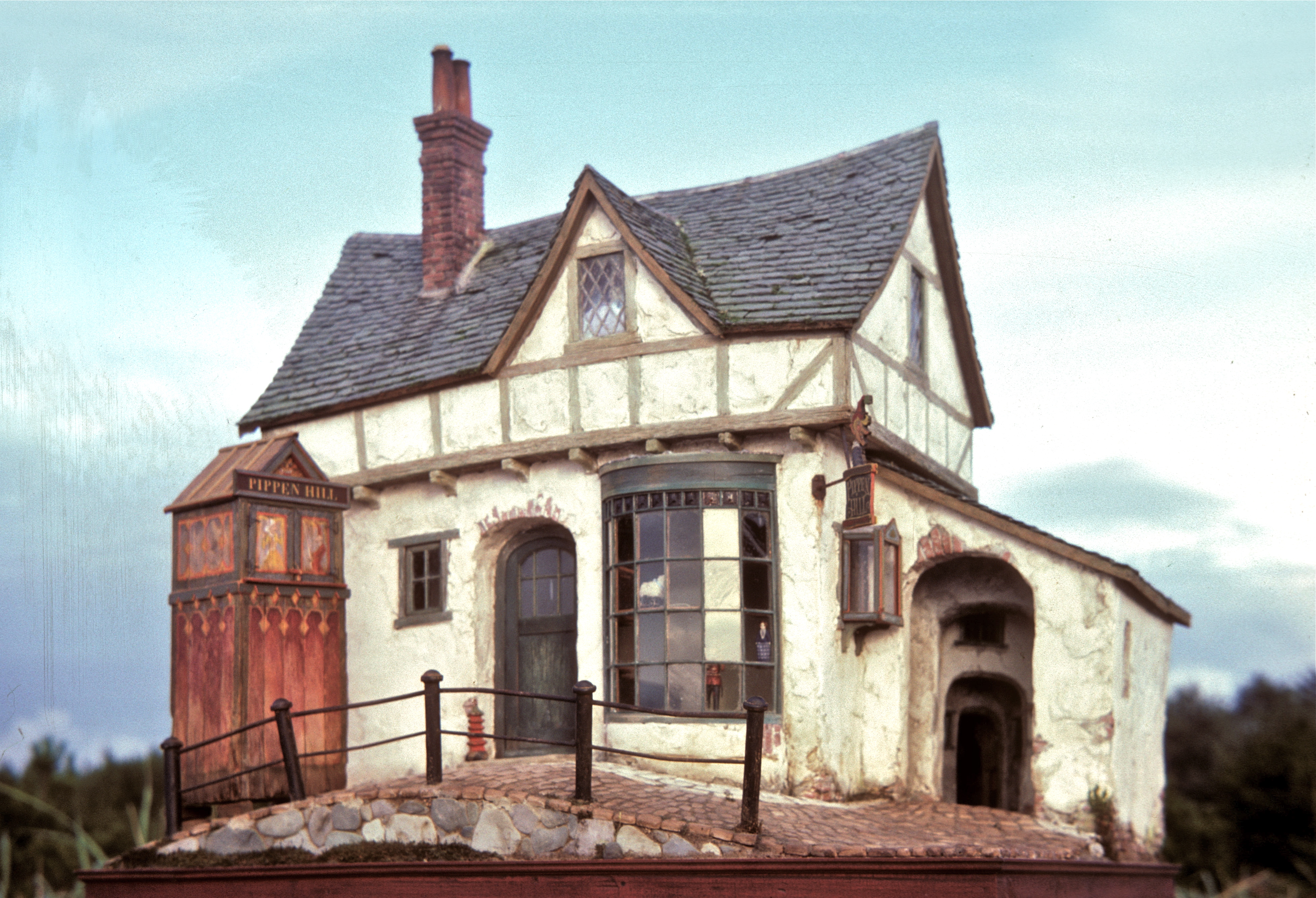
Pippen Hill

Making Pippen Hill was far more fun than should be allowed for a job. Almost everything we did was with new materials and methods, but the design was pliable, and organic, inviting experimentation. A house and shop for a puppet maker (as well as the customer, a highly imaginative doll-maker)—it was a storybook house, childlike in feel, with very little predetermined. As usual, we made it up as we went along, taking out what didn’t work, and sailing along on what did.

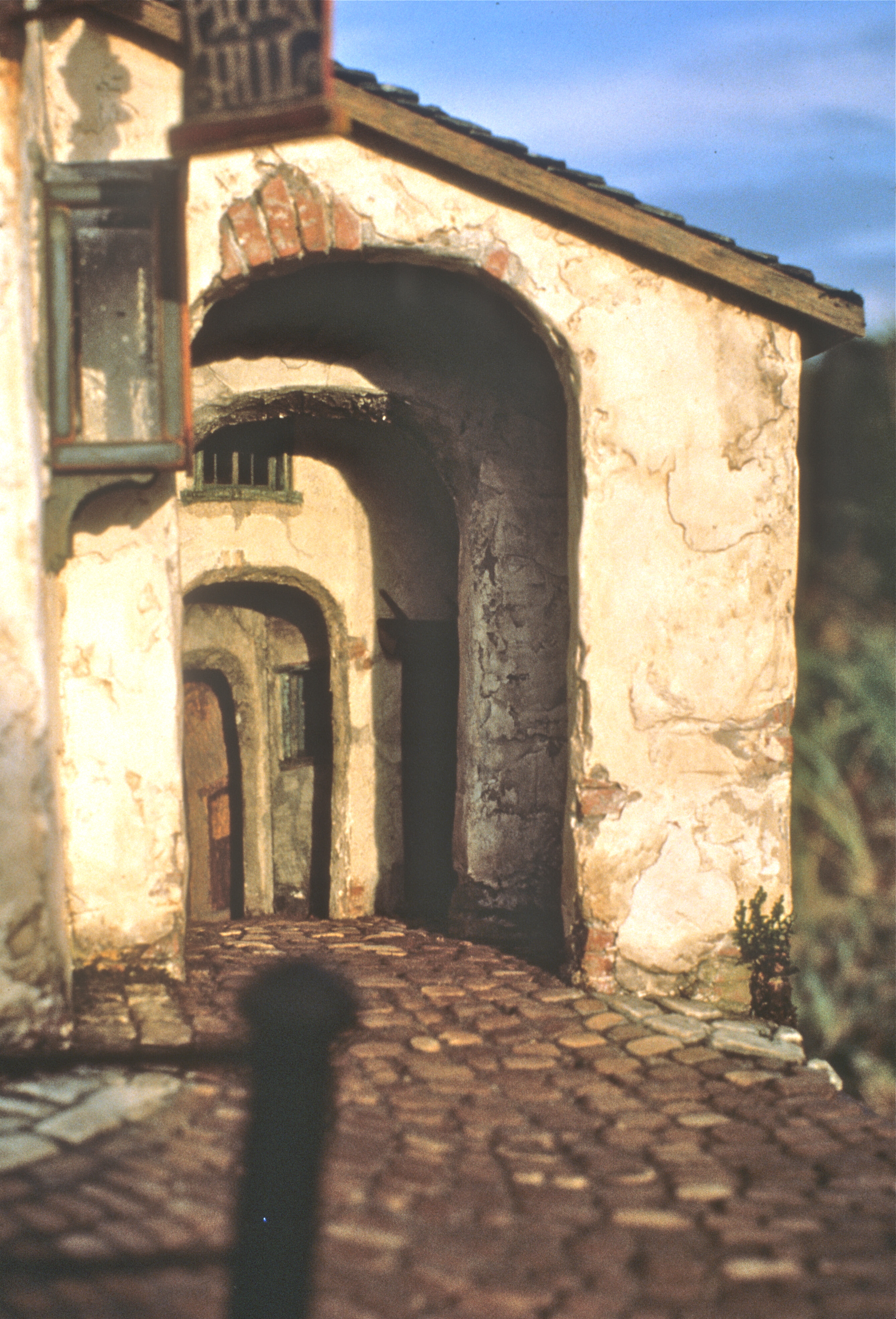
      A major element was the use of false perspective, to give the feeling of  greater space and depth. For the front, we wanted the feeling of seeing the building from a distance, which is why we made the humpy little hill for the puppet theater. Plus, Noel designed that alleyway to give the feeling of depth and mystery—where did that alleyway lead? A reader has asked if we used a specific angle, or laid out the vanishing point on paper for that alley. Not exactly. Noel and I have an aversion to math, and our mathematical attempts got in the way of our miniatures work far more than they helped. We worked best in eyeball geometry.

I believe the alley was around 7” deep. It was open at the front and dead-ended into a wall at the back of the project. It was also on a curve. Noel built a series of archways in descending sizes (whatever looked right) leading to the back. Then he added a door at the back the smallest size he thought he could get away with. I should mention here that he has a natural sense of where a focal point would be—a talent he developed in art school (half a century ago!). What you probably can’t see in the photo is a tiny upper window to the right at the back, before the door. A window where a light shines (if the bulb hasn’t burned out). It was my job to pave from front to back in the right perspective.

Making pavers and cobblestones

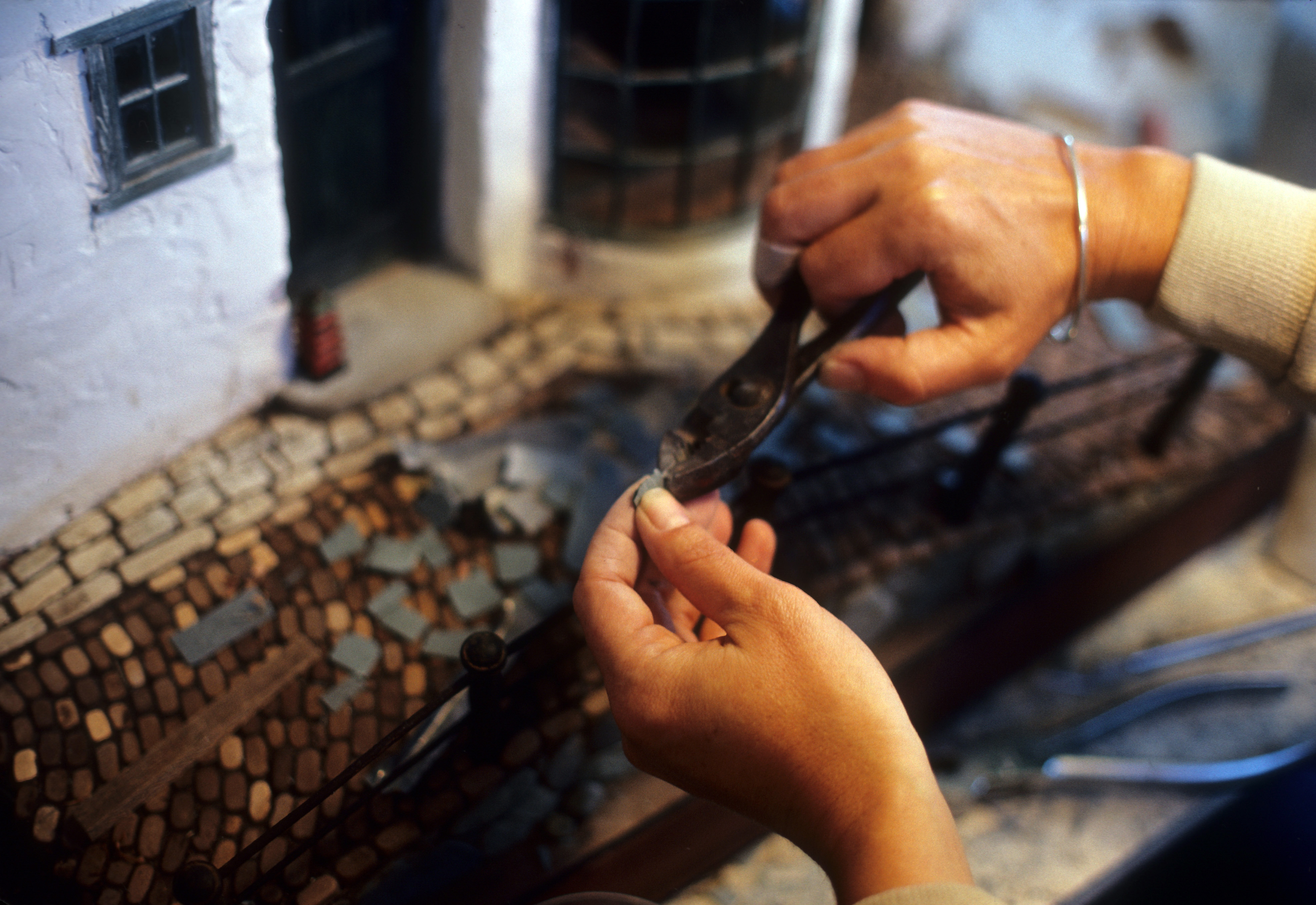
I paved the front sidewalk first, getting a feel for the bricks, and how to make the sidewalk feel deeper than it was. I think I used Mini Brick & Stone’s plaster-like bricks, in various colors, for both the pavers (at the edges), and the stones. Once soaked in water they were easily carved with pliers and an Exacto knife into the sizes and shapes I needed. When I got to the alley entrance I stopped to make s few stones that looked right in relation to the door at the back. Once I determined my final smallest size, I started again at the entrance and worked my way gradually back. It was one of those jobs that took over—once I got the feel for it, the stones, or the stone people,  told me what to do.

The best response to the alley was from our friend Chris, who stopped at the house to see the project, an Englishwoman as it happened. After looking at the alley for a few minutes, she went around to the back (the open side) of the project, expecting to see more alley. She let out a little yell—“where did it go?!”. Of course at the back the alley didn’t exist—we were back to real-time 1/12th scale for the interior. What would have been the continuing alley was a wall. The alley is part real and part imagination. A matter of perspective.

For the life of me, I can’t remember what was on that back wall.

Interior before…

Interior after…

Another matter of perspective is my storytelling nature. While I stick to the truth, as I remember it, in these postings, my writing mind also likes to frame it all in a good read. As in, those probably weren’t Chris’s exact words, but the feeling. As I recall. I say this in partial apology and partial explanation, because a reader noted that in the last posting I incorrectly attributed the puppet-maker doll to Renee Delaney, who commissioned Pippen Hill. She was right—the doll was made by Arlyn Coad, a talented Canadian puppeteer and doll-maker, and that should be noted (I have corrected the blog). I should have remembered, but I didn’t, so I thank you for setting me straight. Renee sent me the correct information, and, after reading the blog, noted my memory was different from hers as to the where’s and how’s of the commission. In many ways. So, I confess to taking some, or a great deal of, artistic license in this history of our work. I hope the entertainment value is worth the rubber-banding of the “truth.” At least you know the photos are the unenhanced, true record of our work, as my right-brained mind will never be able to figure out how to use Photoshop.

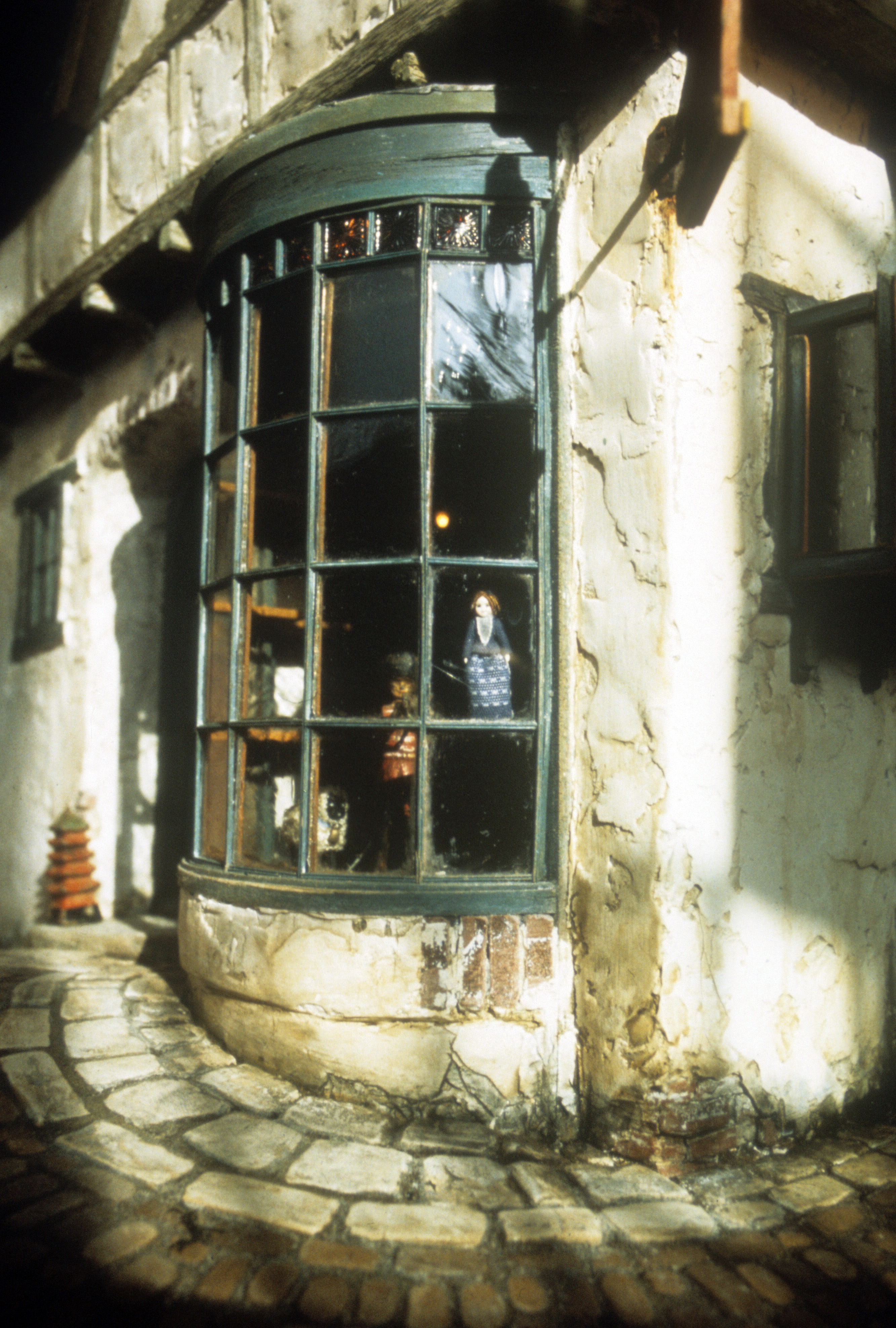
Bow window detail

Posted in Houses, Memoir, Miniatures | Tagged , , , | 16 Comments

New Tricks: Pippen Hill, Part I

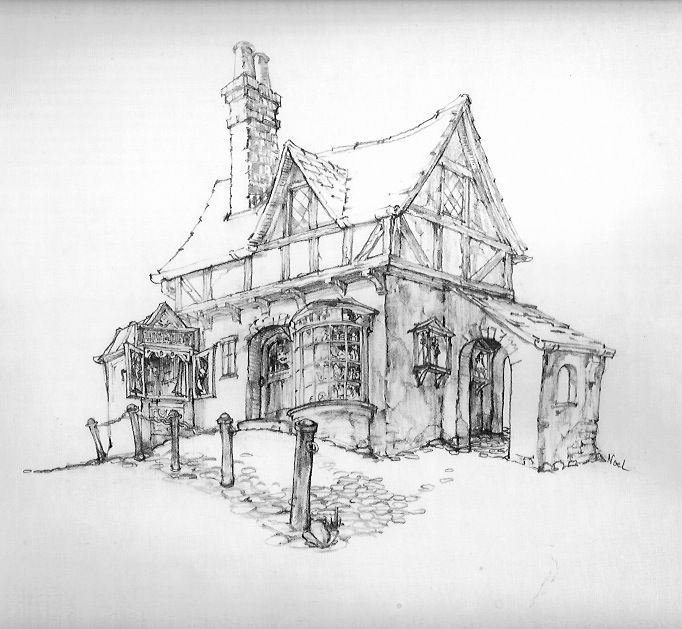
Pippen Hill on Paper

Coming in sideways, I am running late with this post, which is no way to treat the slew of you who read and responded to my last post. Before I start a new entry, I assemble the photos on hand, which gives me my jumping off point for stories and details. By the time we reached this project—Pippen Hill, #32 in 1984—we were switching from prints to slides, as they reproduced better for publicity. Over the past ten days I’ve been teaching myself to scan slides, in a new scanner, which is tricky, especially when it comes to trying to improve the look of under-exposed film. This old dog is slow to learn new tricks—not that I can’t, but I can almost hear the wheels creaking around (or not) as I move from one step to the next. Because you all have responded so well to the photos, I hope to include more of them as we go along. Some are not that great, but they show detail that you might otherwise miss.

As another sideline, you might be interested to know that the last post, about the Craftsman Bungalow, had the largest response (other than the posting that mentioned both Barry Manilow and married…but that was a whole other group of people) in one day–476 of you. WordPress, the blog host, makes it easy to obsess on one’s stats—it’s impossible not to peek every hour or so after a new post is up to see how many people have read it. Overall, since this began (January 2011), nearly nearly 26,000 hits have been made on the site. By big blog standards, that’s not much, but for us it’s pretty great. Thank you all.

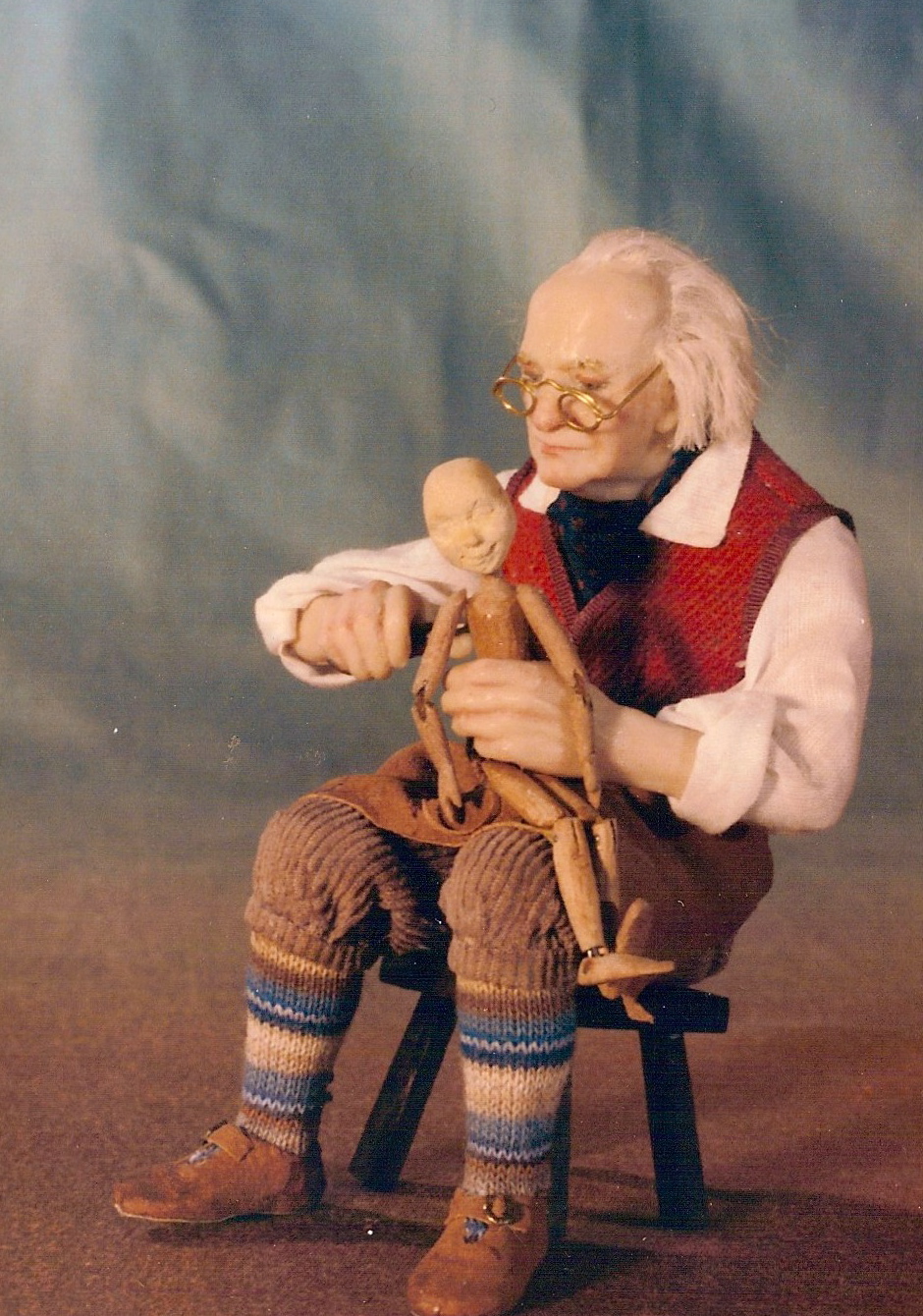
Arlyn Coad’s Toymaker

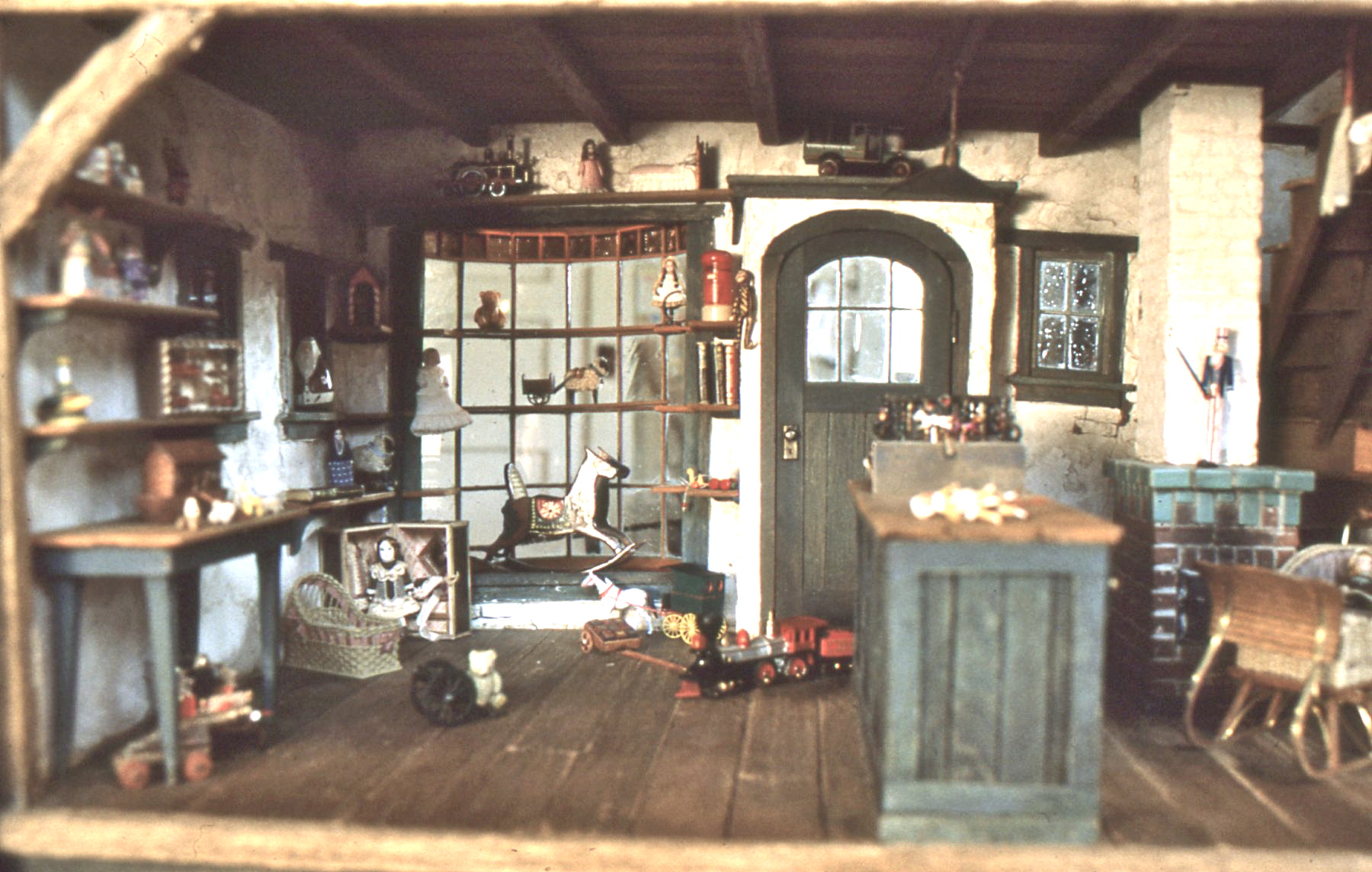
Okay, on to Pippen Hill, Part I. Our customer was Renee Delaney, a highly accomplished mini doll and toymaker. While we sat in the living room of her newly restored Victorian home, she showed us a  1/12th scale wax doll, made by Arlyn Coad, a Canadian puppeteer and IGMA artist. It was a wizened toymaker, carving a puppet. She said he needed a home. She then showed us a book illustrated by the Dutch artist Anton Pieck, and said, “I think he lives in a world like this.” We were immediately taken with the charm of his watercolors–an appealing old Europe/fantasy world, childlike without falling into “cute” or “sweet.”  Playing around in other people’s imaginations—Pieck’s and Renee’s, not to mention multi-hundreds of years of aging–sounded like the beginnings of a great new project.

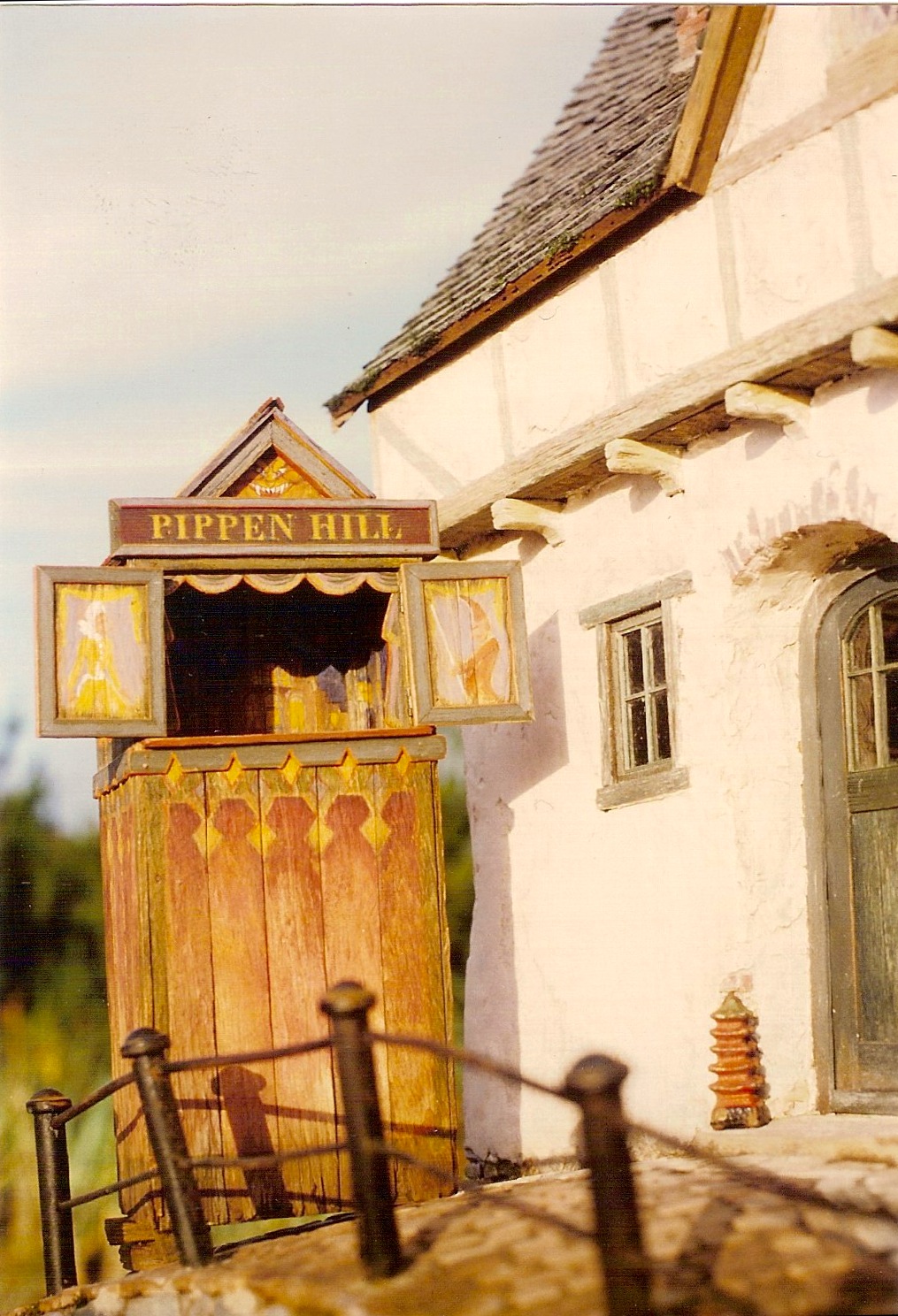
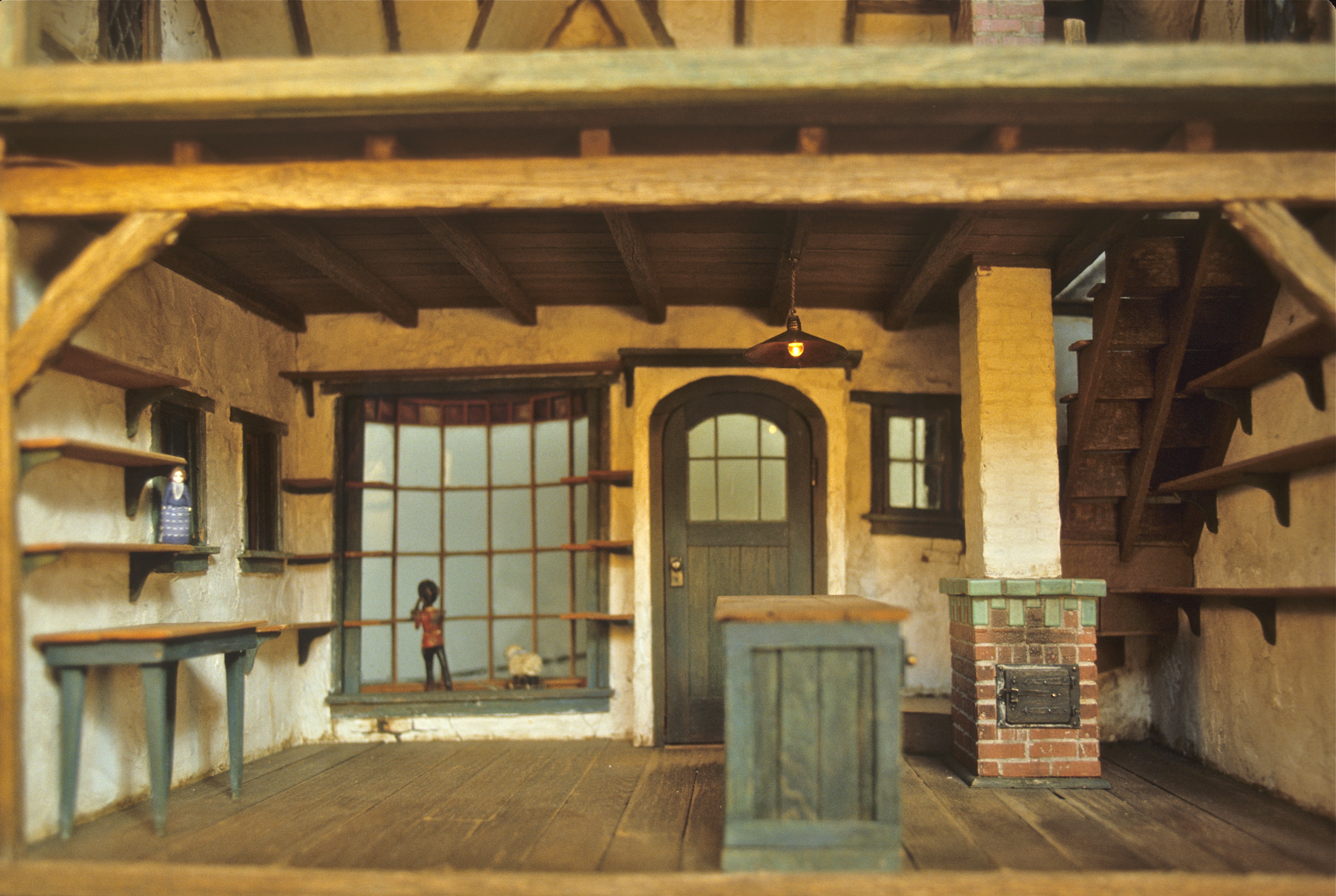
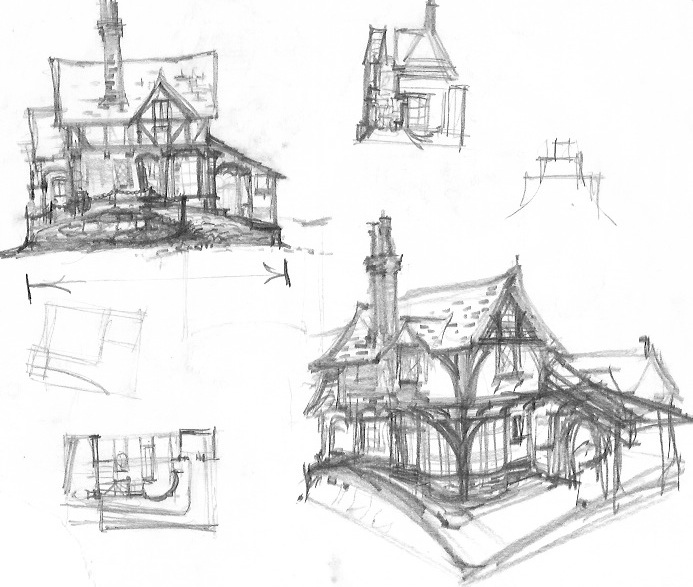
The timing of Pippen Hill was perfect—building a fantasy toymaker’s shop after months of  working under the thumbs of Charles & Henry Greene’s exacting standards.  It felt the way a horse must feel running free of saddle and bit–not a straight path to be seen. We were also free to come up with all the materials we’d never worked with before or knew where to find—wattle and daub, cobblestones for the terrain (great texture, as Pieck so wonderfully illustrated) and a slate roof. But that could be dealt with later, first Noel got to play with design. He came up with a relatively small project (26”wide X 19” deep) that included an alleyway, bow window, cobblestone street-front, and a portable puppet theater (to take to the park a la a Punch and Judy Show).

Early drawings

Just about done

Trotting out into the field, we just took each problem as it came. We built the initial structure, as always, from ¼” ply. The wattle (wooden framework), framework and beams were rough cut from and unknown wood—maybe mahogany.

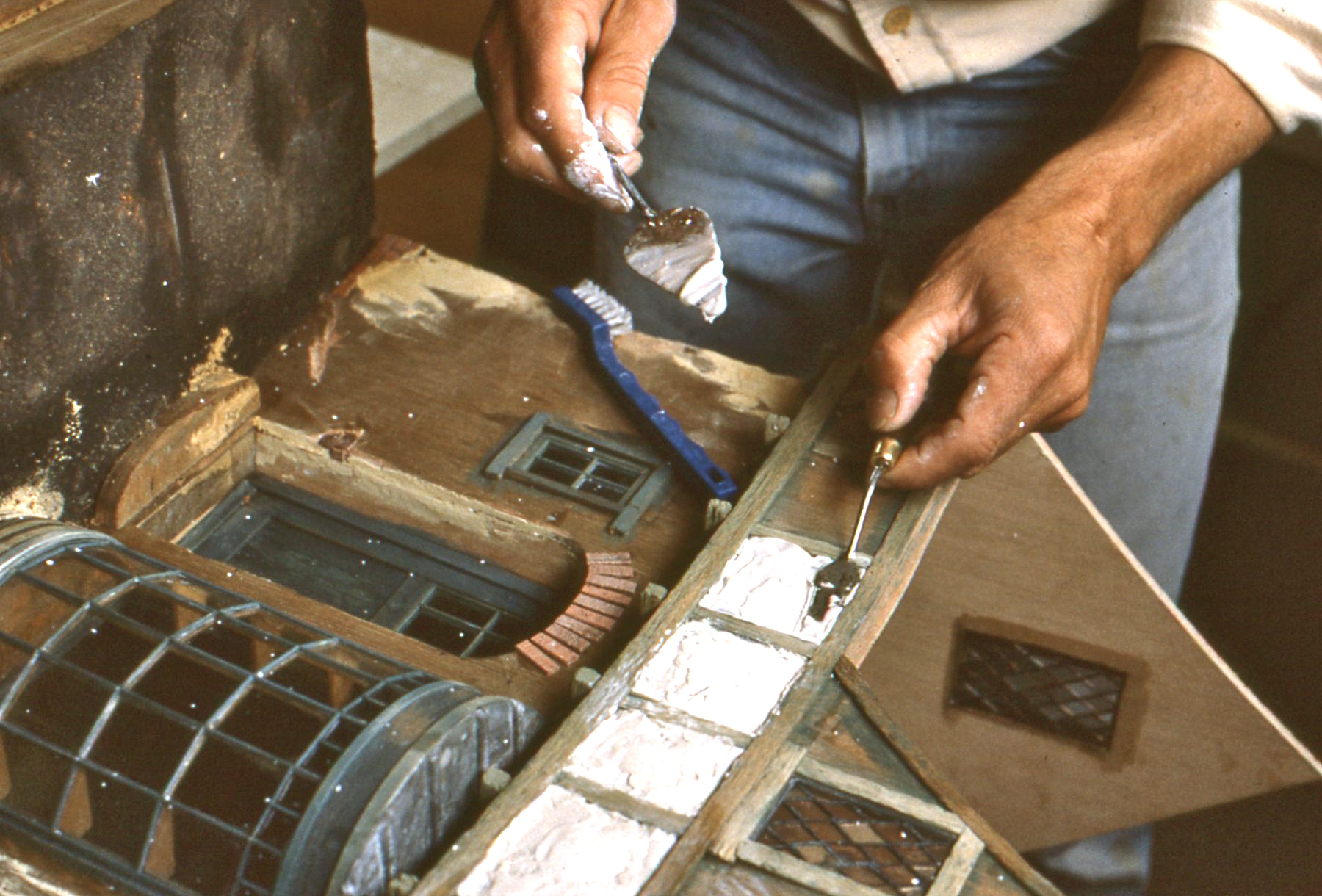
Daubing plaster between the wattles

Noel remembers it was hard wood, and required a lot of wire-brushing and end-aging with an Exacto. It looks old to me, even before the Bug Juice, like something we scavenged. The “daub” was Plaster of Paris, with probably a little Acryl 60 cement adhesive added (a product which holds the plaster together, and to the wood, preventing chipping or powdering down the line).

Jack Blackham custom cut the roof slates, each one with beautiful crisp edges I subsequently rounded and aged with needle-nose pliers. Because Noel designed-in an alleyway with diminishing perspective, I had to come up with cobblestones in ever-decreasing sizes. I think it was Mini Brick & Stone who made the bricks of a plaster-like material, tons of which I soaked in water and carved to the size and shape I needed.

The facing stones at the front of the terrain look like flatish stones we must have found on the beach. The hill terrain has crumpled newspaper underneath, covered with a mix of sawdust, Elmer’s white glue, water, and Bug Juice to darken it. Once that mix is dry, it’s hard as stone. It can be painted with a diluted Elmer’s then sprinkled with sifted dirt, or sand, but for this we just glued the bricks and border paving stones right to the sawdust. 

Puppet Theater under construction

Next post I’ll get into the glamorous shots. This time I’ll end as I began, with a sideline I can’t resist: the other night Noel dreamed  that someone bought our Bug Juice formula for $60,000. Yahoo! And that was just the earnest money. Such are the dreams of ex-and-aged mini old house builders.

Posted in Houses, Memoir, Miniatures | Tagged , , , | 16 Comments

The Bungalow: Once Bitten

The Bungalow, 1984

Somewhere in the late 70s we ran across a copy of American Bungalow magazine. Inside its covers lurked photos of the Craftsman bungalows of Pasadena, CA designed by Charles & Henry Greene. One look and we were smitten, or more like bitten by the bungalow bug. And the bite was deep. After all those Victorians we’d built, the bungalow looked like a breath of fresh air—the deep overhangs, the harmonic horizontal lines, the play of light and glow of the interior spaces, the exposed woodwork.  The bungalow vampire–instead of sucking the lifeblood out of us–re-charged our juices for continuing to build miniatures.

Thanks to a subsequent mini house delivery we got to tour the Greene’s Gamble House Museum (aka the Ultimate Bungalow) in Pasadena, along with another of their smaller houses in the neighborhood. Noel and I and a couple of European architects toured the house in almost total silence, stunned by the understated details, the brilliant problem-solving, and overall beauty of the spaces. At one point I had to laugh at how all five of us were standing with our mouths agape as we discovered an unexpected and fairly inconsequential use of the Greene’s signature “cloud-lift” design in a corner of a window. It is no overstatement to say it was a reverential moment, one of many we would have that day. The promise we had seen on paper played out even better in person. In Foodie terms, the discovery was tantamount to finding your first sushi bar after being raised on classic French cooking.

Bungalow Inglenook with herringbone oak flooring

We drove home with a pile of picture books from the museum store, and a lot of animated conversation. Before we could attempt the style, we had to step up our learning curve, and finish off a few more commissions. In late 1983 we dove into a test run with a smaller house, to see what we could accomplish—maybe a Baby Gamble. Now that we were taking on the exacting style of two specific architects, we wouldn’t be able to fudge the details—every element had to fit perfectly with every other, with each space carefully planned in advance. We, two seat-of-the-pants dollhouse builders, merely had to duplicate brilliance.  Or fake it well.  Hee hee. But hey, the worst we could do was fail.

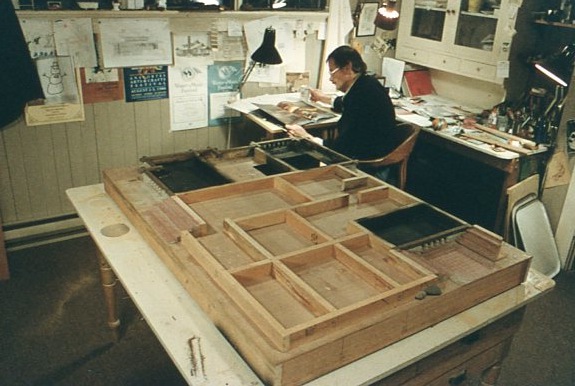
In this worktable shot you can see we finished the interiors first—we had to have as much access as possible to fit the puzzle pieces together. We used basswood to simulate the various hardwoods used in the originals. We ordered lots of 3-4″ stock so we could choose sections with more pronounced grains for the wall panels, then mill them to width and stain them the desired colors.

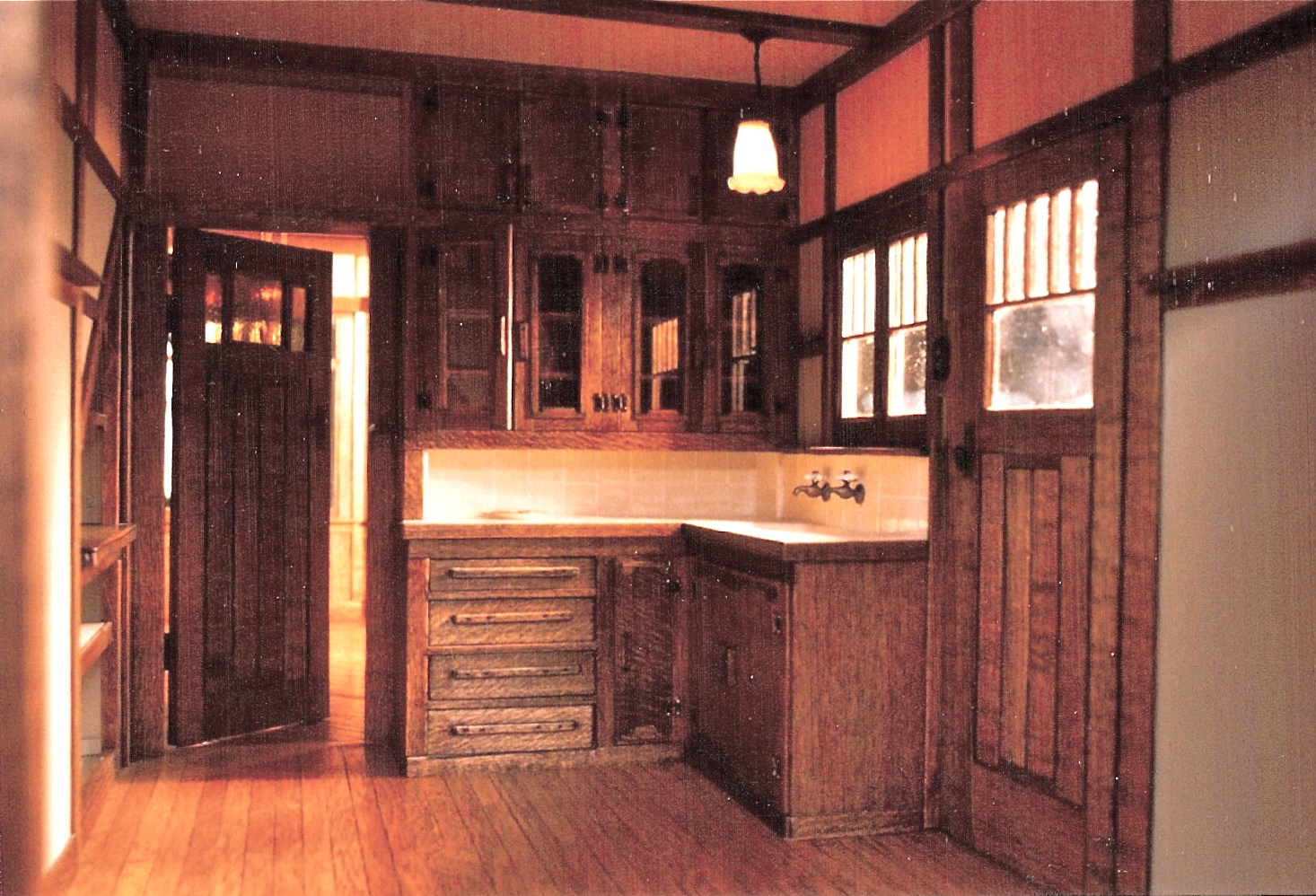
Bungalow kitchen

Each wall was designed and built like a piece of furniture. And, emulating the Greenes, the edges of every piece of stripwood were hand-sanded to a slight curve. The real trick was in getting the herringbone oak floor planks to line up through door ways and around corners. And, there were times we had to stop and re-figure, because a whole wall design would be out of balance with the rest of the room.

In the worktable photo you can also see the undulating clinker-brick base—another of the Greene’s signatures. We used plaster mini-brick, breaking and carving each one. The brick foundation segued into stone to soften the transition from house to landscape.  I’m not being facetious when I say it got really fun around the other side when we built the patio wall—

End view with clinker-brick wall

I loved the Zen of creating something so organic within the confines of the design.

As we worked, we tried to learn to think like Charles & Henry (as we came to call their ghosts, but not to their faces…) but often felt more like apprentices running around after them with our little brush and dustpan. They had been known to make their workmen tear out a whole day’s work if it didn’t meet their standard. Were they rolling in their graves, watching us slaughter their aesthetic?

Upstairs bedroom

Finally, we were satisfied the project was good, done, and ready to ship. We named it The Bungalow. Although it was decidedly a more Greene & Greenish bungalow than any other kind, we didn’t feel we could claim that association by name (by this time Charles and Henry were gods). But we remained bitten (and wanted more sushi!). Our mission was to find another customer willing to take on our dream of building a 2nd and larger bungalow, an adaptation of the Gamble House itself.

End Note: The Bungalow can currently be seen at The Toy & Miniature Museum of Kansas City.

Posted in Bio, Memoir, Miniatures | Tagged , , , , | 9 Comments