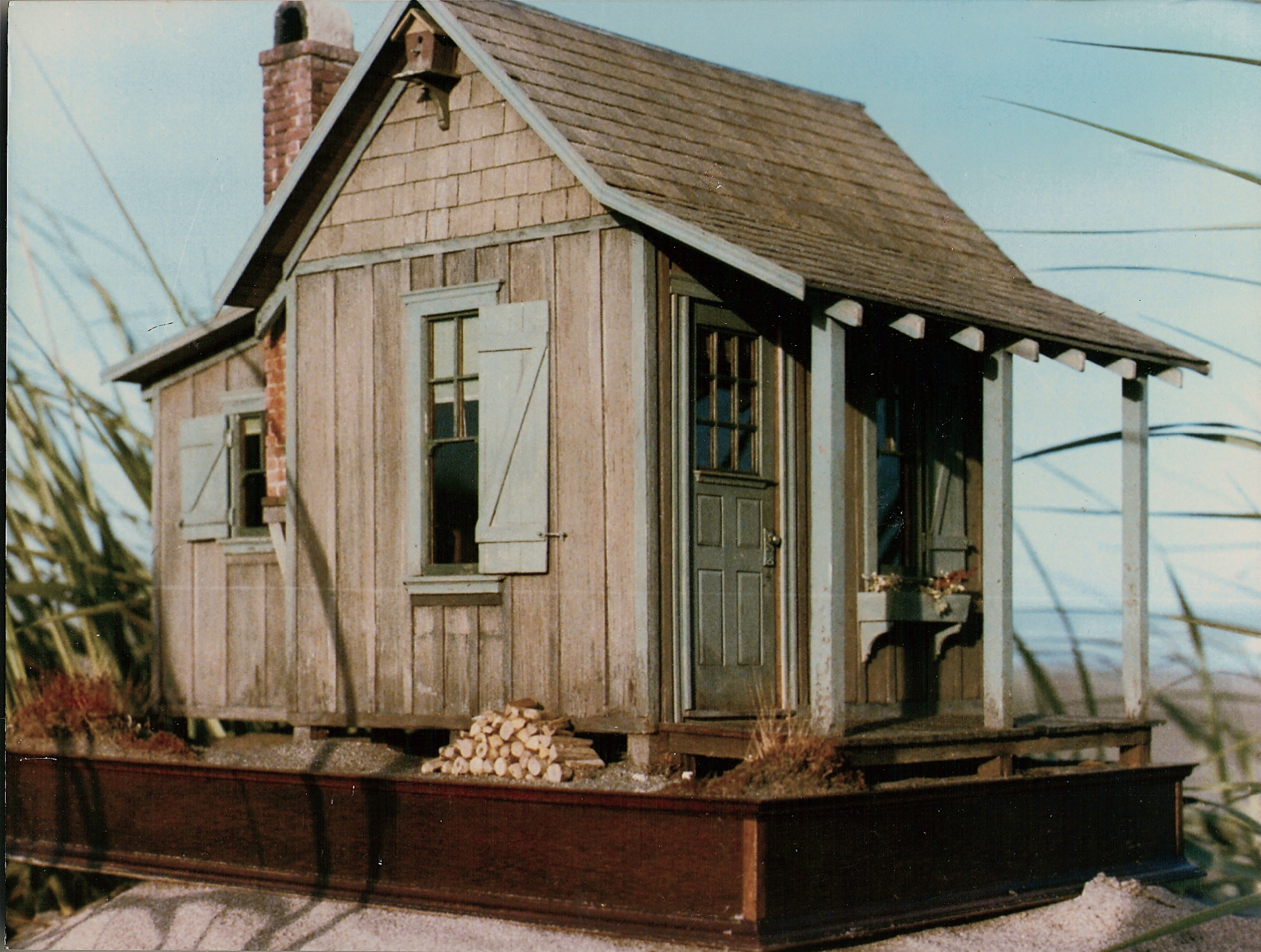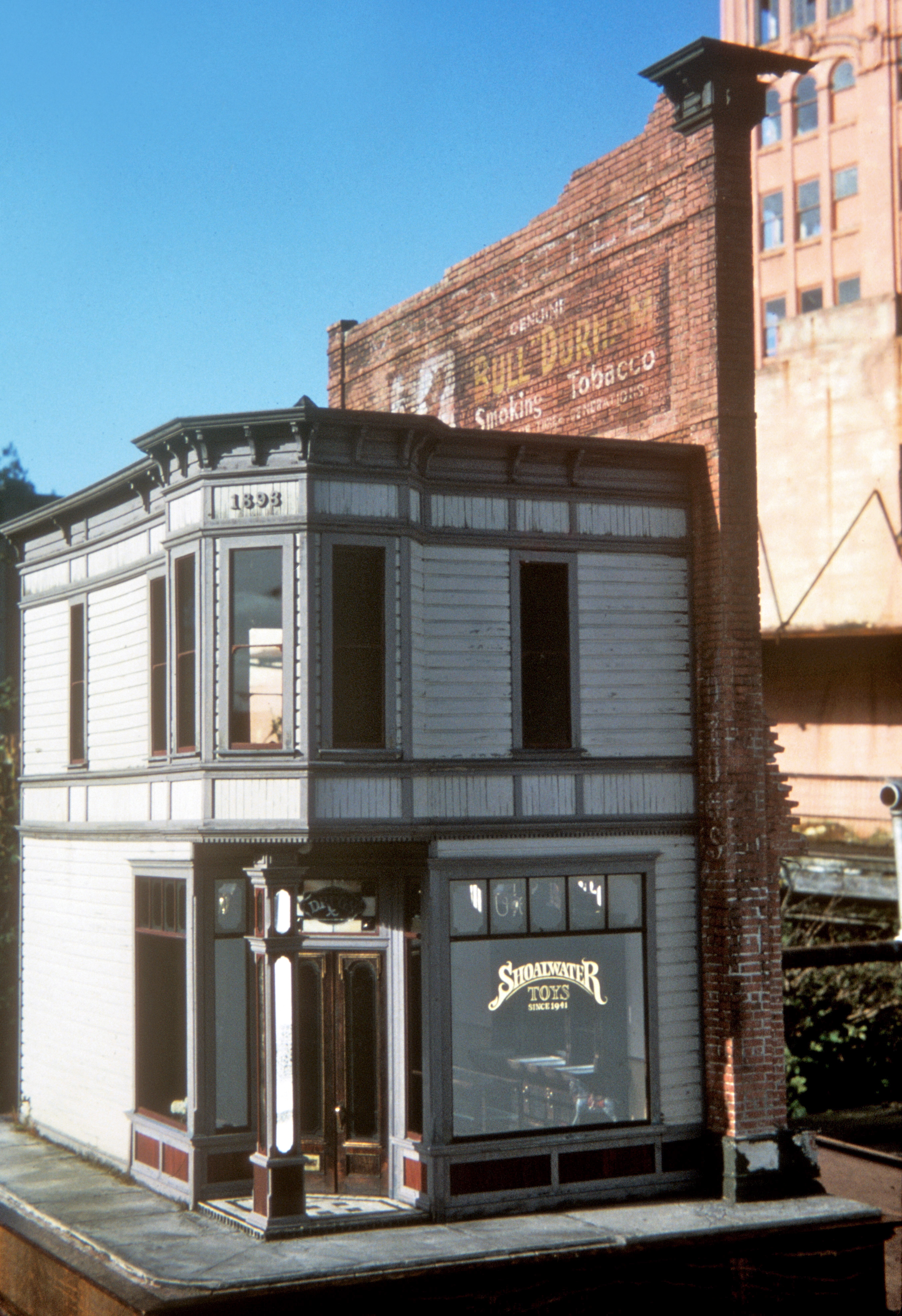
How to Lose a Dollhouse: Shoalwater Toys

Shoalwater Toys, 1983

A few weeks into the construction of Shoalwater Toys, our 30th structure, and 2nd and last major commercial building, we received an invitation  to show at the IGMA’s Guild Show in New York City. Until then, we had only shown on the west coast, and westerners comprised the bulk of our customers. We decided to commit to the show, and work like crazy to get the building done in time to be shipped by our art shippers across country from Seattle to New York. As always, we felt like we were jumping off a cliff—this was a big investment of time and money when we were living on a shoestring, trying to make houses fast enough to pay the rent, and still make each one a unique design.  The show date made for a tight deadline, and we weren’t even sure of what the building would look like. Plus, the buyer lived in Santa Monica, CA, which required a second cross country trip for our big, fragile baby.

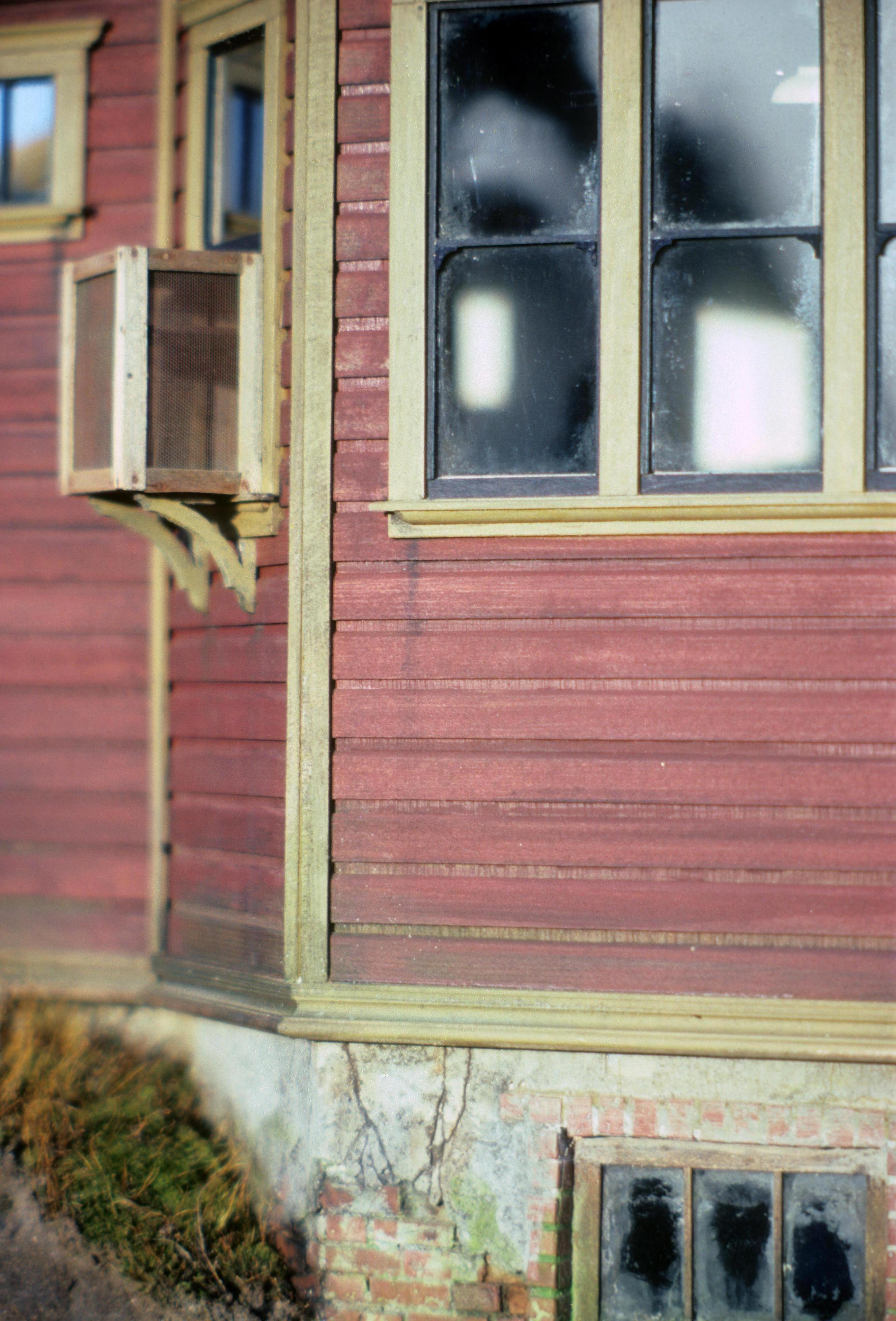
As with our first commercial building, Shoalwater Toys was inspired by the Victorian buildings of Port Townsend, WA, and gave us a chance to delve more deeply into sidewalk grunge, and how aging affects wooden siding, brick chimneys and signs, tarred roofs, gutters and downspouts. Noel also managed to squeeze a back alley into the design which gave my city-born heart a thrill. There is only one side left fairly plain, otherwise there are major points of interest on the other walls, and the roof.

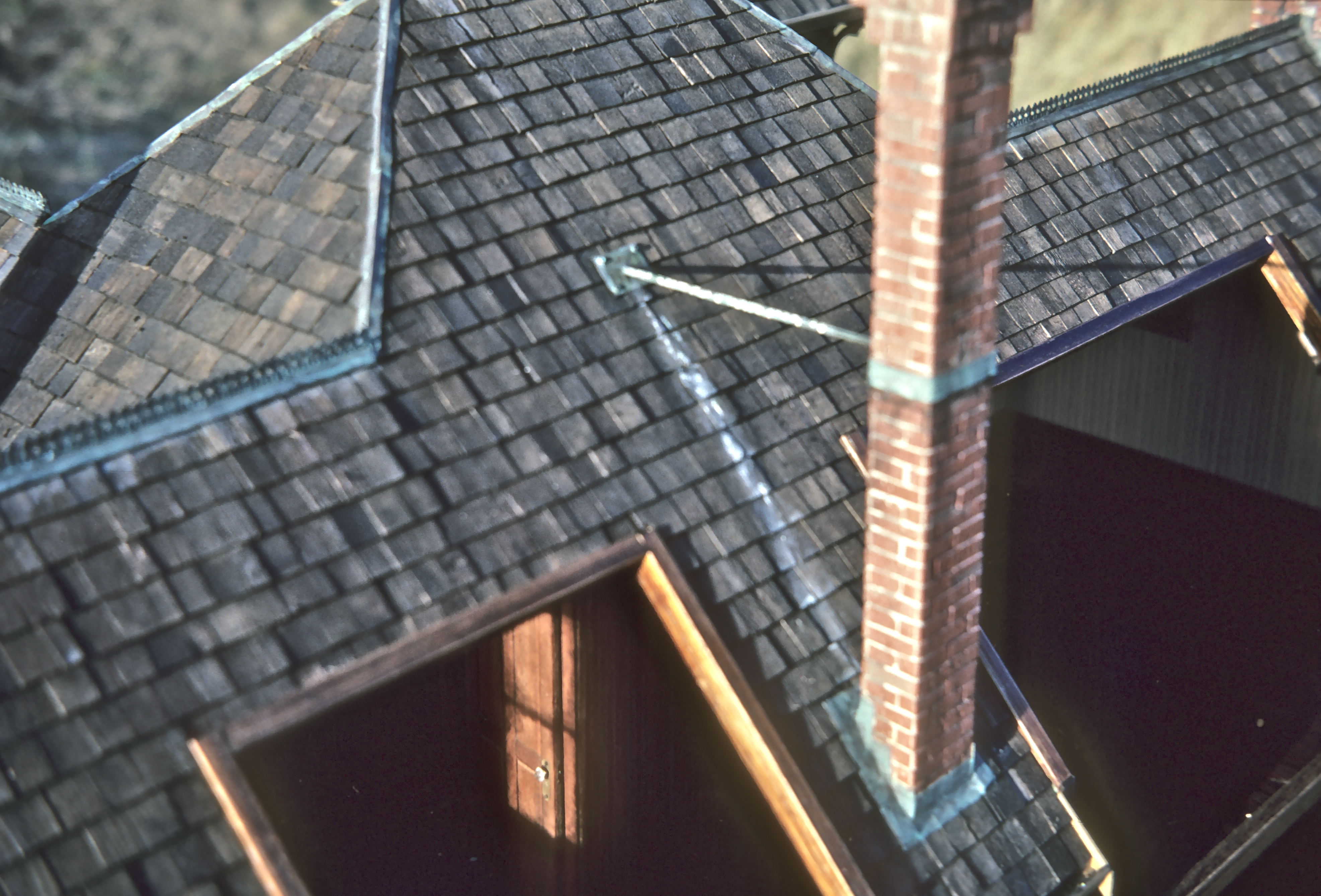
Having spent a couple of my early adult years in a Manhattan 5th floor walkup studio overlooking (and trying to sunbathe on) rooftops, I was ready to tackle the goopy mess that is a rolled and tarred roof. I laid strips of muslin with overlapping edge, glued them down with Elmer’s, and tarred the whole thing with asphalt patching goop. Later I went back to age it with acrylic washes and Crackle It, to give it a murky, uneven color, and texture to the whole.  I finished up by adding some trash and dirt to the corners, and was on to the back wall bricking. By this time I realized I was better at the grunt work—the somewhat tedious but (to me) relaxing jobs like beveling siding, gluing on thousands of bricks and floorboards, so Noel could go back in with his painter’s tricks and designer’s eye. On this building in particular, I provided the canvas, and he got to make it look pretty, in our trademark aged and sagging sort of way.

Not satisfied with a shingle roof on the cupola over the entrance, Noel made a glass roof, to bring in extra light. He also made an intricate copper-foil stained glass window transom-light over the front doors. The more jewel-like the entrance became, the more ideas he had. He gold-leafed the sign on the window, and etched the edges of all the glass. The final touch was the mirrored column on the leading corner. From there he turned 180 degrees to make the decrepit and rotten-looking back door and alley way inset on the back corner. The major back wall abutted what would have been the next building on the block. The top of the wall extends above the roofline, and what’s below is a torn-away view of the plaster interior wall of the other building. It also has a split in the middle so that whole wall can open up for access to the interior.
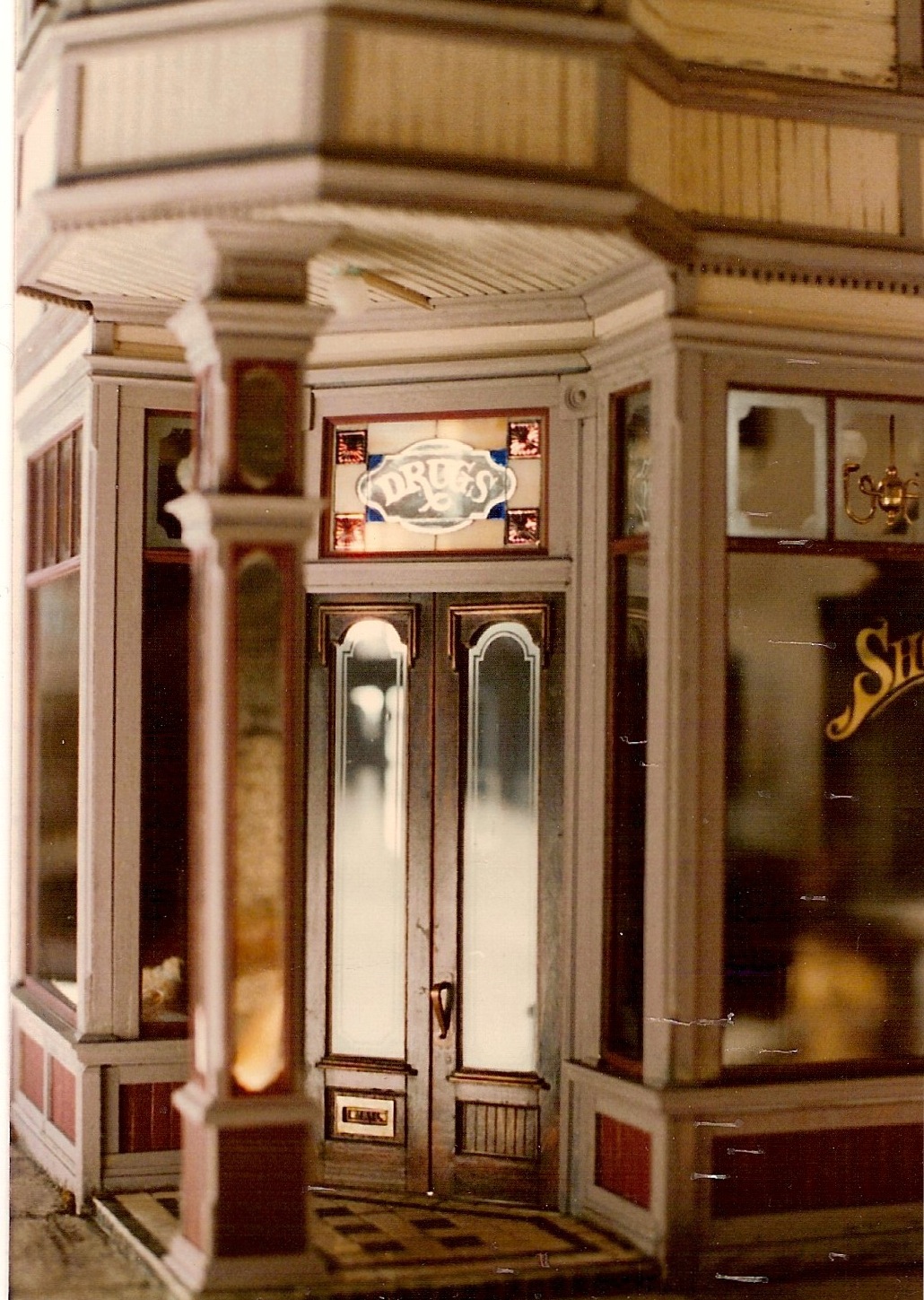
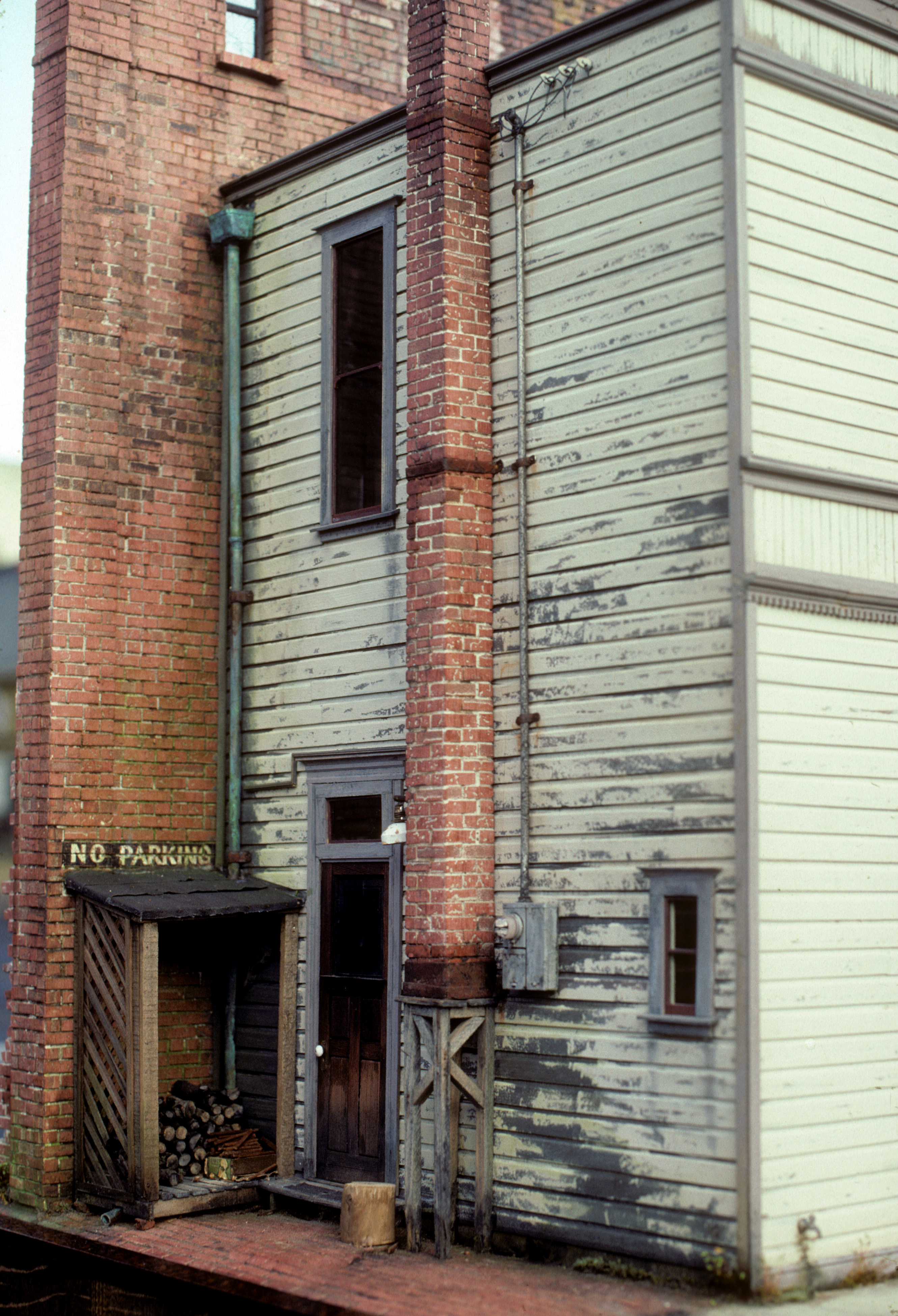
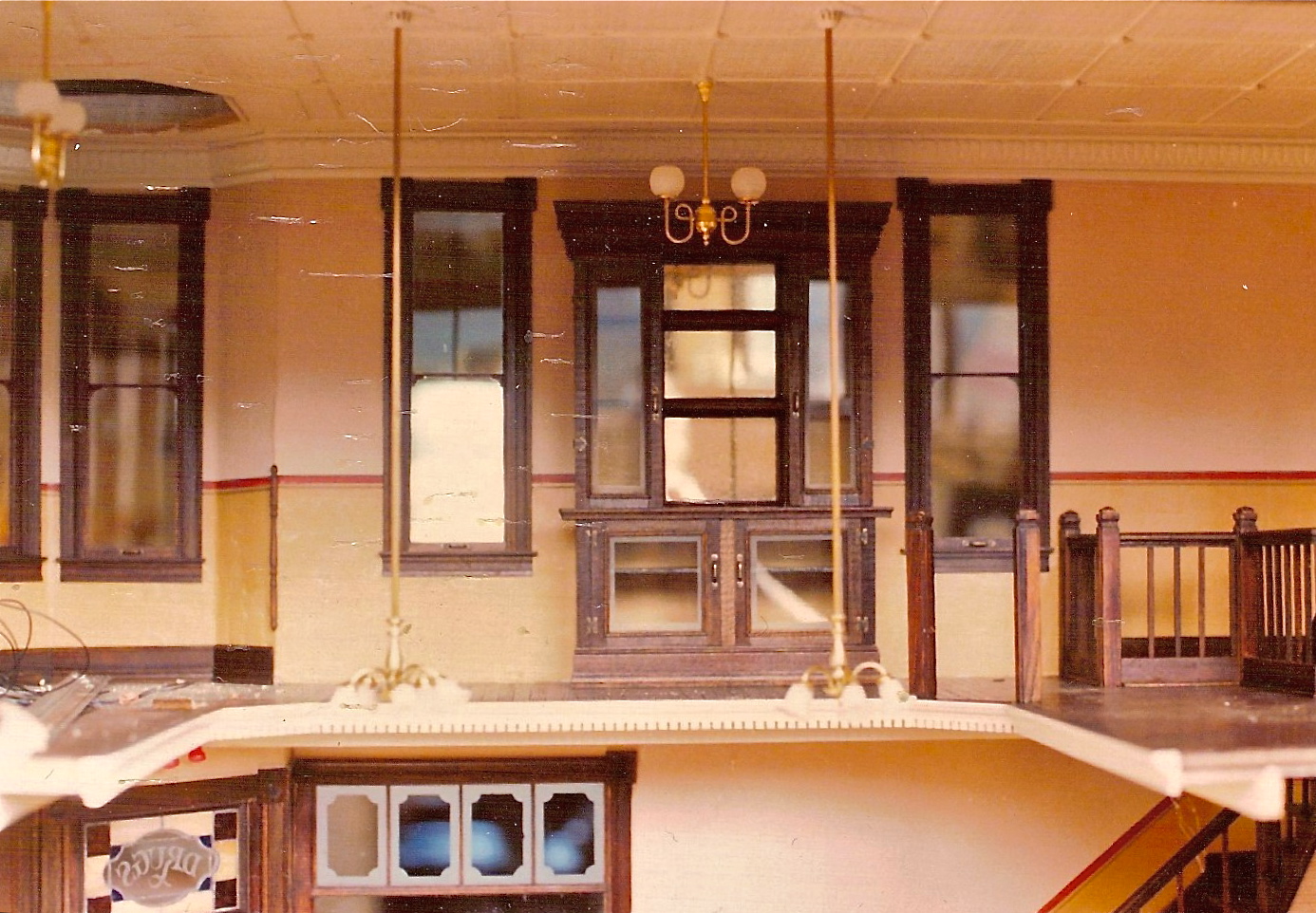
Mezzanine level

Inside, the building has a mezzanine, which is a little hard to see in photographs. It brought a lightness, as well as light, into the interior. As with the 20th St. Emporium, we used embossed cards for the “tin” ceiling, and laid stained ¼” fir planks for the flooring.

Main Floor

Finalizing the exterior, as with all our projects, was accomplished with “dirty water washes”—made with various combinations of burnt umber, Mars black, and raw umber Grumbacher tube acrylics, mixed to a paste and thinned to transparency with water. Basically a lot of water with a little muddy color. These thin washes we painted on with a #10 round watercolor brush, allowing each application to dry as we built up to the right amount of grunge. The final touch is the moss—added by dotting on Grumbacher Academy Sap Green directly from the tube onto moistened corners and shaded areas.
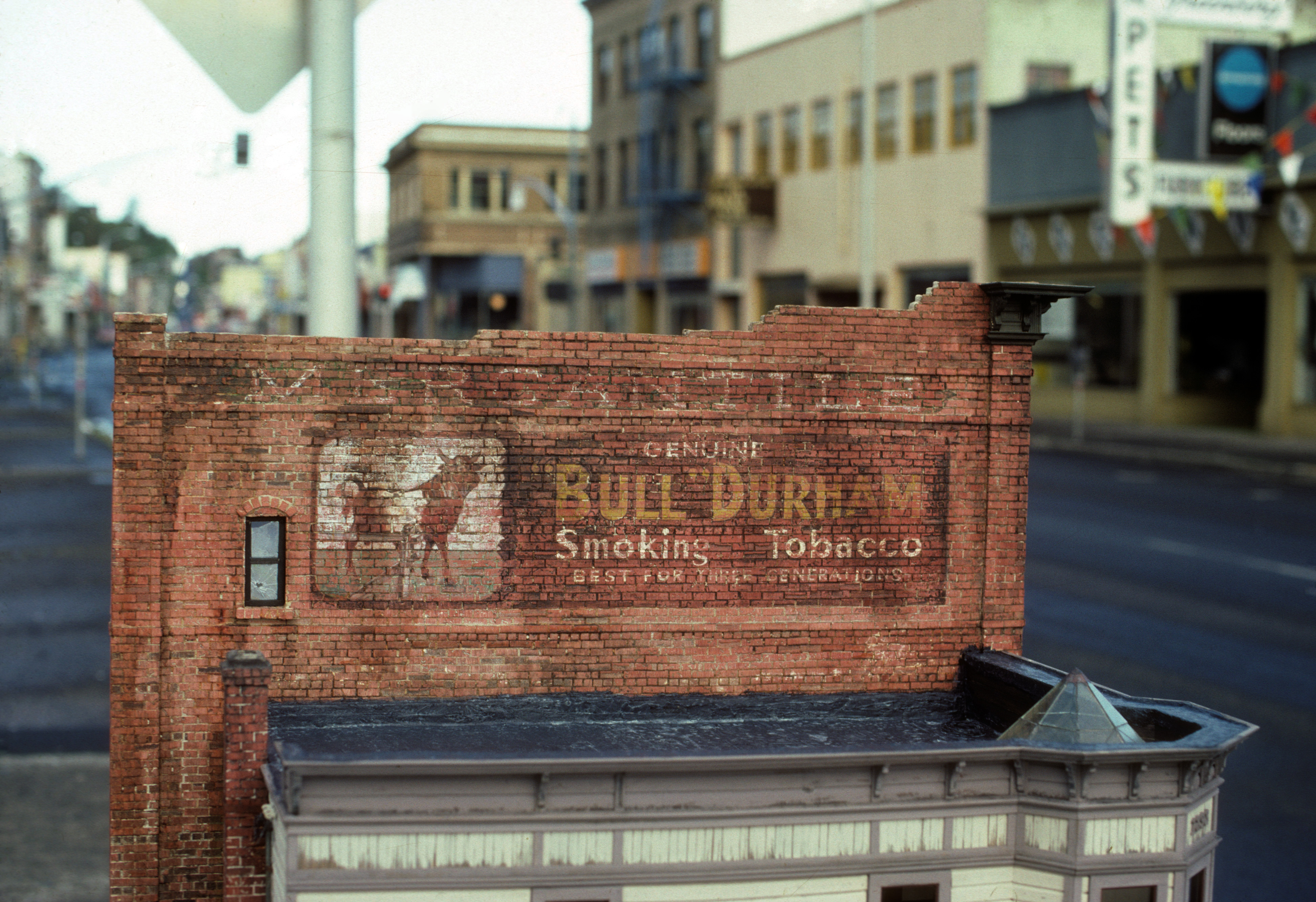
Rooftop detail with aged sign

The paint was barely dry before we packed it in the van to take its picture in our nearest city–Astoria, OR– for convincing backdrops. Aided by our ever-ready friends Roy & Gordon, we got it out onto the street about 7:30 a.m., with bike riders and pedestrians passing by on their way to work. It was the one time we shot a house that not one person even glanced our way, or asked about the miniature. From there we drove it to the shippers in Seattle. It was all a matter of 3-4 months from start to finish.
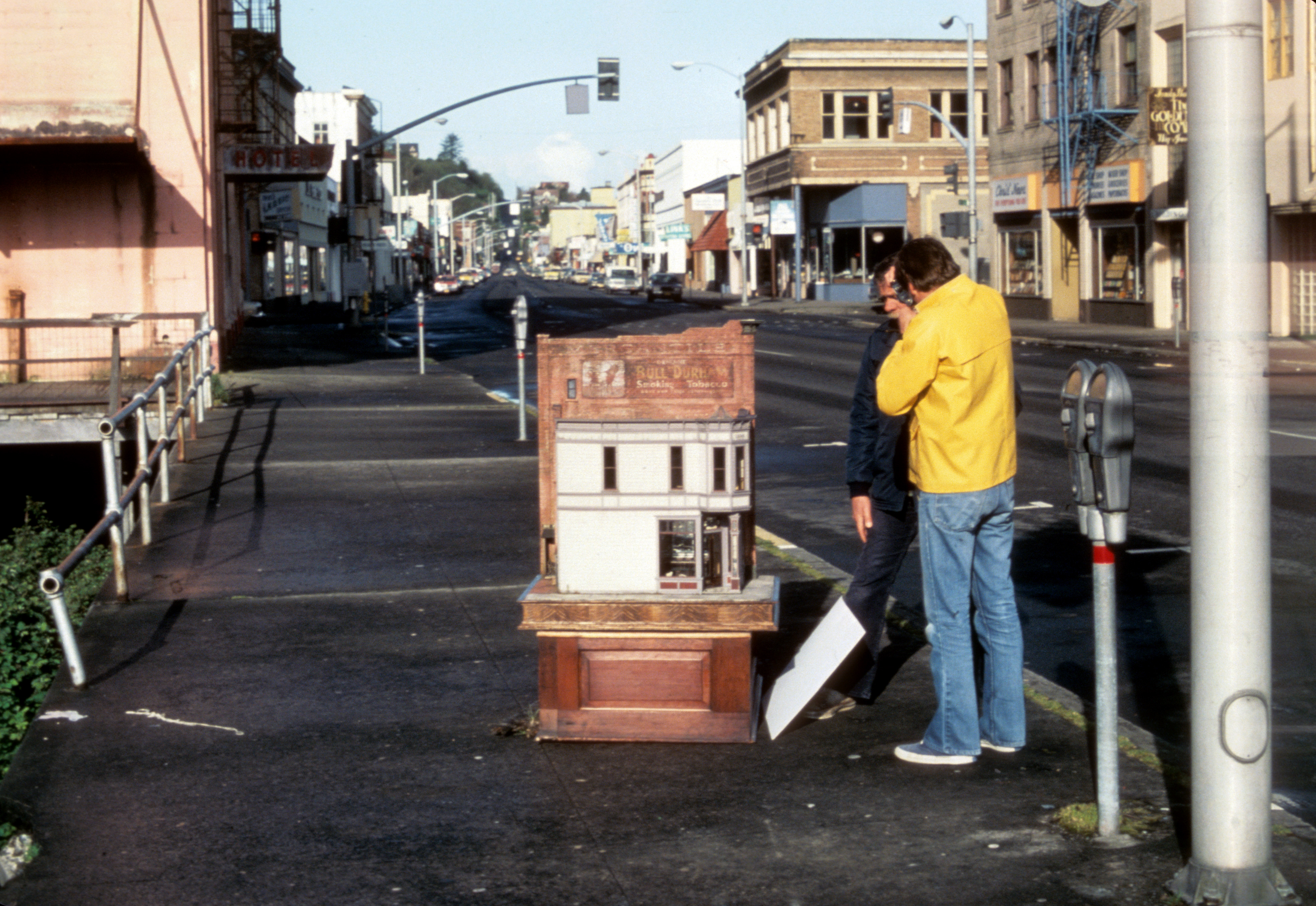
On site in Astoria

No matter how a project is packed and/or delivered, the transition process from studio to owner always set me on edge.  Artech, our art shipper in Seattle, had already delivered many of our pieces, so they were ready to crate and ship this one across country to the convention hotel. Their crates are wooden, and huge—the size of a small tool shed—impossible to ignore or hide, and hard to toss around. We kissed the building goodbye, and headed home to pack for our own trip to New York.

My first errand at the hotel was to find the person in charge of convention shipments. Alas, she had gone home for the night, but I was told “someone” would help us right away. With a crate that big, that’s like not knowing that an elephant was delivered. You can always tell when there’s real trouble—no one wants to talk to you, or make eye contact. All the “someones” knew nothing. A call to the shipper confirmed its delivery the day before, signature illegible—it was lost, or worse. My heart was in my stomach, while I was running “Don’t Panic!” through my brain. To make a long story short, sometime after midnight the janitor clocked-in, the man who knew exactly which basement closet the monster inhabited. It had been delivered, and stashed, but all was well. Eventually (we have no recall of re-crating it, but we must have) it made its way back safely to its new home in Santa Monica, and my heart settled back into its cave.

End note: My best news of this week is that the blog–Notes from the Studio: from Bug Juice to Bird Poop–is going to be translated into Russian for a new website introducing the people of that country to miniatures. Welcome, and Добро пожаловать (Dobro požalovat’)!
Posted in Miniatures | Tagged , , , , | 3 Comments

North Cove Rear View

North Cove Kitchen rear view

By request, here’s the rear view of the kitchen in the last post, to better  show the layout. Not the greatest shot, but it gives you an idea.

Posted in Houses, Miniatures | Tagged , | Leave a comment

North Cove Kitchen: Geek-to-Geek

It’s always startling to discover which world-changing events whirled past while we were holed-up building miniatures. The construction of our second project of 1983 coincided with the introduction of the mobile phone, the creation of the internet, and the release of the first Microsoft PC, events which went unnoticed in our studio. We did, however, watch with great anticipation the maiden flight of the Space Challenger while laying brick and beveling siding for the North Cove Kitchen.

The North Cove was a single-room structure, an imagined and rather ornate outbuilding, or ell, containing only a kitchen. We took a liberal view of its era, utilizing elements of Cape Cod as well as early 1900’s beach architecture. Many of the details we chose because we felt an emotional attachment to them. Jogged by memory, circumstance, and because we had the time to focus on a single room, we played with the project without worrying much about historic accuracy. Looking back, I see that this design was the precursor to our future teaching projects–the Beach Cottage and Garden Shed.

Wood stove & water tankInside, Victorian rondells embellish the door and window framing. The stove, made of plywood, cardboard and miscellaneous metal findings, was built into a Colonial-inspired fireplace.  Noel created an elaborate plumbing system connecting it to the copper water heater that would have supplied ample hot water for an entire house.  He also built in an inside-outside drawer for loading wood for the stove.

Wood-loading drawer

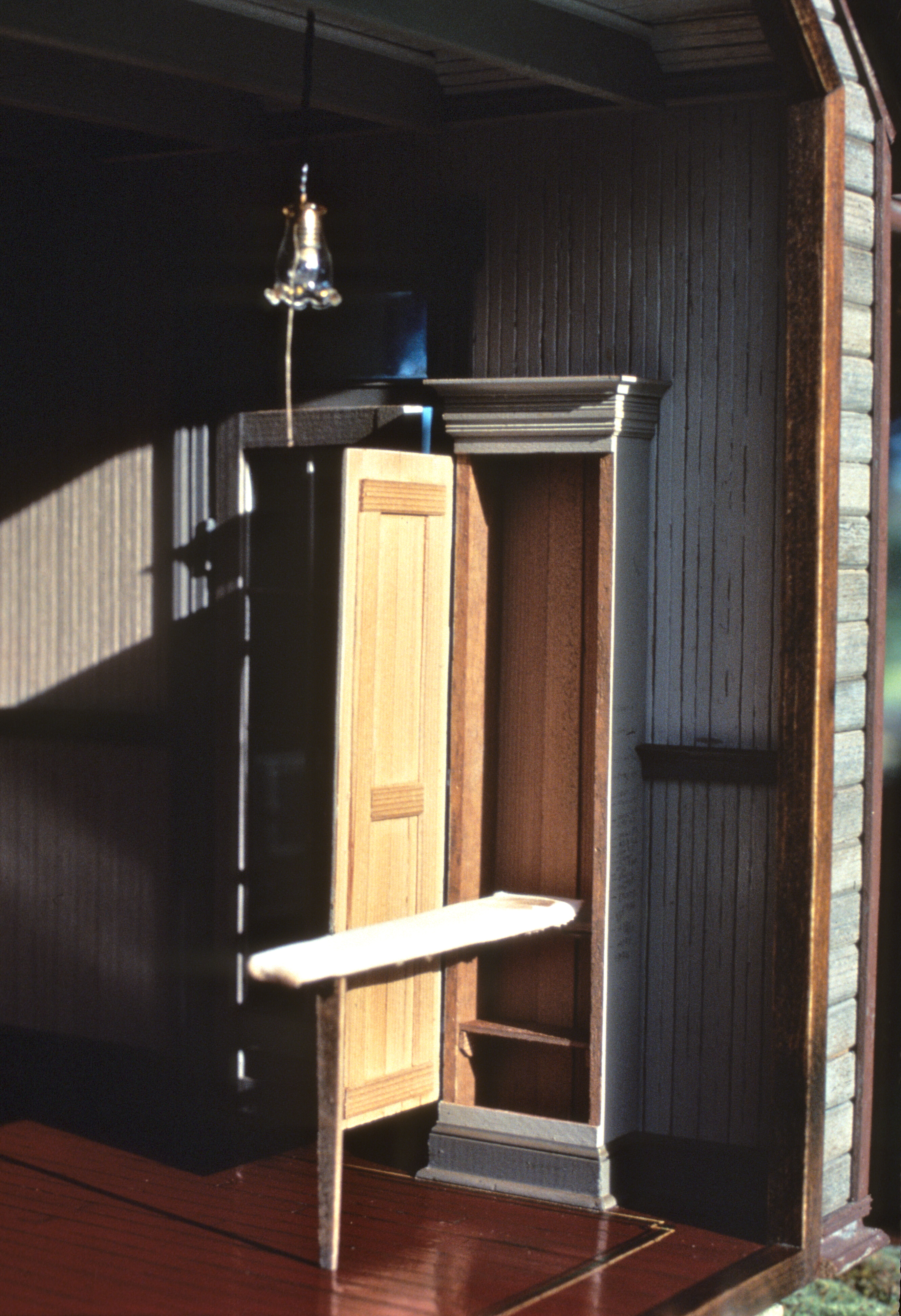
The project  includes a working ironing closet, similar to one I had in an apartment during a brief stay in Georgia, a detail we also found in Washington State beach cottages. As a child I loved the smell of steam ironing, or maybe it was the residue of line-dried laundry, so we made a tiny iron with which to scorch the home-made ironing cloth on the board.

The chimney is elaborate enough for a mansion—again because it was fun, and we knew how to brick. And we went a little overboard on the working cupboards and drawers in the butler’s pantry. My grandparents had a similar pantry in their 1920’s Dutch Colonial—a narrow hallway of sparkling glass, small panes, and mysterious drawers.Butler's Pantry And, in the spirit of leaving no quarter untouched, we made a crawl space above the kitchen, stringing electrical wiring around porcelain insulators (a pin and two small beads), and insulated with our miniature newspaper. The original, full-sized newspaper was discovered by friends, lining the bottom of an old pull-out couch. Another friend, Rick, the local printer and born tinkerer, decided to see if he could recreate a readable paper in miniature on his press (even then, so old it was almost an anachronism). He could, and did, printing out 3000 sheets on cut ends of aged newsprint.

While we mini-geeks were at home recreating the past in miniature, Rick was building the future—his first computer. He asked us and some other friends to stop by one night to see what he was doing. Like a kid with his first toy train, he explained the wonders of computer circuitry in incomprehensible techno-geek language, astonishing us with the scope of information that could be stored on a small square of plastic. Noel, caught up in Rick’s enthusiasm, sent us to the floor with laughter when he blurted out one of those classic reverse compliments you will be reminded of forever by friends and family–“Compared to miniatures, Rick, this is nothing!”

The North Cove & Friend

Posted in Houses, Miniatures, People | Tagged , , , | 3 Comments

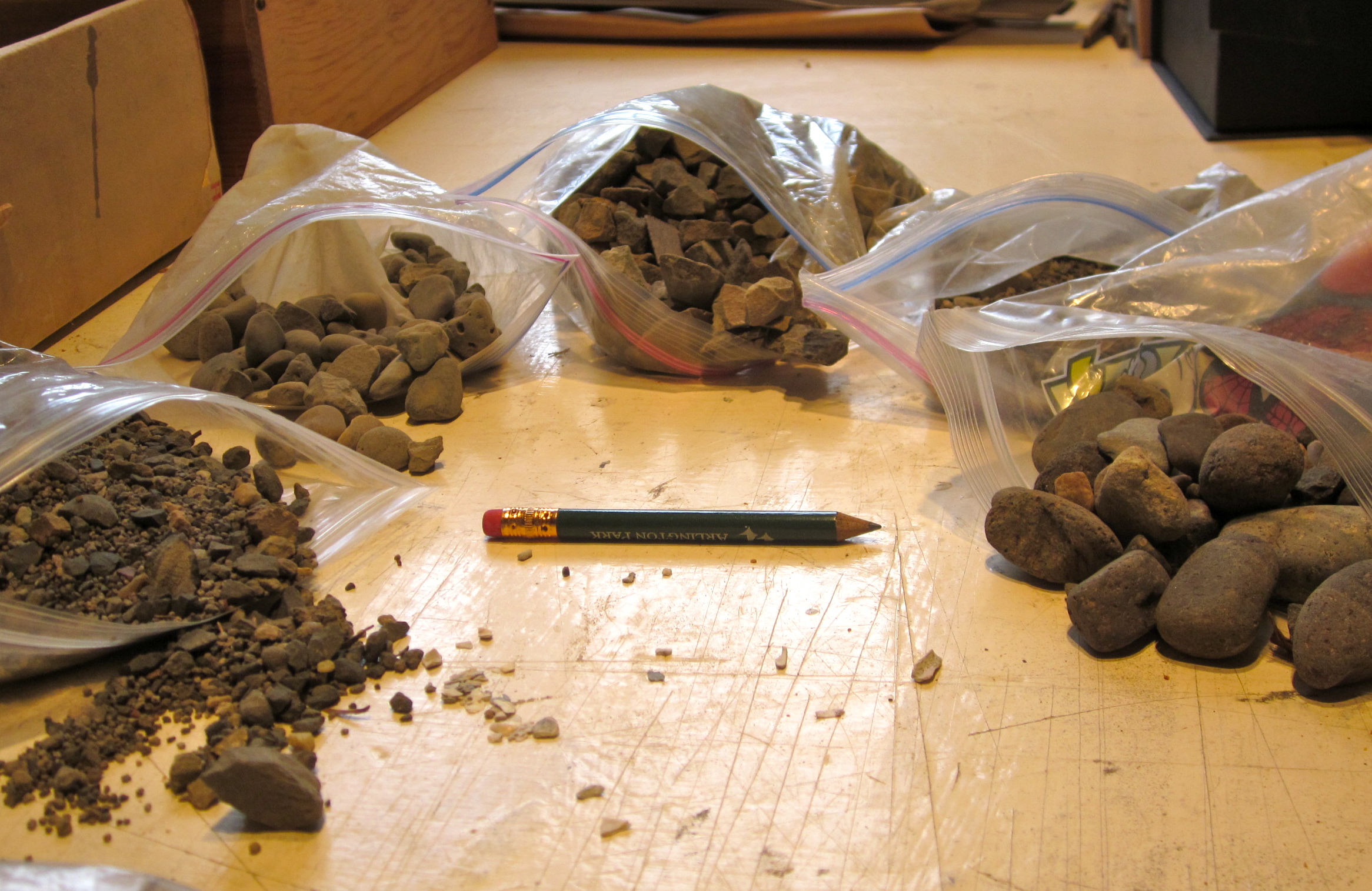
Hoarding, or, a Miniature Builder’s Suggested Inventory:

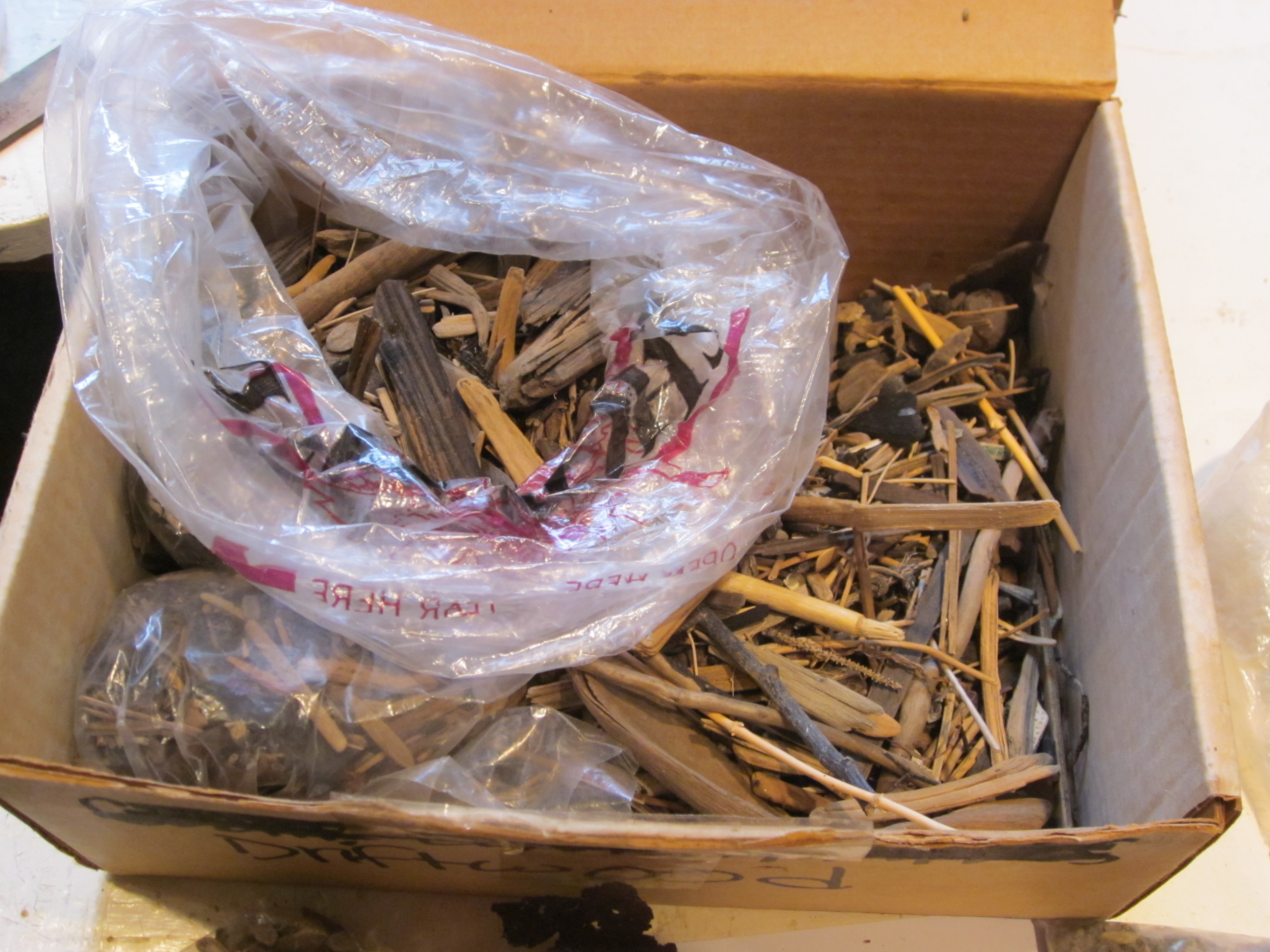
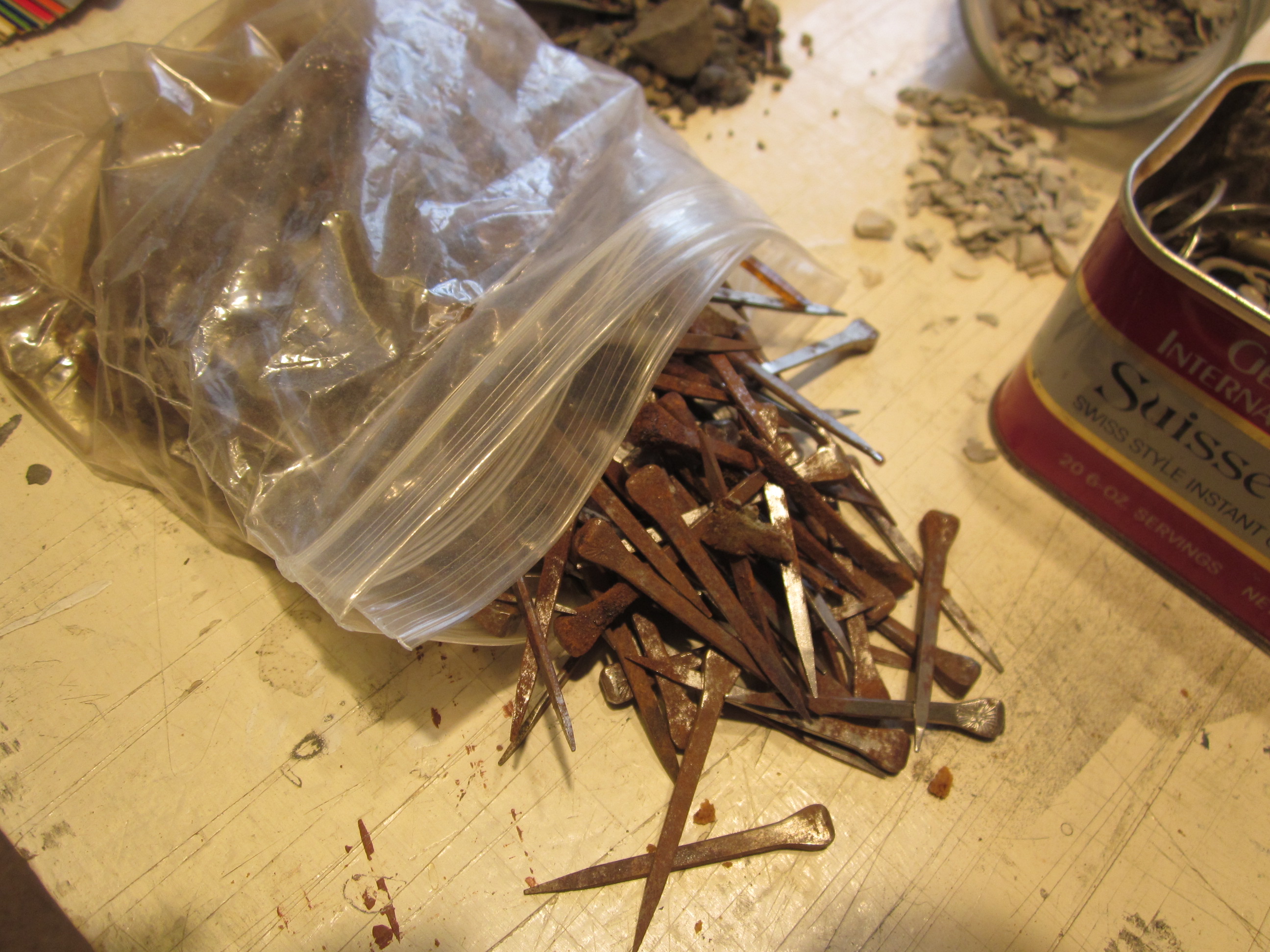
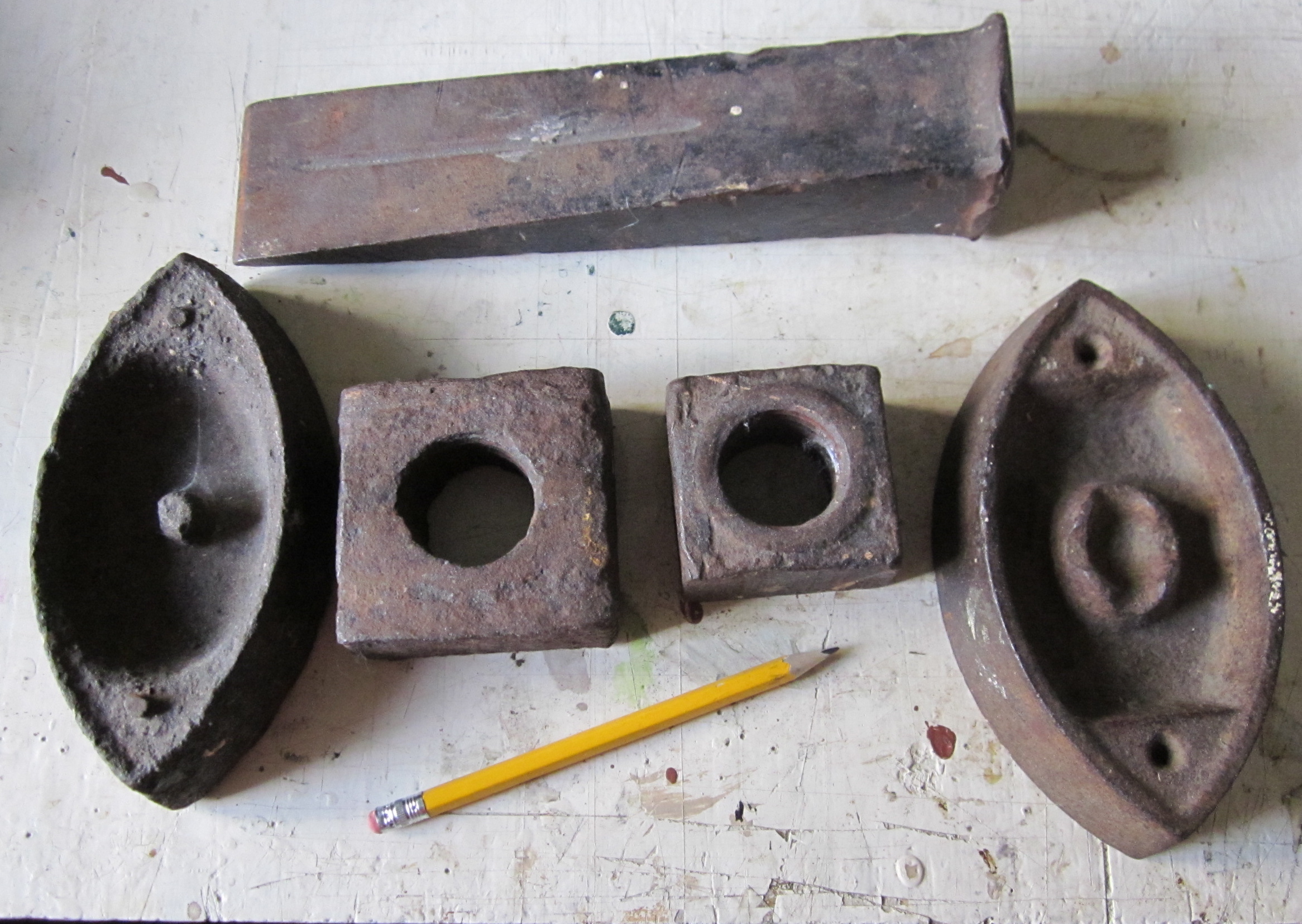
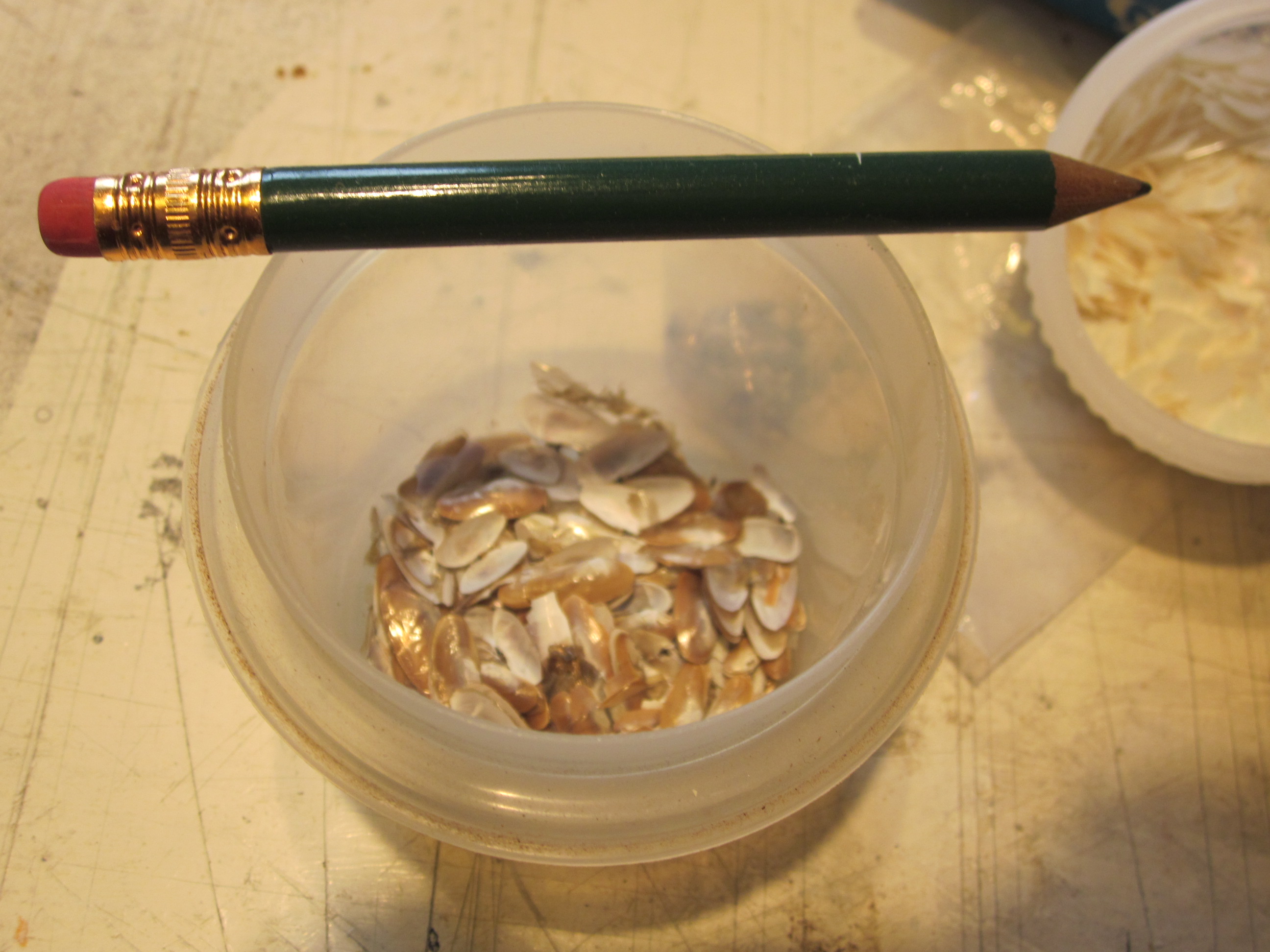
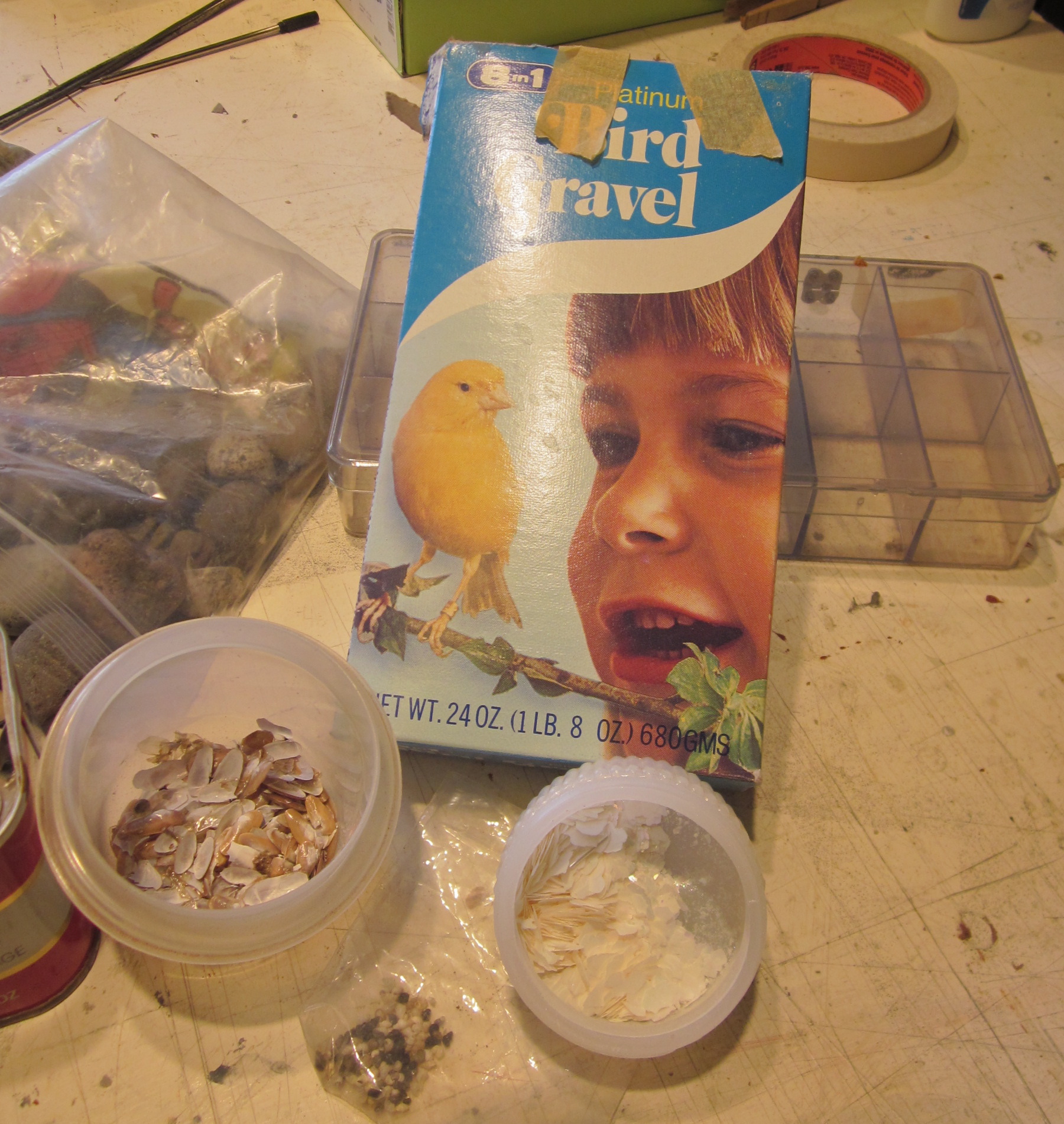
Mini driftwood broken sorted by size, mini stones, gravel and pebbles, beach sand, bird gravel, mini bricks and seashells, 1 coffee tin beer pull tabs, rusty metal, rust dust, real-world-sized rusted wood–splitting wedge, railroad spikes and flatirons, baby bird head-feathers (don’t ask), cigarette ashes, dental drill bits, horseshoe nails, dried creeping thyme, 4 lbs. of brass pins a millimeter too thick for sewing, and copper screen sections too small to be useful.

In a burst of energy the other day I emptied 8 boxes of mini supplies into, 1: the wastebasket, 2: the Find Someone to Send These To pile, and 3: the I Can’t Decide box. It’s a system I developed a few years ago while dealing with family bric-a-brac after my parents died. My project has been to go through at least one box a week, family or mini. Long ago our mini supplies outgrew the studio and workshop shelves and drawers, and spilled into coffee cans, pickle jars, and baggies to be shoved under worktables or stacked in the garage. Twelve years ago when we left Seaview, WA, I packed this overflow into small, tidy boxes, labeled them, then unpacked them in Astoria onto the shelves of what would have been our pantry. Many of them remain unsealed today.

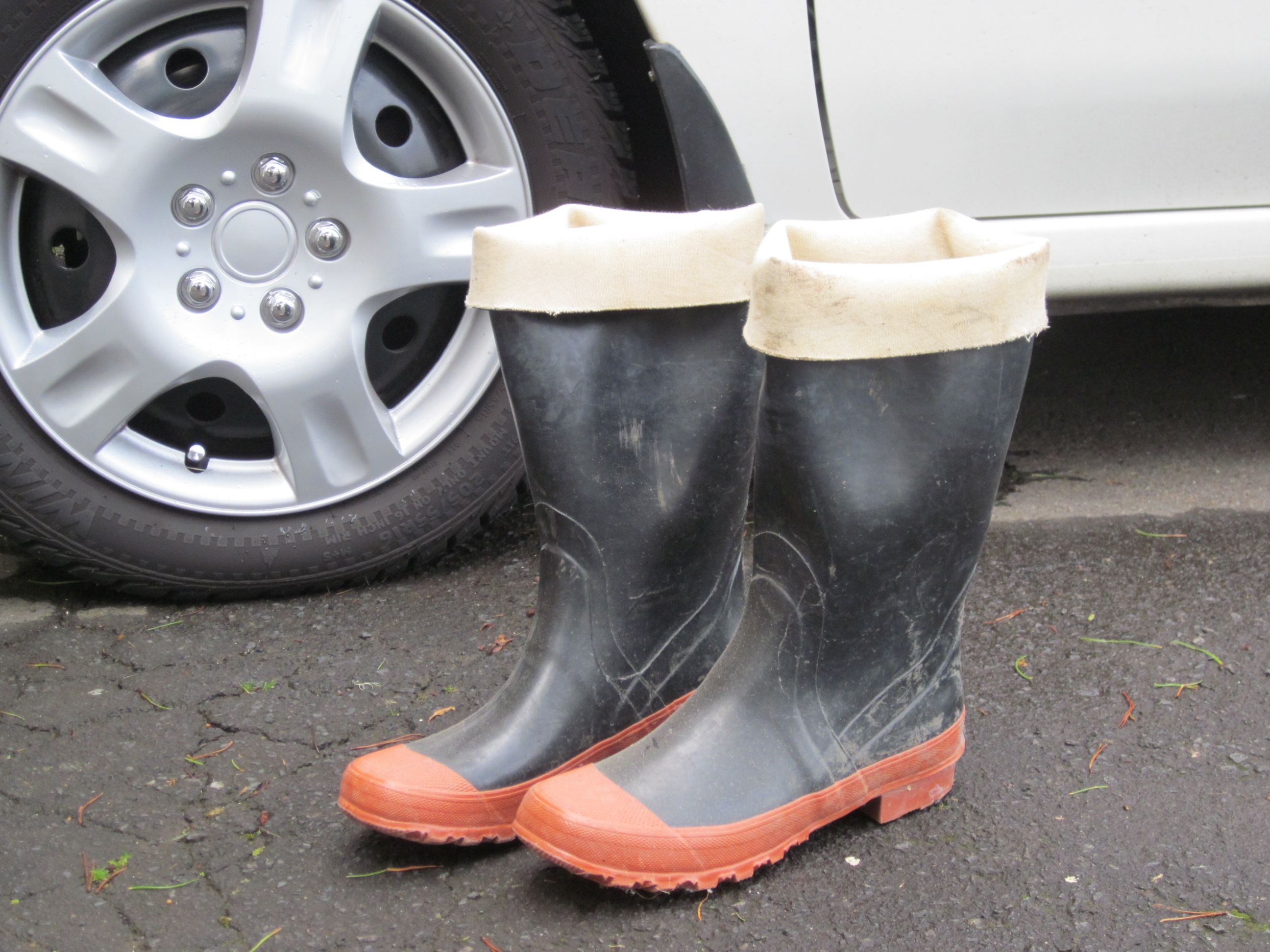
This inventory shouldn’t surprise any of you who know us as miniaturists, because we’ve been handing out this essential stuff  in our workshops for years. Hoarding is an affliction passed on to me by Noel. Back in 1971 when he took me camping in So. California at the then-remote Kern River, he began carting home the rusted tools and unidentifiable iron chunks we found in the rattle-snake-infested hills. These chunks moved with us, the cats and the plants, from Los Angeles, along with an old and particularly stinky bag of vacuum cleaner dust (because it had the right odor for old attics). Noel discovered the treasured vacuum bag one night en route from LA to Seaview when we were cleaning up kitty litter from a motel carpet.  One day a year or so later, Noel arrived home from the dump—in those days we still had open dumps–with two blue-and-white speckled washing machine tubs—“Here,”  he crowed, “strawberry planters!” I made him take them back. He came home with a pair of rubber boots and a rusted-out coke machine he traded right off the back of some other guy’s truck.

In an attempt to exonerate ourselves from accusations of blatant hoarding (we like to think of ourselves as Collectors), the aluminum beer can tabs were cut down for various appliance handles (imagine oven doors), the feathers were glued to our birdhouses, the cigarette ashes rubbed into Johnson’s Paste Wax to age flooring, the horseshoe nails used to anchor tiny pieces of glass for soldering stained-glass windows, the flat-irons and spikes to weigh things down while glue dried, and the bird gravel was glued over emery cloth to make a white roof for the Whittier, a So. Calif. bungalow. I never did find a use for the brass pins—they caught my eye in one of those surplus catalogs, and cost practically nothing…

Bug Juice Bucket

Fact: The big rust became the basis of our Bug Juice brewing business, and we had to gather more when that was eaten away by the vinegar.

Fact: Noel  used the boots for washing the van, and cleaned up the coke machine for our front porch.

Fact: When we left Seaview we filled two big Dempsey Dumpsters to overflowing*.

Fact: I moved some of the stuff I threw away the other day from the wastebasket to the I Don’t Know box.

* Bob, the guy who built our miniature kits, took our dead couch out of the Dumpster and moved it into his living room. Yes, he lives alone.

Posted in Miniatures | Tagged , , , | 13 Comments

Image

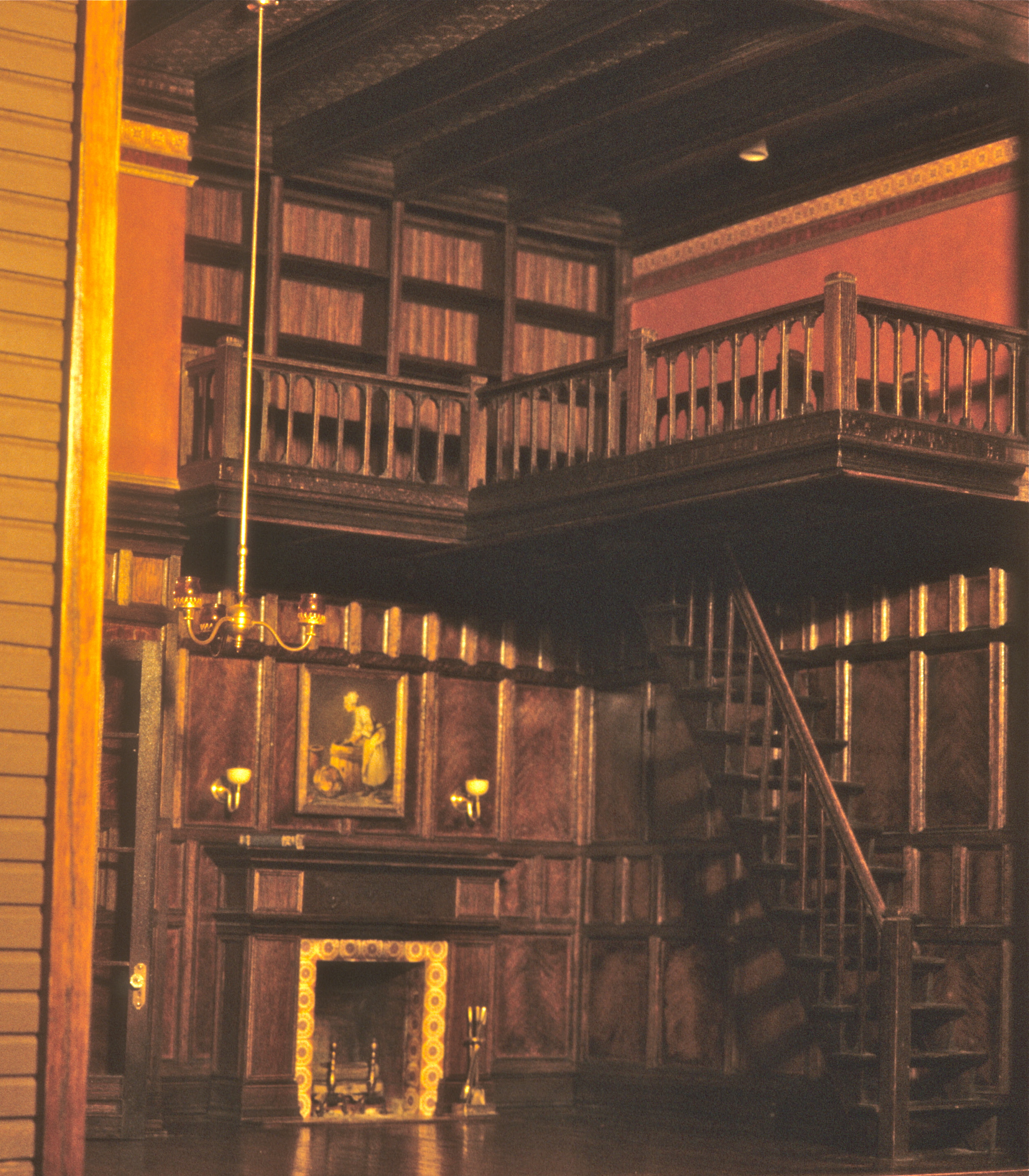
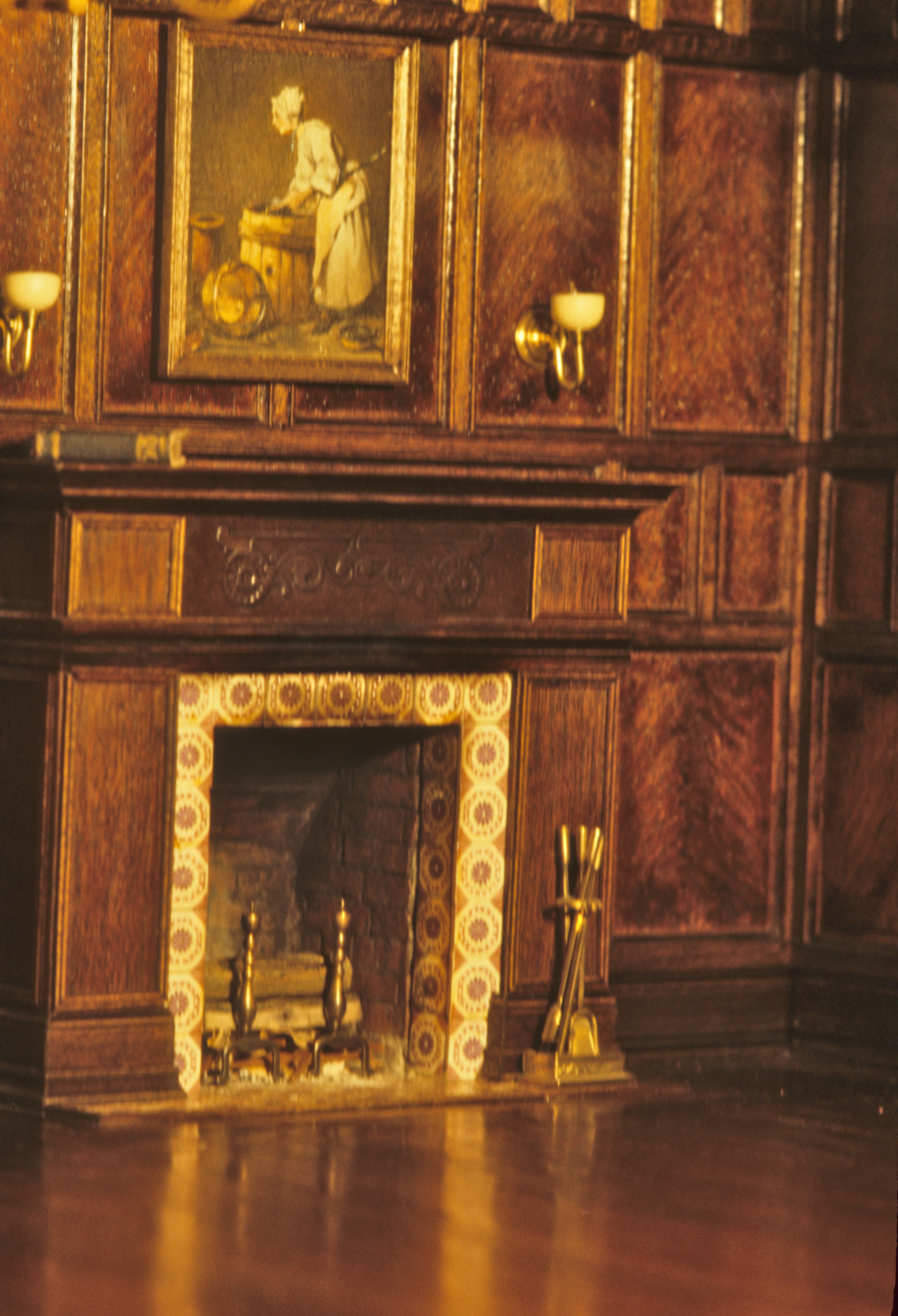
“One day I’d like a small piece of your work.” Those words floated above our work from somewhere in the mid-70’s until 1982. They were spoken by Marie Friedman, one of the finest miniature craftspeople we would ever meet. She worked in glass, metal, leather, porcelain, all in incredibly fine detail. For years Marie built our mini-light fixtures with hand-blown glass shades, set in brass fixtures she also made, and wired, but she always refused our money in exchange. She also made us chandeliers and sconces with cranberry glass shades—the color comes from gold oxide being mixed with the molten glass. We couldn’t use her miniature porcelain dishware, so she made porcelain tiles for our floors and fireplace surrounds. She just enjoyed being part of our work. Every time we asked about what she wanted, she’d just smile and tell us not worry about it—she’d know someday.

During those years we got in a lot of long evenings of conversation over dinner (many cooked by her husband Norm, who made superb, fresh and off-the-grid Chinese dishes) at her home in Portland, hoping to coax a project out of her. Finally, in early 1982, she asked us to Portland to see her latest creation, a graceful, cranberry glass chandelier, each shade framed in gold filigree, hung from a long brass stem. And she had a box of tiny tiles, each embellished in a cranberry and gold design. She wanted a library room to house her chandelier, with a fireplace bordered in the tiles. She thought some dark wood paneling would be nice, too, but the rest was up to us.

            We loved the idea of tackling a single room—the trouble with building houses was that the exterior work always predominated, and this time we could focus on an interior. Of course it had to be a spectacular interior, up to the standards of Marie’s meticulous work. And, this smaller piece was just the breather we needed after having spent two years creating our three most elaborate Victorians. The paneling would make the room dark, we didn’t want a window in a library, and couldn’t light a fire in the fireplace, so our focus became using every possible means to create warmth and bounce as much light around as possible. I always thought formal libraries should feel warm and inviting, like well-used gloves, and I wanted to make that in miniature.

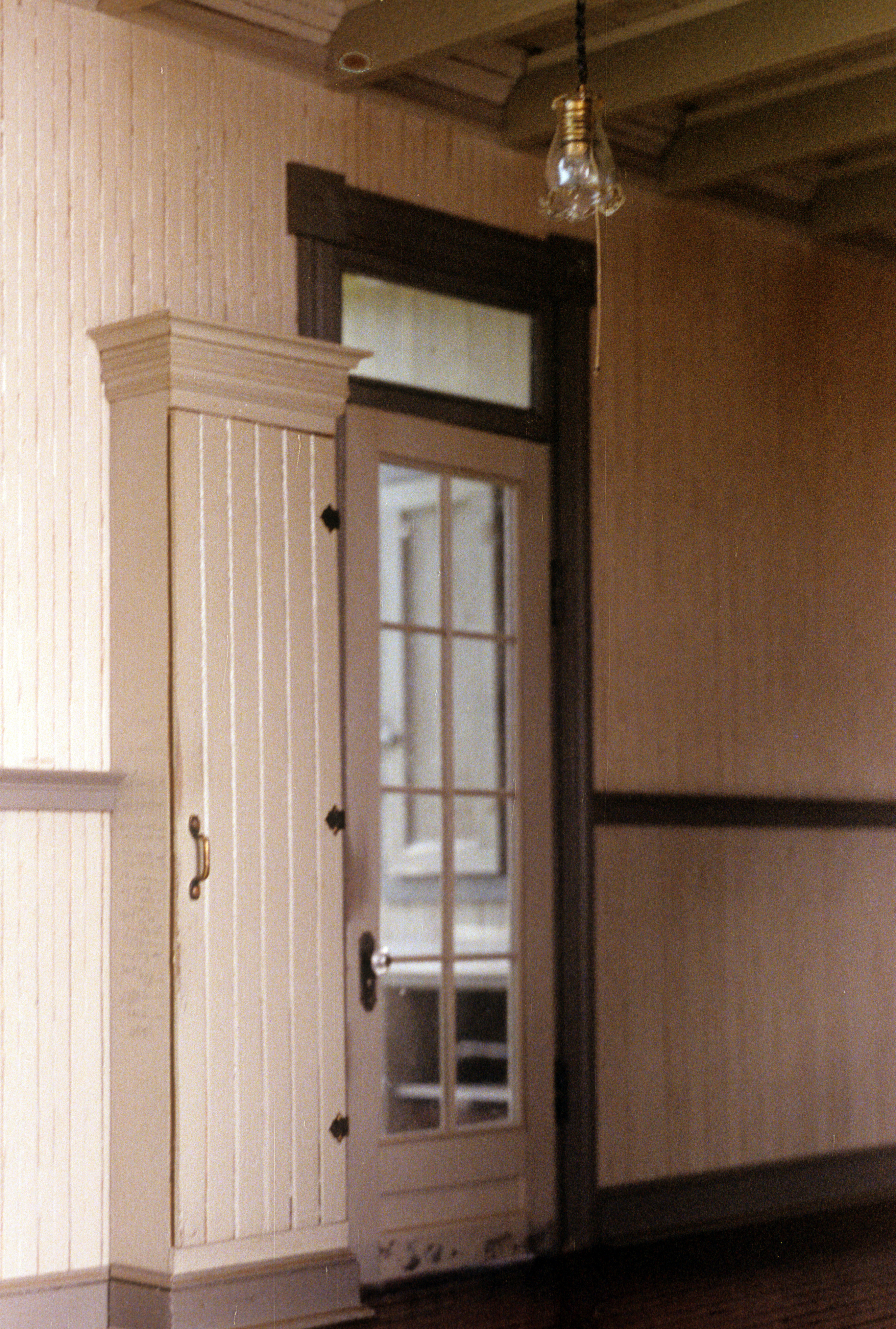
In lieu of a  window in the room, we stole a Eugene Kupjack trick by having a door at the back of the room, open to a hallway with a copper-foil stained glass window, which we could light from in front and behind. Noel spent a lot of time on that window, working to build something that would compliment Marie’s chandelier without detracting from it. The door, too, is glass, again for its reflective quality as well as transparency.

Initially, for the upper walls, we decided on a light-reflective wallpaper above the dark paneling—an antique off-white with a silver design. The paper also surrounded the upper gallery of the room, drawing the eye up the stairs. Years later, after Marie’s death, when this room was acquired by another collector, she asked us to re-think the wallpaper—she thought it didn’t fit the room. After we settled down our bristles, we realized how right she was, and went back in to paint the wall a deep cranberry, ragged on so that highlights from the original paper would show through. Then we bordered it in gold, and the whole room bloomed into what it should have been.

To make the wood paneling, we used basswood, which Noel faux-grained– with thickened dark oak stain–to look like an exotic hardwood. That way he could control the grain, and we wouldn’t have to buy a lot of wood from which to select just a few usable pieces.  With a few exceptions, all the rest of the woodwork is basswood. The exceptions are the oak plank floors bordered with purchased inlaid banding, and the oak framing the fireplace. The inset under the mantel is one of those embossed business cards we used for the tin ceiling in the Emporium, this time stained in dark oak. One of the hardest parts was aging Marie’s tiles, for fear of ruining them. She laughed at the thought, saying, “I can always make more. Do your worst.”

Marie seemed immensely pleased with our “worst,” and we celebrated the completion of the project a few months later over yet another of Norm’s spectacular Chinese meals. That was the night she announced she’d decided to give up miniatures for a new love—the study of Chinese language and culture, in China. She died of cancer a handful of years later, but only after spending enough time in China to learn multiple dialects, and “adopt” several Chinese students who came to college in this country. She lived a fuller life than most. My only regret is that she didn’t get to see the library in its best incarnation, with the deep cranberry walls.

Posted on by smallhousepress | 1 Comment

The Octagon, Part II: Working the Puzzles

Noel's drawing of the proposed Octagon miniature house

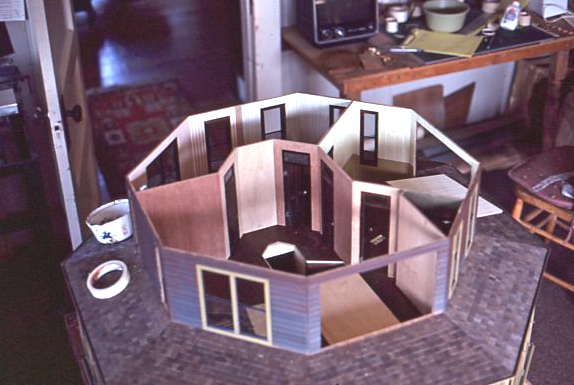
Thanks to one of your comments, dear readers, I combed our slide files and found a paltry handful of Octagon interiors–just glimpses of rooms under construction. The dearth of interior shots is a mystery, as we normally cataloged our work as we went. Obviously the puzzle of this house had us so entwined we forgot to shoot the finished interiors. Noel says it’s because the octagon shape demanded we keep most of the outer walls intact.

first floor interior

Interior access is mainly through smaller hinged window sections, too small to get a decent camera angle. Plus, the house was shipped directly to New York, so our Los Angeles photographer friend didn’t get a chance to shoot it. Besides the shots included here, you can see how it looks today, at The  East Hampton Ladies Village Improvement Society, including a small parlor interior glimpse by Googling “Octagon_East Hampton” or trying this link http://easthampton.patch.com/articles/holiday-house-tour-in-minature#photo-8508984

2nd floor plan, note center staircase that went from basement to the dome room.

Armed with my trusty new scanner, I was able to reproduce the floor plan to the left, as well as some construction shots that will give you an idea of how the puzzle of the house went together. We tackled it layer at a time, like a big wedding cake, starting with the basement. What you cannot see is the Boynton Square Pot Crusader Furnace Google it to see the original ad for it) Noel made–a replica of the full-size behemoth in the original Armor-Stiner house. It is a masterpiece, and evidence of our obsession with basements.

Octagon basement 1

The basement also contains a laundry room, a greenhouse (a room with above-ground windows), and an entirely inaccessible room, a corner of which can be seen through one window with the aid of a cleverly placed flashlight and dental mirror. The room is stacked with mass-produced miniatures we didn’t know what else to do with. Originally the storage room was illuminated by a single lightbulb, which must must have burned out years ago. If it hadn’t been the first floor we worked on, I doubt it would have been that detailed. But maybe.

Octagon second floor

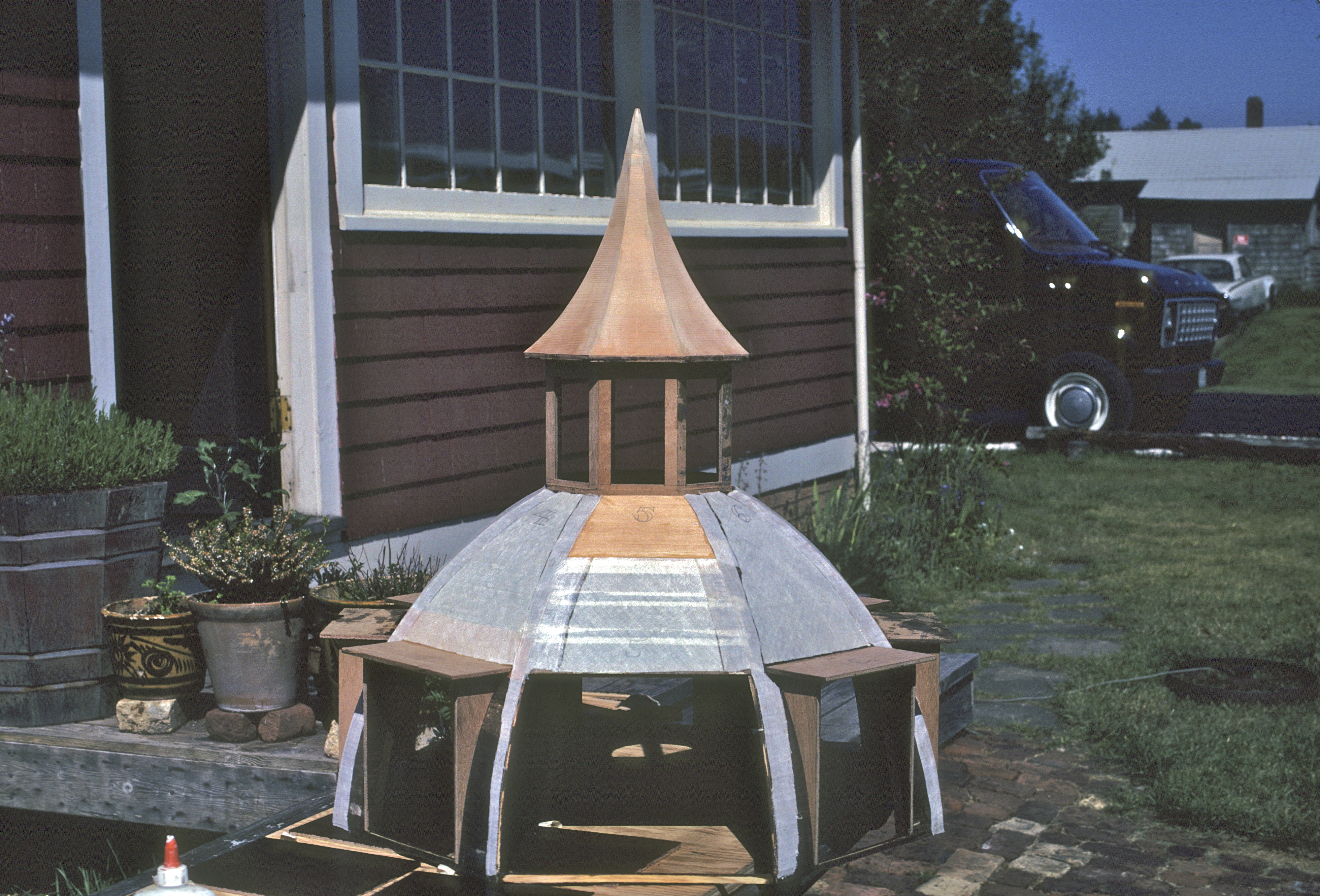
While we papered, paneled and laid flooring in the first and second stories, our minds worked at decoding the mystery of the dome. Not only the actual construction of the dome, but how we would achieve something that looked like the original, intricately-patterned slate roof. We knew slate was out of the question, so we had to recreate that illusion with cedar shingles. Plus, there was the whole wood-paneled interior to make. When the time came we began with what I can only describe as seat-of-the-pants construction.

Kitchen

Dome ribs in place

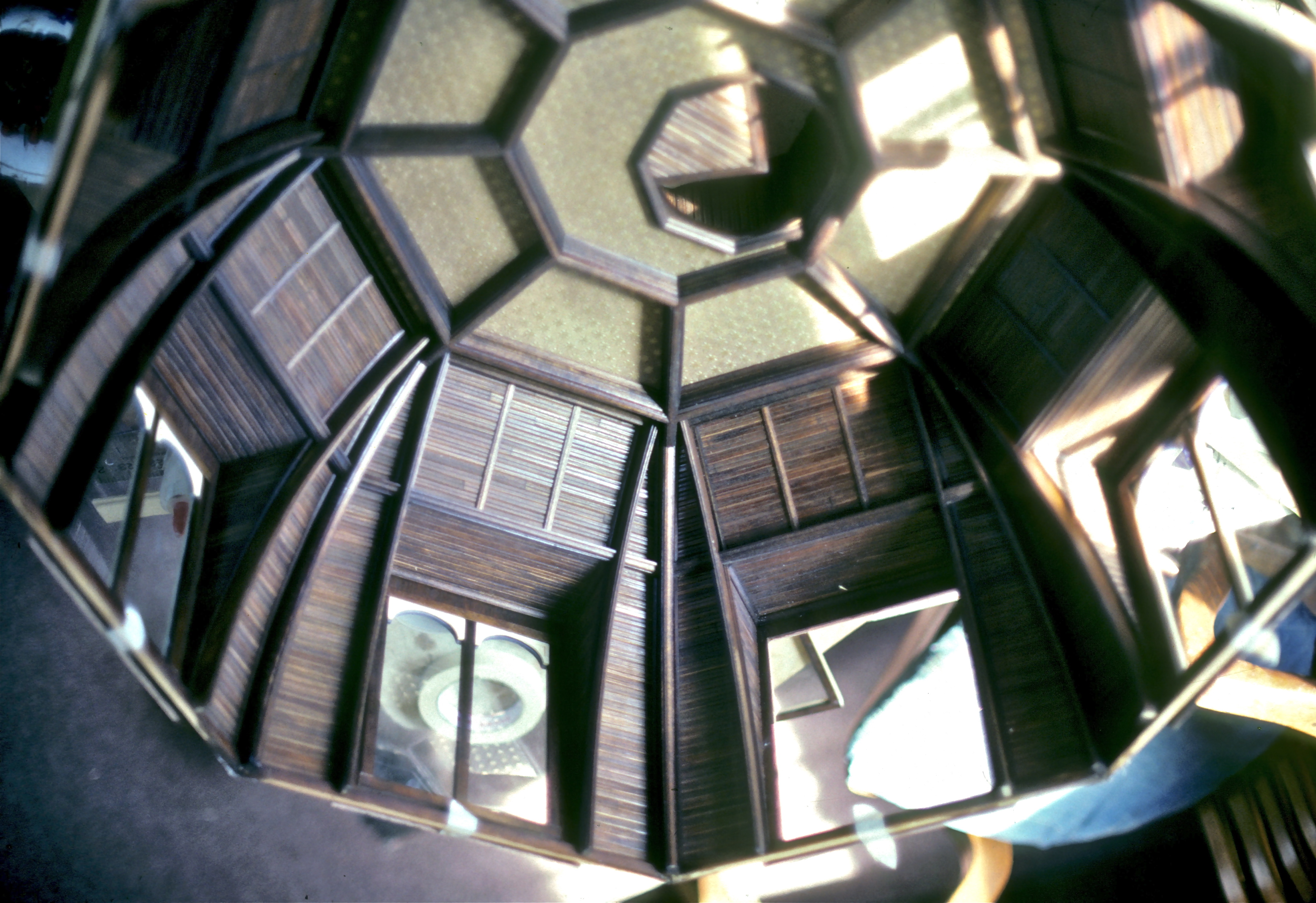
While I went to work on what would be the interior horizontal beadboard paneling (1/4″ X 1/16″ fir I beveled on both edges), gluing miles of the side-by-side strips on sheets of newspaper, Noel started in on the interior support ribs–the beams that would give the dome its shape and stability. We had no idea if this would work, but knew it had to.

Once the beams were in place, we cut the sheets of beadboard to fit between them. Not trusting just the glued wooden joints to hold it all together, I glued a layer of muslin to the outside. By that time we could have rolled it down the street without damage.

Reinforcing dome structure

Dome interior

Noel got to slice the thousands of tiny fish-scale and diamond roof shingles on the Dremel scrollsaw. I got the job of gluing them all on, trying to emulate the precise, more-or-less floral patterns on the original house. As they do, often the rows went sideways a little–the courses falling out of alignment due to varying shingle widths, as well as applicator-error. Noel then had the job of going back with paints to fake the patterns where the shingles had gone astray, and create what we liked to call the illusion of reality.

Finished Dome

Maybe this is justification, but, I think if the shingling had been perfect, aligning to the millimeter, the house wouldn’t have been as successful. What we produced was the work of human hands and hand tools, and that something else–the muse of miniatures, some extra-terrestrial help from Orson Fowler–that made it all come together. The puzzle was not exactly solved, but juggled and carved into a believable structure.Finished Octagon, 1982

Posted in Miniatures | 3 Comments

The Ultimate Victorian: The Octagon House

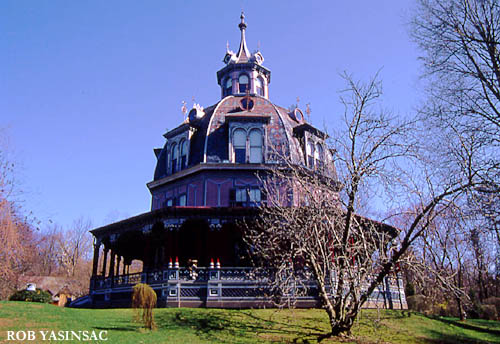
The Carmer Octagon House, thanks to the Irvington Historical Society

Thanks to the frenzy of enthusiasm for Victorian architecture during the 1970s-80s, we had lots of reference materials, largely in the form of period architectural magazines, coming across the doorstep. Plus, our reputation as builders of miniature Victorians brought in clippings from people all across the country. In one envelope was the story of the 1859-60 Orson Fowler-designed octagon house, the Armour-Stiner House (now the Carmer Octagon), in Irvington, NY, built in 1859-60, then recently nominated for the National Register of Historic Places. It was, and is, basically, a spectacular dome, all decked out in ornate Victorian gingerbread, and a fish-scale slate roof. It was so picturesque, so unusual and over-the-top loony, that we knew immediately we had to build it. We also realized it would take a particular kind of customer to love such a house. As we cut and glued our way through our tower Victorians, the idea of the octagon simmered along. That simmering was fired up by the purchase of a Dover re-issue of The Octagon House: A Home for All, Orson Fowler’s paean to the 8-sided house.

The Octagon, 1982, Waikiki Beach, Ilwaco, WA

The octagon style has been referred to as the brain house, and rightfully so. Before he designed houses, Fowler practiced phrenology, the study of the skull’s bumps and contours to determine one’s character. While a brain-shaped, or round, house was not particularly practical, the modified octagon was. Fowler also championed women’s rights, suggesting the fairer sex throw off their corsets and follow a course of brisk exercise. To help this idea along he proposed an open, light-filled ballroom at the top of the house, where the presumably unfettered woman could jog and cavort in privacy or bad weather. He also put the all the home improvements in the basement or first floor as an aid to women, his theory being that once the wife made the beds upstairs, she could come down for the day “to pick berries for her husband’s lunch,” do the cooking, cleaning, laundry and dishes downstairs, thereby saving her multiple trips upstairs every day. One has to wonder at his notion of the only upstairs chore being to make the beds. And the berry picking? But his heart, I imagine, was in the right place. He also believed that square-cornered rooms harbored drafts and germs. I wondered what kind of furniture and carpets one put in pie-shaped rooms. Not to mention how we would do those thousands of tiny, fish-scale roof slates. Or a domed roof.

Noel designing the mini-Octagon

We had far more questions than answers about how to recreate such a structure in miniature, but were not deterred. I can’t remember exactly the sequence of events, but as the time approached for us to wind up #25, The Port Townsend House, I wrote to the next customer on the list to say her turn was coming up. It was another of those serendipitous moments when we broached, with trepidation, the idea of an octagon to her. Maybe we even sent her the initial sketch of the house. By then we were hooked, and had decided to build an octagon next, even if we had to search for a buyer. We waited for the mails to wend their way eastward. Then, I think the customer called. She couldn’t have been more enthusiastic—the octagon was a style she had studied and adored for years, to the point of wanting one in full-size. A woman after our own hearts, and the architect of another quirky adventure. In 1982 we commenced with the Octagon, house #26.

Posted in Houses, Miniatures, People | Tagged , , , , | 8 Comments

Diving In: The Model A Garage

Model A Garage, 1981

When Allan Davis and Babs Raftery of Mr. Peepers mini-shop in Seattle asked us in 1981 to come up with a project for teaching our aging techniques, we had no idea of how much we didn’t know. They insisted that whatever we did, the students would love it, and to dive in. As that had been our basic M.O. for the past 7 years, we took the plunge, thinking our biggest problem was coming up with a building small enough to teach. Our idea came across the breakfast table as we were looking out the window at our full-size aging 1920s 2-car garage that tilted a bit to the north. It was single-walled and unfinished inside, shingled on the outside, with a composition roof full of dry-rot and moss. A stairway at the back lead up to a bare-bones apartment with a main room, a bath, and a kitchen under a shed-roof dormer. If we pared it down to a 1-car garage, and made it an exterior-only class (they could finish the inside at home on their own), it just might work.

We did a test run by adding a garage to our Megler Landing house. Our full-size garage had a dirt floor and driveway, but a wood floor and brick drive seemed the better way to go, design-wise, and besides, we had cases of brick tiles to use up. We opted to change the roof to wood shingles, along with the front wall over the door. To make the building more interesting, we decided on board-and-batten siding (vertical battens applied to the plywood walls), dressed up with some Carpenter Gothic inverted chevron and triangle trims, so simple Noel made them free-hand, practically with his eyes closed. We liked it so much we went to work on the class prototype—a slightly larger version that would give us room for the apartment, too. We called it the Model A because that was the only car small enough to fit through the doors.

Kitchen table summit

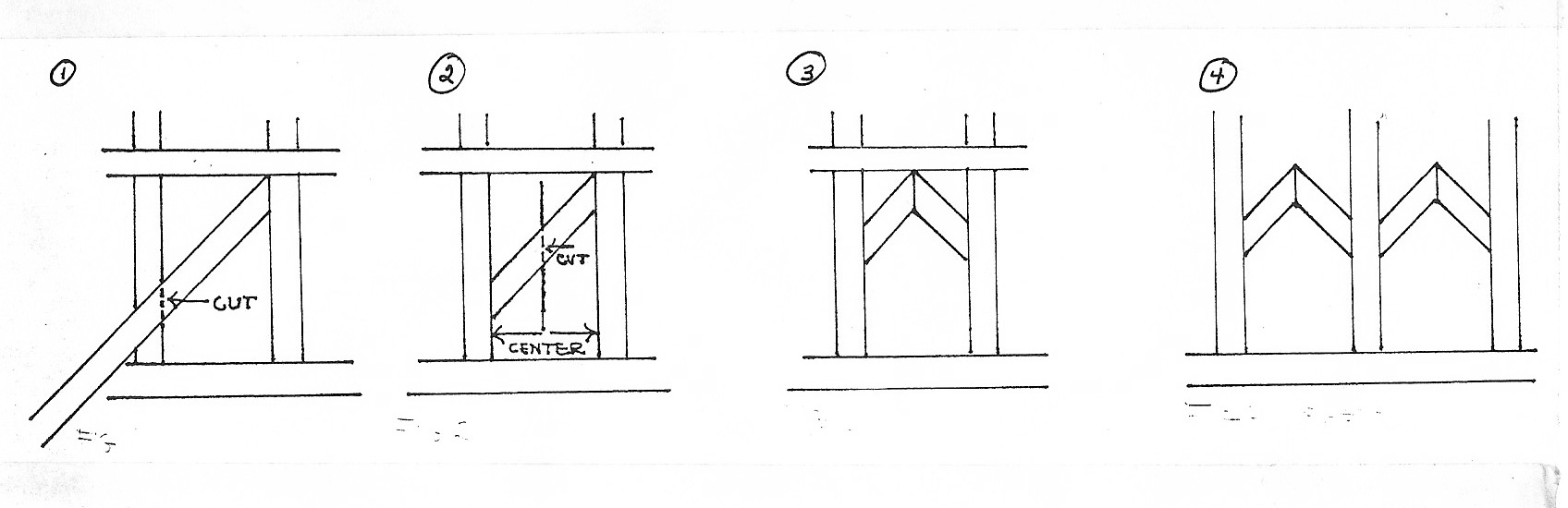
Once we were done, it was back to the kitchen table (the studio was too crowded with tools and the next big house), to break down the elements into teaching units, and make diagrams and instructions. By that time Ray Urh was into large-scale production of our mini-shingles—we’d never have finished prepping the class if we’d had to cut the students’ shingles ourselves. Then there was color–our prototype was green with gray accents, but, thinking maybe the students would want to choose their own colors, we suggested they think about it, and bring their own, or buy the paints at the miniature shop. While Noel built kits, I assembled elements, packed boxes, and practiced making chevrons so I could teach them, quickly finding out it was not so simple to cut 45% angles by hand with an Exacto knife. We didn’t have enough mitre boxes for the students, and that set-up took too much time anyway. Too late, we were committed.

Chevron diagram

I don’t know who decided we could teach this in a weekend (it must have been a 3-day) but that’s what we advertised for. All of a sudden we had 20 enrollees, and we didn’t even have a classroom. All we knew was that we needed a readily available water source for the very messy work we did, and a floor that paint and Bug Juice stain could be spilled on. No problem, Allan said, you build the kits, I’ll find the space.  Oh, and how about a slide show of your houses for one evening? He eventually convinced a restaurant near the store to let us use their back room, which was usually empty on weekends. He got it for free if we ordered lunch from their menu every day. Allan was even more excited because he could take the students for lunchtime drives around the parking lot in some of his antique cars.

Model A apartment

Finally, one September morning, there were 20 students from all over the country, awaiting our words and expertise. My mind has erased the emotions of that moment, other than the realization that we had no idea of what would come next. Each student had a box in front of them with the basic structure, diagrams, directions and all the supplies necessary—it was our idea that we would demo a process and they would set to work on their own, calling upon us as needed. We quickly found we had to teach, step-by-step, how to do what we did—the students were paralyzed with the fear of making a mistake. A very sweet woman from Los Angeles who showed up in a pastel cashmere suit smiled at my suggestion she might ruin it. She was somehow protected by mysterious forces that never let her spill or splatter a drop. The nearest water source was the Ladies Room, whose drains we clogged with paint. We modified the swirly-patterned rugs forever. Lunch plates and ashtrays cluttered the work tables. The people who strayed from our color choices hated them by day two. More than one person cried over the chevrons, and students took their projects back to their hotel rooms at night to shingle and brick, showing up bleary-eyed in the morning. Of course no one finished the project, but the amazing thing was they all thought it was fun, many to return as future students. And they loved the slide show, and touring around in Allan’s cars. When we came up for air, Noel and I went home jazzed with their enthusiasm. Jazzed enough to return for another 30 years of teaching.

Addendum:  Articles in the September and November 1981 issues of Nutshell News–the first two in my long-running series of how-to aging techniques–give more information on the Model A. You’ll notice some differences in the origins of the building, but if you ask me which is right, I’ll say both.

Posted in Miniatures | Tagged , , , , | 9 Comments

The Port Townsend, Pyrotechnics, and the Deer Revival

Port Townsend House, 1981

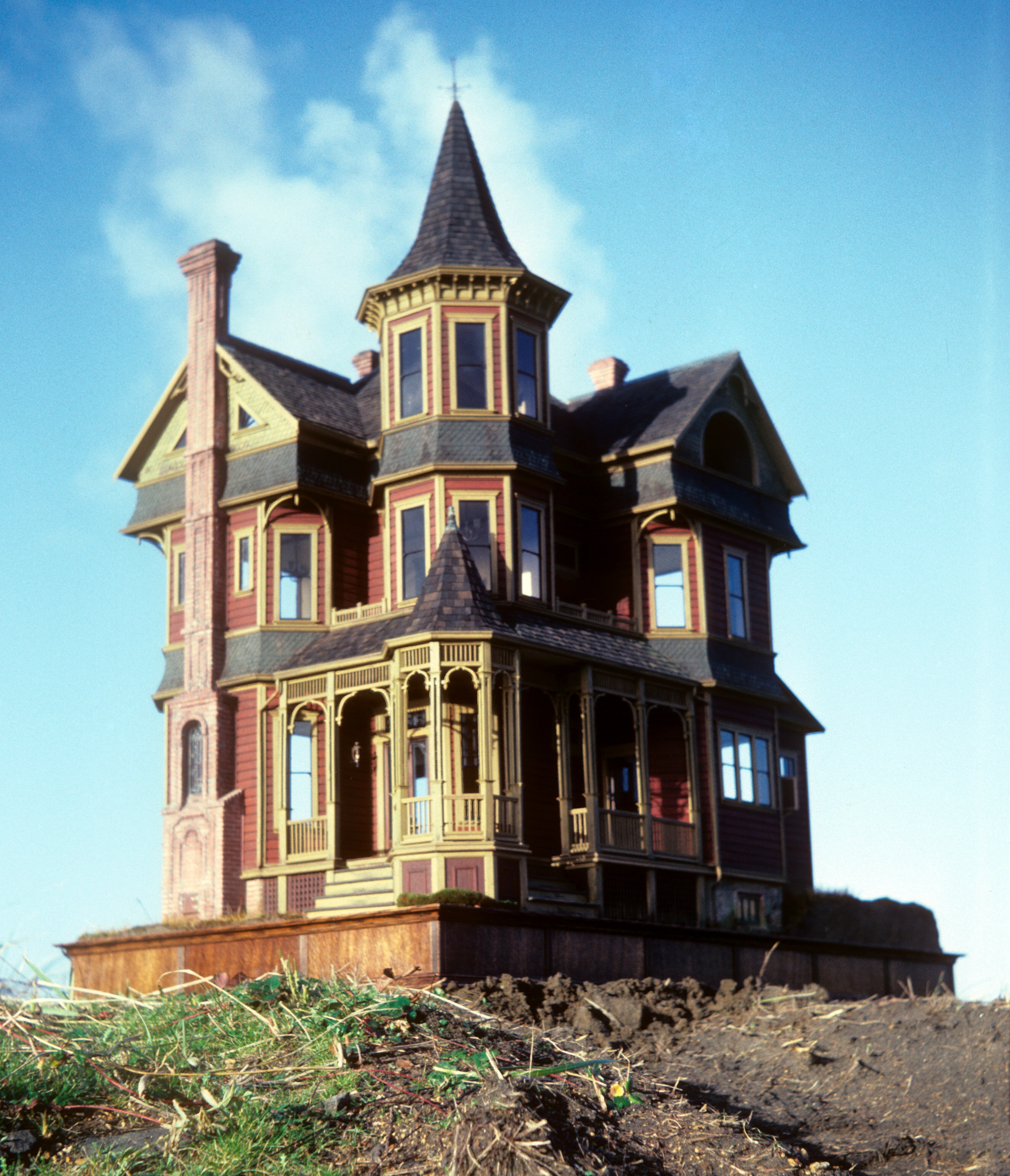
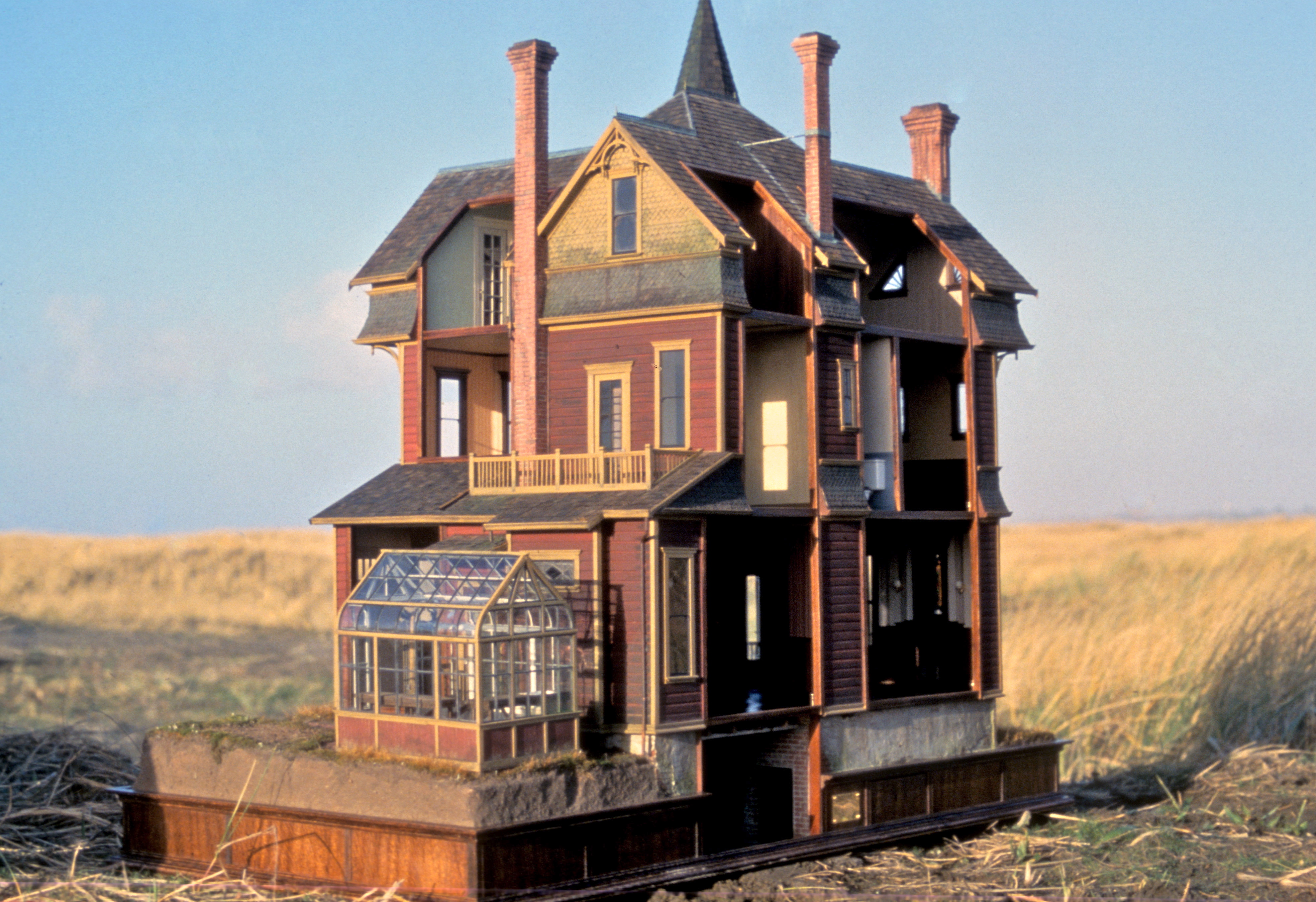
The Port Townsend, miniature house # 25, was the second of the major houses we built in 1981. It was named for a Victorian seaport on the Quimper Peninsula in Washington State, a town whose architecture deeply influenced our own Victorian period. The Port Townsend was the last of our asymmetrical Queen Anne-inspired houses, sporting towers, deep overhangs, and intricate gingerbread. The project was the culmination of all we had learned on the previous houses. Once it was done, we felt it was time to explore some new territory. The buyer was Barbara Marshall, collector and founder of the then new Kansas City Miniature Museum (now the Toy & Miniature Museum:  http://www.toyandminiaturemuseum.org.), a collection we feel honored to be part of.

Port Townsend rear view with greenhouse

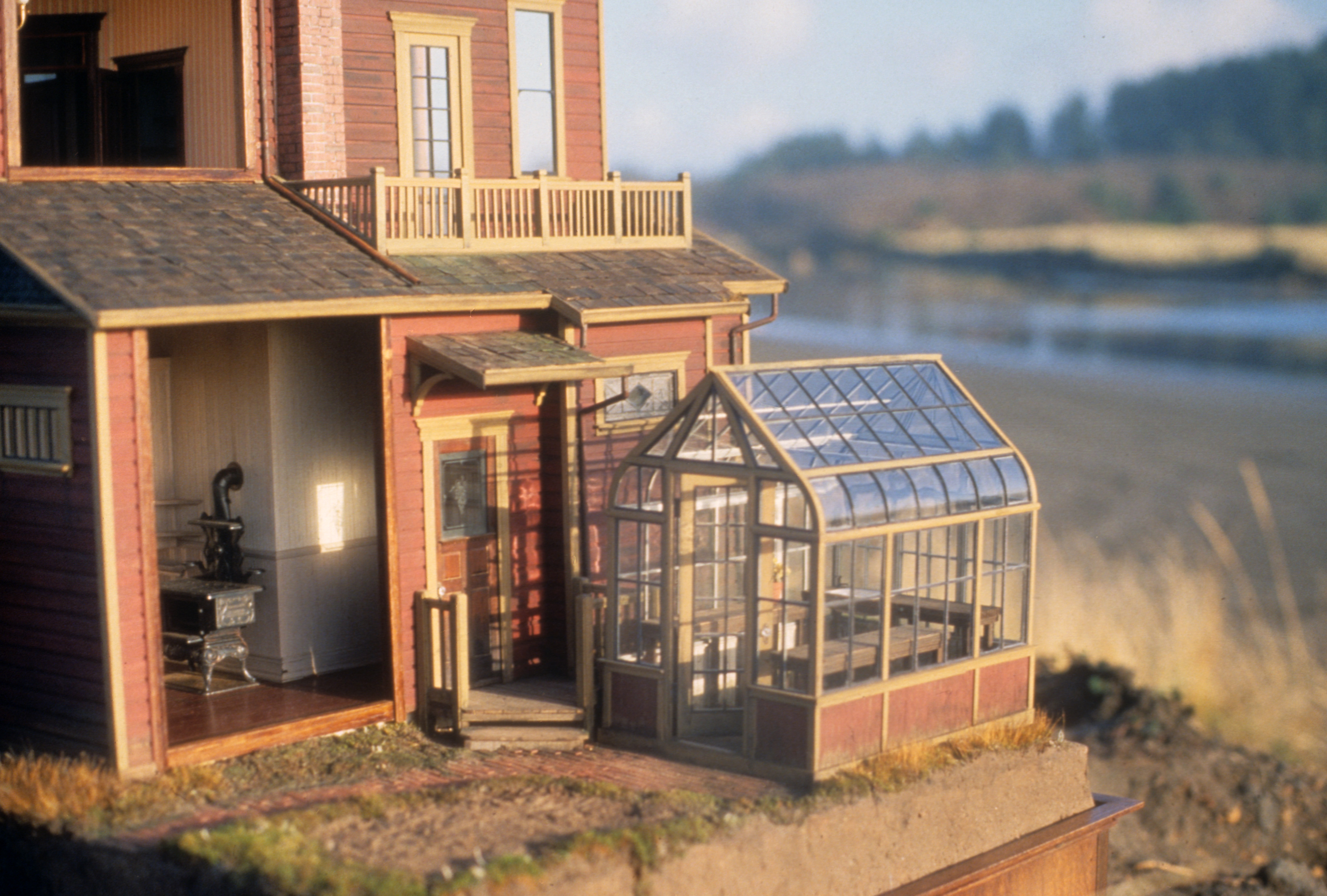
The Port Townsend and the Megler Landing (house # 24), were variations on a theme. One of their major differences lay in their outbuildings. The Megler has an unattached garage, the Port Townsend has a greenhouse, in honor of Mrs. Marshall’s other miniature pursuit, propagating bonsai. Noel’s first drawing of the house showed a greenhouse with curved glass bordering the top edge of the walls, though I don’t think the curved glass really registered with me beyond knowing whatever he had drawn looked right. It was a few days before I looked him in the eye and asked, “How are we going to do this curved glass?” We had no idea, but put the thought away and went to work on the main house.

Knowing we couldn’t shape glass, we began looking for round-shouldered bottles we could cut, maybe with our window-glass scribing tools. One day in the supermarket Noel found a pickle jar with the perfect curve and bought a dozen or so (yes, we were lucky again, the pickles were good). However, the glass turned out to be too thick and irregular for our glass scribers. Before dollhouses, we were watchers of late-night TV, when those crazy Veg-O-Matic and Ginsu knife ads ran. One of that ilk was a gizmo that could cut a Michelob beer bottle to make a stemmed beer glass, should one feel the bottle was uncouth. It was one of those mind-sticking gimmicks people must have ordered, as a lot of them showed up later on garage sale tables. We knew we had seen one recently, but couldn’t remember where, and the concept of Googling had yet to be invented. Noel went into one of his mind-Googling trances and remembered a pyrothecnic trick from his childhood where he would, for inexplicable reasons other than it involved fire, soak a string in gasoline (where was his mother?!), tie it around a bottle, set it on fire and douse the whole thing in cold water. If he got lucky the glass cracked all the way around in a perfect circle. I saw this as a path to disaster, but Noel began the process of burning up string on pickle bottles. There was a lot of breakage, spillage of flammable liquids and more than one more trip to the grocery store, but eventually he got enough like-sized pieces to complete the greenhouse. He then treated the whole thing as a 3-D leaded glass window and copper-foiled and soldered the pieces together, adding stripwood for support and the illusion of a solid structure. The bottle glass is thicker and more distorted than the rest of the glass (old window glass), but the finished product is such a great illusion I don’t think anyone has noticed.

Port Townsend greenhouse


And while I’m on glass, there’s a trick we learned about using regular-thickness glass for miniature windows. Once you cut the glass to shape, darken the edges with a black felt-tip marker. This prevents light from reflecting off the cut edges, and once it is framed in wood channeling the thickness of the glass disappears. The mullions glued to either side of the glass appear to be one piece. The extra thin glass available for miniatures is very hard, and difficult to cut without a lot of practice. Plus, if you scavenge well, you can find many sources of old window glass, and get those vintage, wavy reflections. Try it. You will become a believer, too.

A few years after we completed the Port Townsend, the museum had a calamity—the heavy plaster ceiling collapsed. Huge chunks of plaster fell on the exhibits, most of which were inside glass cases, which helped buffer the blows. Many exhibits were spared, but quite a lot of plaster landed on our house. Barbara called, asking if we could come and make repairs. The damage looked so extensive no one there wanted to touch it. She was particularly concerned about the crushed weathervane, which was sheet brass, a Clare-Bell with a deer on it, and something we just happened to have another of. We packed up some paints and stripwood, our Exactos, Elmer’s, and the weathervane, and headed for Kansas City.

Chimney brace

We were relieved to see the building was of a piece, and after a day clearing away plaster and glass with a vacuum cleaner and paintbrushes, it became apparent that the damage was minimal, other than a very dead deer weathervane. What amazed us was that the chimney hadn’t toppled, considering the weight of the plaster. After construction, a contractor friend had insisted we add the brace because the chimney was too tall and would blow over in a medium windstorm. The sheet-lead brace we glued between chimney and roof somehow took the brunt of the blow. It dented into a “vee,” but stayed stuck and did its job as chimney support.

Pie coolor and exterior aging

As we worked, several docents asked about the weathervane–it seems the deer had a following, and its restoration to the top of the tower would indicate that all was well in the world. When they weren’t around, Noel jiggered with it, straightened it out, polished it on his shirt, and declared it savable. They applauded when we replaced it at the end of the first day. After that it was mostly a matter of repairing gutters and trim, re-touching paint, and we were done. For the duration we were treated royally, as guests in a wonderful downtown boutique hotel, tours through Barbara’s family farm, and dining out on Kansas City’s famous steaks. If it hadn’t been for our dog at home, and the pull of the next project, we might have lingered.

Posted in Houses, Miniatures, People | Tagged , , , | 8 Comments

A Warp in Time: The Megler Landing

Megler Landing Miniature House, 1981

In 1981 we built two of our most elaborate Victorians—the first with a garage, and secret room, the other with a greenhouse–as well as the prototype and 20 shells for our first class. Plus we squeezed in a date night to see Raiders of the Lost Ark. The thought of that amount of work continues to stagger me. Does time really pass slower when we’re young? It has to be more than just an accumulation of double-digit daily work hours, bending time back on each of our days like a folding tape measure. A warp. Or a hole, one those black holes physicists continue to beat their brains over. If we were to start now we couldn’t check off even one of those projects in a year. Well, maybe the garage prototype. And the movie.

The Megler Landing, house #24, was a fun project from the get-go. A young couple approached us at a Seattle miniature show to build them a house. When we said it would be a four year wait, at the very least, they were not discouraged. By the time we got around to starting their project we had become pen pals, learning that she had become pregnant shortly after we met, followed by news of the birth of their son and subsequent holiday photos of his growth. They invited us to stay at their home on our way to and from delivering houses that preceded theirs (and the invitations did not cease after Noel spilled a glass of red wine on their white couch).

Megler Kitchen

In our correspondence we mentioned there was a secret room, and a garage for the men in the house. By the time we delivered their house, the son was 4 years old. His name was Brody, a name Noel etched into the dust of one of their mini-garage windows.

Megler Garage

The Megler name came from another nearby landmark, an expanse of basalt rocks on the Washington side of the Columbia where the Astoria-Megler ferry once docked. It was just up the river from McGowan where a family of that name had built a large Victorian home, nothing like our design, but one of the prominent Victorians in our neck of the woods.

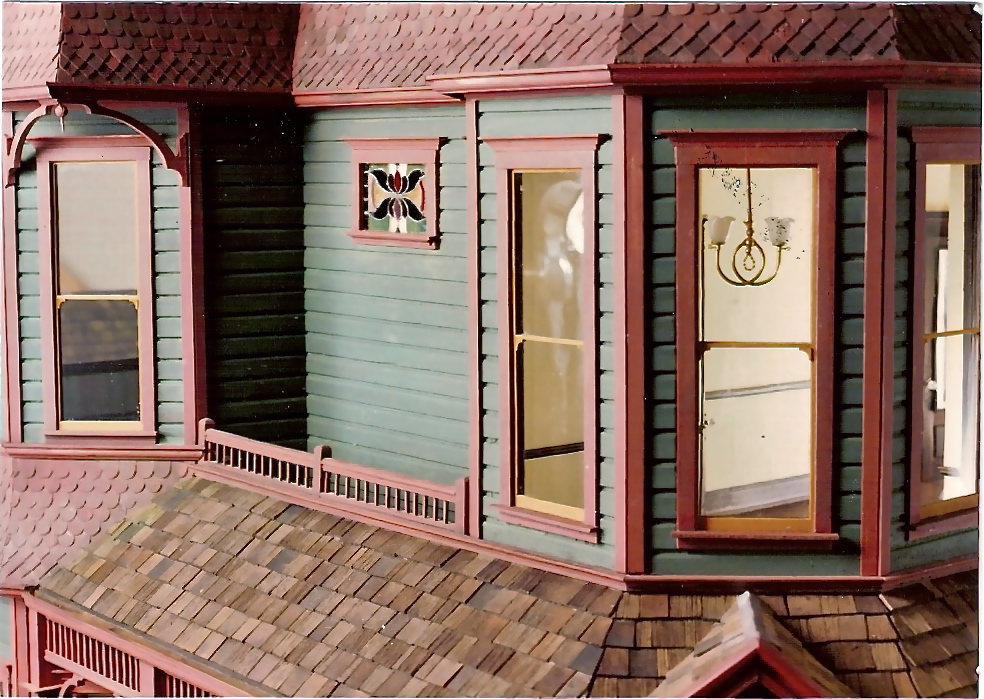
Again we dug into our hoard of reference books to come up with something new. Until this time our houses had been mostly red or green with white trim, like the Victorians in our area. The modern interpretation of houses of the period. One book in particular—Exterior Decoration of the Victorian Era–showed more representative colors of the time–brooding, darker pallets, with color combinations closer in value. It included multiple illustrations of a single design with different color treatments, making the overall effect easier to imagine. As the owners-to-be were deep into Victoriana, we dove into a deep red and green color scheme, with yellow ochre for the window mullions. After a quick check for the owner’s least favorite color for a house (purple), we started in. As was our pattern, our first stop was the hardware store to have them try to mix our colors. From there it was back to the studio to mix in some umbers, as the formula colors always wound up too bright. Then we took the plunge, hoping the final effect would look rich, rather than gloomy.

On location in Los Angeles with Harry Liles

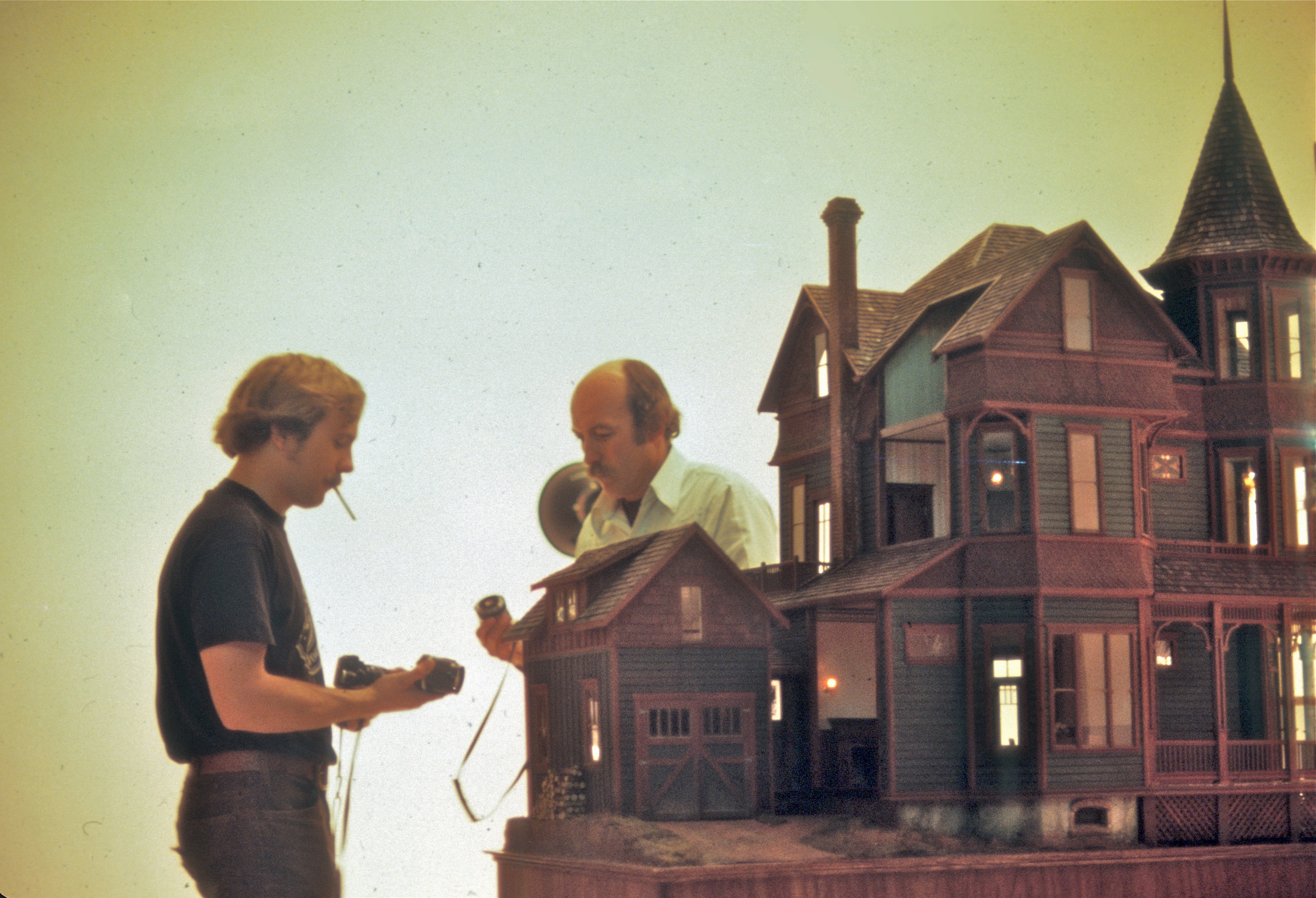
The night of our delivery of the Megler (via Los Angeles to have it photographed in our friend Harry Liles’s studio), long after we were tucked into their guestroom bed, the owner spent hours sitting in the dark with the house, its lights on, figuring out the location of the secret room. We were sure it would take weeks, if not months. But she had it by 2:00 a.m.

Note: Recently the ownership of the house changed. It is now on permanent display at the Gateway Museum Center in Maysville, KY.

Posted in Houses, Miniatures | Tagged , , , , , , , | 4 Comments